Ice in the Shadows: SPHEREx Spots Vanishing Ice in Prestellar Cores ✛
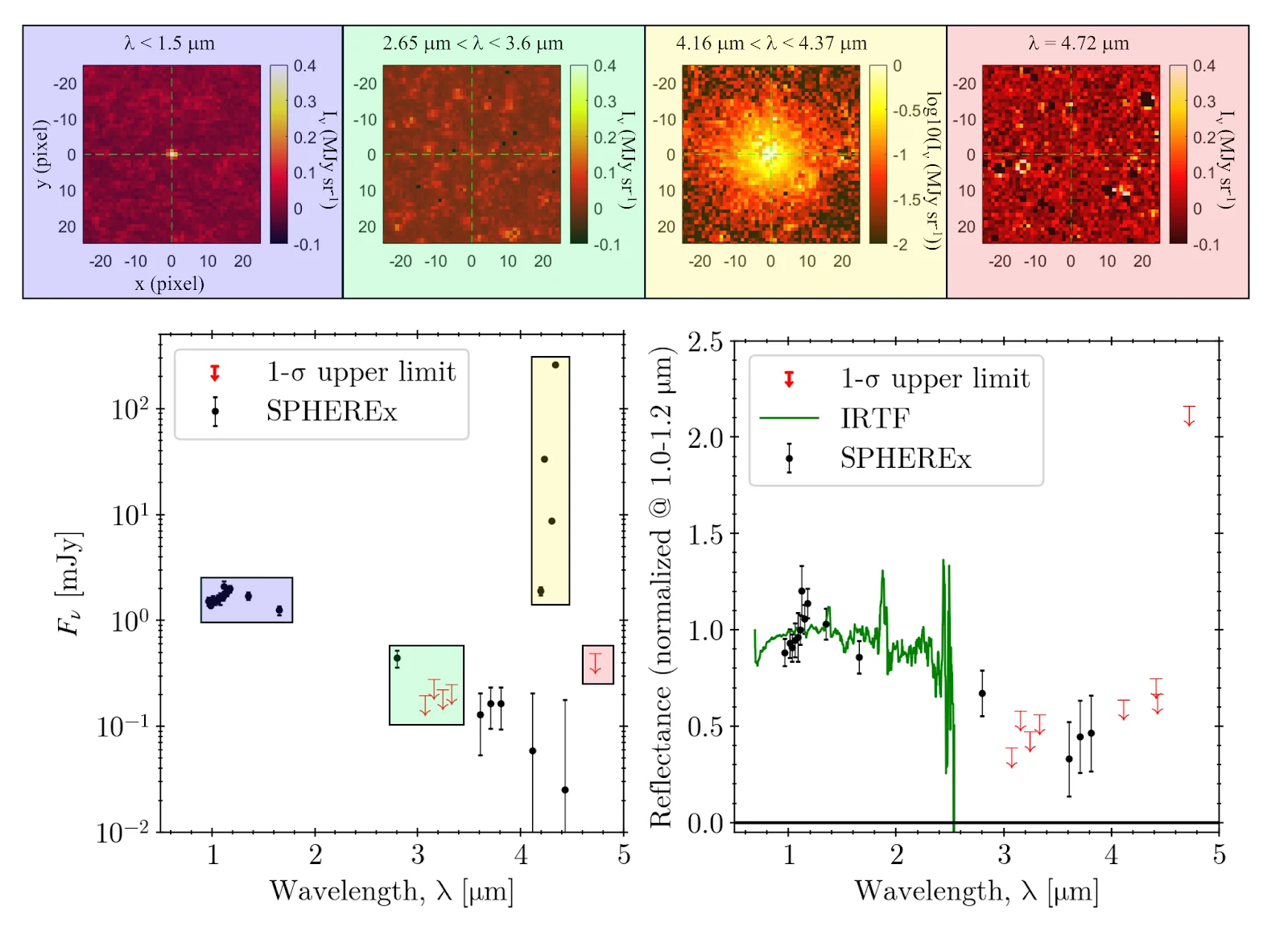
Deep inside a molecular cloud, where temperatures drop to 10–20 kelvin and gas densities reach a million particles per cubic centimeter, a frozen shadow prevails. There, far from starlight, water, carbon dioxide, and other molecules freeze onto dust grains. These icy mantles are the building blocks of future planets and, possibly, the source of water for future life. But something is causing the ice to vanish even before the cloud begins to collapse into a star.
The SPHEREx space telescope SPHEREx peered into these dark regions in the near- and mid-infrared. It saw how interstellar ice absorbs light from background stars at wavelengths of 3.05 and 4.27 micrometers. The more ice in the line of sight, the deeper the absorption features. Comparing dozens of cores, the researchers found that as gas density increases, the abundance of water ice drops by a factor of 3–5. Meanwhile, the dust temperature stays below 20 kelvin, far too cold for thermal evaporation. So another mechanism must be at work: nonthermal desorption, where cosmic rays knock ice molecules off without heating the grain.
This discovery upends the conventional picture. Previously, it was thought that ice simply waited quietly for the core to collapse and only then, in the protoplanetary disk, began to evaporate and redistribute. Now it is clear that ice is actively reprocessed even before the star is born. The total mass of vanishing ice in a typical core is estimated at 10^−5 solar masses, comparable to the mass of a future protoplanetary disk. In other words, the chemical makeup of future planetary systems is set earlier than we thought.
What does this mean for us? For now, it is pure knowledge, with no immediate applications. But it changes estimates of how much water and organics will end up on future planets. If ice disappears this early, some systems may have less water than previously assumed. Perhaps the water deficit in some planetary systems is explained by this early loss. The next step is observations with higher spectral resolution to separate different forms of ice and trace the fate of evaporated molecules. The icy shadow in scattered light turns out to be not so static after all: it lives, breathes, and melts long before the first star ignites.
The temperature in the studied cores is only 10–15 degrees above absolute zero, yet even at such cold, ice evaporates, thanks to cosmic rays that knock molecules off the surface of dust grains.
In Arthur C. Clarke's novel "2010: Odyssey Two," the icy moons of Jupiter hold water for future generations. SPHEREx observations show that water in the form of ice can disappear from the coldest places in the universe long before it becomes available for life.