Quark Captivity: The Secret of the Invisible String's Snap ✛ ✎
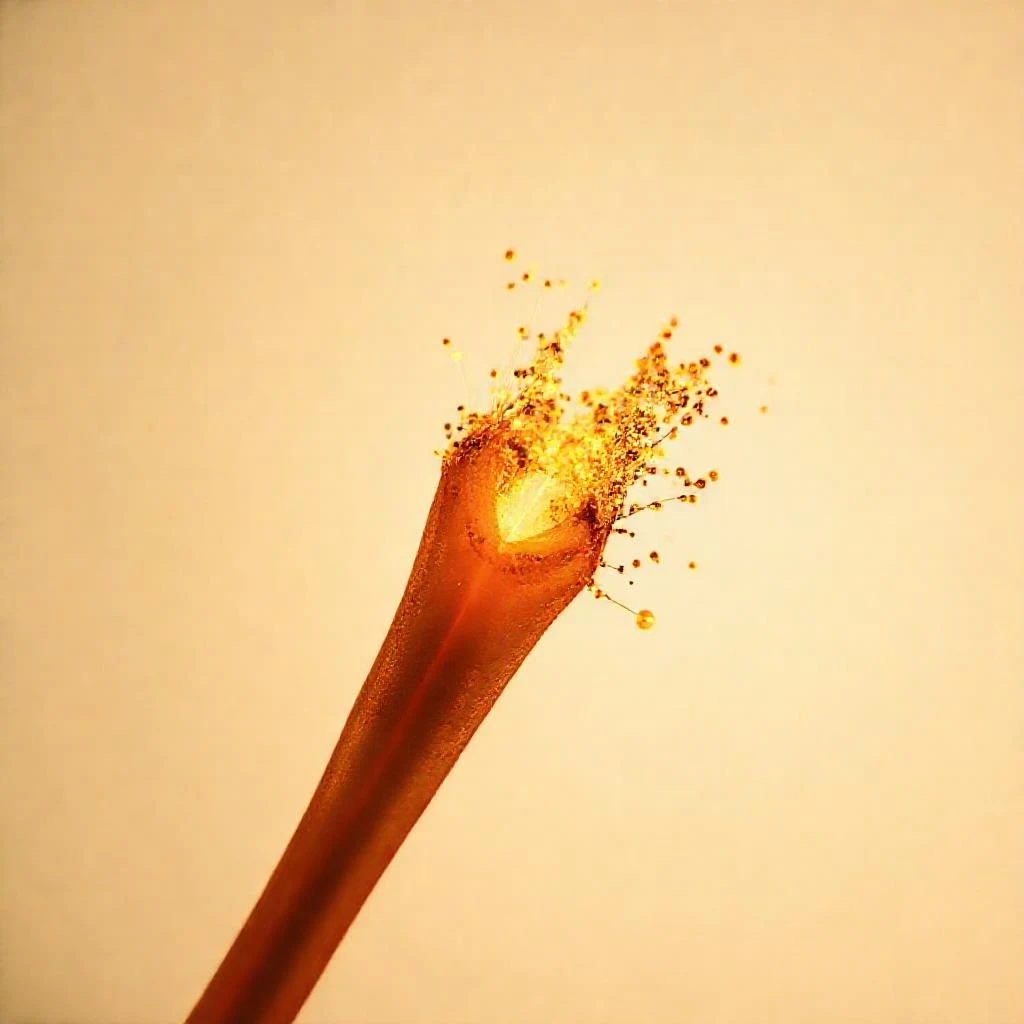
Quarks are like beads on an elastic cord. The farther they fly apart, the tighter the cord stretches, locking them forever inside protons and neutrons. This cord is the strong force. Frank Wilczek showed that when the beads come closer, the cord miraculously weakens, allowing the quarks to move almost freely. The idea of strings was also developed by Edward Witten for other purposes, but here the string is a real force cord.
When the cord finally snaps, its colossal energy instantly transforms into new particles. Computer modeling revealed that the snap is not a simple pop: it gives birth to bouquets of mesons (quark-antiquark pairs) and even three-quark baryon-antibaryon pairs. In a dense medium, the taut cord suddenly stiffens, delaying the rupture: this is the 'baryon blockade'.
The most unexpected twist: sometimes transverse waves appear on the cord, and at a certain frequency they completely relieve the tension, as if the rubber band momentarily loses its elasticity. Such a resonance, akin to the spectral lines of atoms, has never been observed, but it could be verified in quantum simulators. And the cord can also close into a loop, creating a glueball — a pure lump of the force field without particles. These discoveries will help us understand how matter behaved in the first moments after the Big Bang.
The string snap releases enough energy to spawn a whole set of heavy particles – it’s like a microscopic fireworks display.