A meson is a subatomic particle composed of one quark and one antiquark, bound together by the strong nuclear force. Mesons are hadrons, meaning they are subject to the strong interaction, but unlike baryons (which are made of three quarks), mesons have integer spin and are bosons. They are unstable and decay into lighter particles, such as electrons, neutrinos, and photons. Mesons play a crucial role in understanding the strong force, as their properties reveal how quarks interact and how the force binds matter at the smallest scales.
History
The concept of the meson was introduced by Hideki Yukawa in 1935 to explain the nuclear force. He predicted a particle with a mass between that of the electron and proton, which was later discovered as the muon (initially mistaken for Yukawa's meson) and then the true pion in 1947 by Cecil Powell and colleagues. The quark model, proposed by Murray Gell-Mann and George Zweig in 1964, provided the modern understanding of mesons as quark-antiquark pairs.
How it works
The quark and antiquark in a meson are held together by the exchange of gluons, the carriers of the strong force. The binding energy is so large that it contributes significantly to the meson's mass. Mesons are classified by their quark content and quantum numbers, such as spin and parity. For example, the pion (π meson) is the lightest meson and mediates the residual strong force between nucleons in atomic nuclei. Heavier mesons, like the kaon (containing a strange quark), decay via the weak interaction, which allows quarks to change flavor. In particle detectors, mesons are identified by their decay products and mass reconstruction.
In practice
Mesons are used in particle physics research to probe the strong force and test quantum chromodynamics. They are also produced in cosmic ray showers and are studied in medical imaging techniques like positron emission tomography (PET), which relies on the annihilation of positrons (antielectrons) to produce photons, a process analogous to meson decay.
Fun fact
The pion, the lightest meson, is about 273 times heavier than an electron, yet it is the particle responsible for holding atomic nuclei together against the electrostatic repulsion of protons.
A neutron star is what remains after a massive star explodes. Its matter is compressed so tightly that a teaspoonful would weigh billions of tons. Under such conditions, protons and neutrons can rearrange, and new particles (hyperons, similar to neutrons but containing a 'strange' quark) can appear.
A handful of sand in your fist: the grains press against each other, and your hand can't squeeze any further. Ordinary matter behaves similarly. But in a neutron star, compression is billions of times stronger — atoms are crushed, electrons are squeezed into protons, and nearly all space is filled with neutrons.
An old factory where instead of machines there are atomic nuclei, and neutrino radiation seethes all around. When a massive star exhausts its fuel, its core compresses a hundredfold, and the temperature skyrockets to billions of degrees.
At accelerators, by smashing heavy nuclei, physicists briefly create a quark-gluon plasma — a state of matter where quarks and gluons are not confined inside particles but are free. For a long time, it was imagined as a gas, but experiments showed it's an almost perfect liquid.
A drop of cream in a glass of milk. Shake it, and the fat doesn't spread evenly: it clumps into denser blobs that move differently from the rest of the liquid. Quarks inside mesons, tiny particles that live for mere fractions of a second, behave in much the same way.
A meson consists of a quark and an antiquark, and they are rarely equals.
From 2016 to 2018, at the Large Hadron Collider at CERN, protons collided at energies of 13 teraelectronvolts, as if two peas were accelerated to speeds where their impact spawns a whole swarm of new particles.
Colliding two lead nuclei at the Large Hadron Collider is like throwing two hefty bags of marbles at each other. Usually, the marbles scatter in all directions, but sometimes one bag passes so close that the marbles don't collide: they just exchange glances.
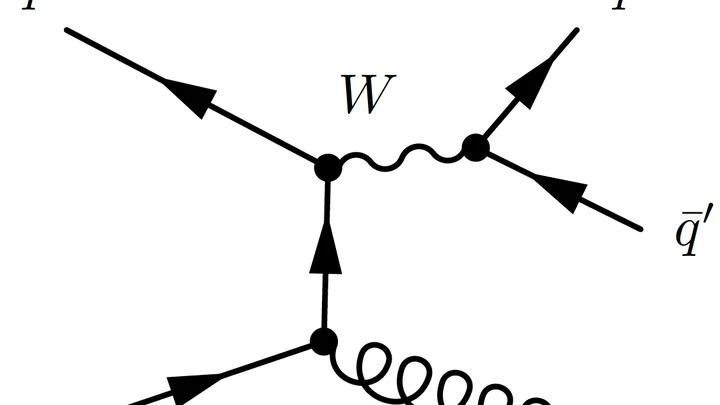
When a W boson, the particle that carries the weak force, decays into a quark and an antiquark, these two fragments fly off in nearly the same direction at the collider's immense speeds.
In an underground ring 27 kilometers in circumference, protons are accelerated to nearly the speed of light and smashed head-on. At the collision point, conditions briefly recreate those of the first trillionth of a second after the birth of the universe.
In 2017, protons at the Large Hadron Collider collided with an energy of 5.02 TeV. The CMS detector recorded these collisions, and among billions of events, physicists hunted for a rare occurrence: the production of a single top quark without its antiparticle.
The proton is not a solid ball. Its charge, mass, and other properties are distributed differently in space, and each property has its own radius. Physicists have long been able to measure where the proton's charge is concentrated and where its mass lies.
When a fast proton slams into an atomic nucleus, new particles are born for an instant. One of them is the phi meson: a short-lived clump of matter that decays into an electron-positron pair. Catching this decay is like hearing the echo of a distant explosion: the blast itself is over, but its trace is still flying.
The atomic nucleus is not a solid ball but a drop of liquid that can be squeezed. To understand how elastic it is, physicists accelerate gold nuclei and smash them into each other. On impact, the matter compresses to densities like those in a neutron star, then flies apart. The shape of this debris tells us about the properties of the matter inside.
At the heart of a neutron star, matter is squeezed so tightly that protons and neutrons transform into heavier particles — hyperons. These particles resemble neutrons but contain a strange quark. For a long time, physicists couldn't understand how a star with hyperons inside could be as heavy as observations show.
All bodies in vacuum fall with the same acceleration: this principle, formulated by Einstein in general relativity, underpins our understanding of gravity. Yet so far it has been experimentally confirmed only for particles of ordinary matter.