Strings That Don't Snap Right Away ✛ ✎
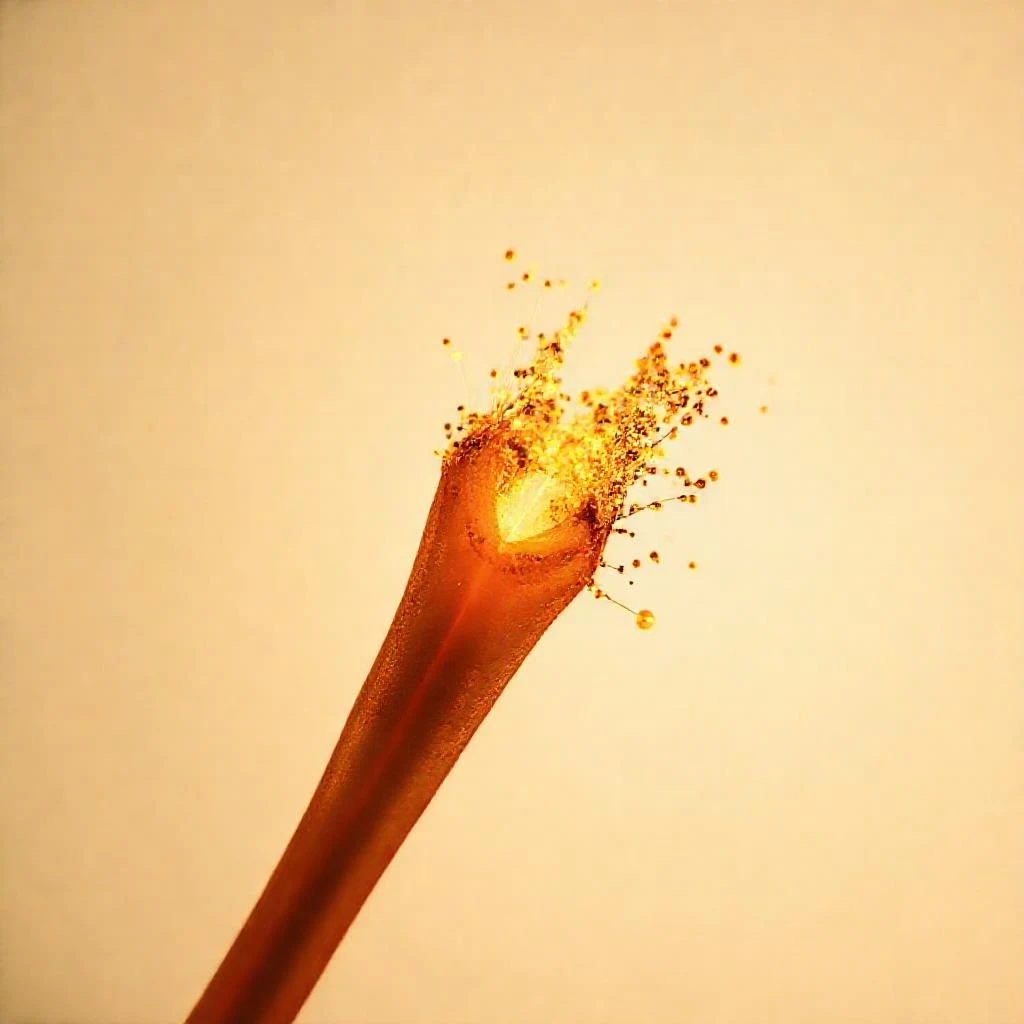
A stretched string between two quarks doesn't pop instantly like a rubber band. It first vibrates, develops knots, and only then breaks, if it breaks at all. This isn't just a metaphor; it's an accurate description of what physicists call confinement: quarks are permanently locked inside hadrons, and the only way to separate them is to snap the flux tube that binds them. But until now, no one knew exactly how this string behaves in a non-Abelian theory, the kind where color charges interact in truly complex ways.
The authors of the new study built a lattice model of SU(2) gauge theory in 2+1 dimensions and tracked its time evolution using tensor networks, a compact way to store a quantum state. Instead of tackling an infinite-dimensional problem, they restricted the gauge fields to the lowest spin states (j = 0, 1/2, 1). This trick is justified in the strong-coupling regime, where the string energy is proportional to the square of the spin and the number of active links. The initial state is a string between two static charges. What happens next depends on the quark mass. At resonance, when the energy to remove one link equals the energy to create a particle-hole pair (m = 3/8 gE), the string breaks: the average Casimir operator drops, mesons and baryon-antibaryon pairs appear, and the entanglement entropy grows rapidly. Off resonance, the string oscillates without producing particles, but due to the magnetic term, glueball loops and self-intersections of the string emerge.
The most surprising effect is baryon blockade. When baryons are added to the system, the string breaks more slowly because it has fewer decay channels. And for higher representations of the gauge group, the string doesn't break at all; instead, it reduces its tension by transitioning from j=1 to j=1/2. This is similar to how an overloaded rope doesn't snap but sags, losing energy. Previously, such phenomena were impossible to see in Abelian models, where strings behave more simply. Here, for the first time, it was shown that the non-Abelian nature of the gauge group changes the very dynamics of the break.
These results are not just a pretty picture. They provide concrete benchmarks for quantum simulators that are already trying to reproduce the behavior of gauge theories on real devices. In the future, one could increase the lattice size, extend the evolution time, and add a finite baryon density. Then, perhaps, we might see how confinement behaves under even more realistic conditions. For now, the stretched string between quarks continues to vibrate, and we now know at which frequencies it breaks.
Baryon blockade means that the presence of baryons slows down the string breaking, as if a traffic jam of particles prevents the string from snapping.
The idea of colored strings and their breaking evokes the concept of 'strings' in science fiction, for example, in Liu Cixin's novel 'The Three-Body Problem', where fundamental interactions are described as stretched strings.