A Traveling Line: How Photons Lose Energy in a Crowd of Electrons ✛
On October 9, 2022, detectors on Earth recorded a gamma-ray burst of unprecedented power. GRB 221009A was so bright that its radiation ionized the upper layers of the ionosphere, and satellite instruments were temporarily blinded. In the spectrum of this explosion, astronomers for the first time reliably identified a series of emission lines whose energy changed over time according to a power law. The line behaved like a traveler losing energy in a crowd of electrons.
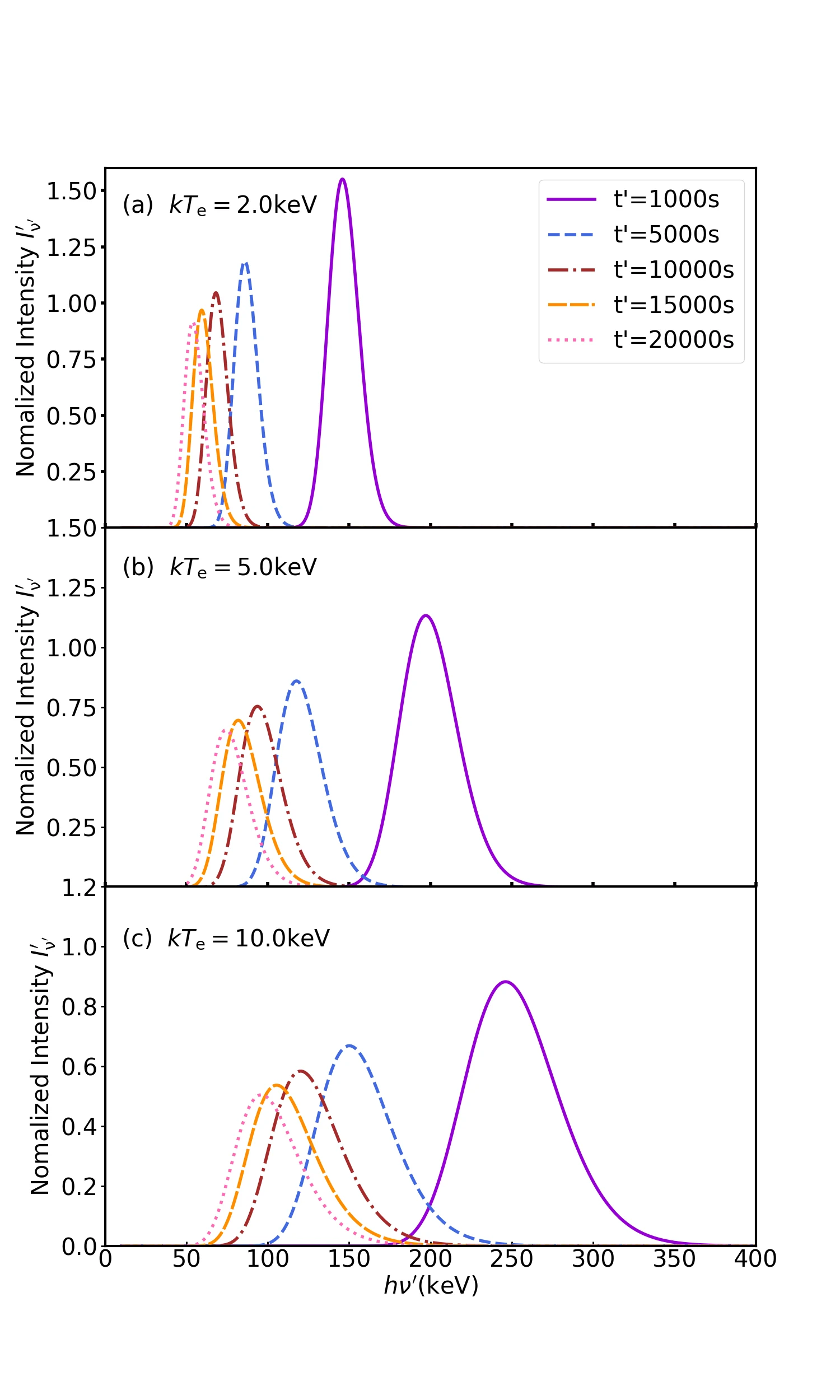
The model proposed by the authors describes this journey. The line is born in the jet's subphotosphere (the inner region opaque to radiation) through electron-positron annihilation, the conversion of a particle and its antiparticle into radiation. The initial photon energy is 511 keV. They then pass through a dense plasma with an electron temperature of about 2 keV and a density of 2×$10^9$ cm⁻³. With each scattering off an electron, the photon gives up part of its energy, a process called down-Comptonization, that is, photon cooling. As a result, the line energy drops from 37 to 6 MeV.
The calculations reproduced the observed line evolution: the central energy decreases as a power law with an index of -1.11, the line width remains about 10% of the energy, and the flux decreases with an index of -1.94. These values agree with the data within uncertainties. The key result is the constraint on the jet plasma parameters: an electron density of 2×$10^9$ cm⁻³ and a temperature of 2 keV. This points to the existence of a dense thermal plasma in the relativistic jet, which had not been confirmed by observations before.
This work is the first to combine down-Comptonization with jet dynamics to explain the evolution of an emission line. Previously, it was unclear why the line evolved as a power law and what mechanism governed its properties. Now it is clear that the line is born from pair annihilation and then cools via down-Comptonization in the dense jet plasma. This method can be applied to diagnose plasma in other gamma-ray bursts and astrophysical jets. The line becomes a tool that allows us to peer inside a relativistic outflow and measure its density and temperature. The traveler, making its way through the crowd, tells us about the crowd's structure.
GRB 221009A was so bright that its gamma radiation ionized the upper layers of Earth's ionosphere, and detectors on satellites were temporarily blinded.