Background radiation, in cosmology, refers to the faint electromagnetic radiation that permeates the entire universe. The most famous example is the Cosmic Microwave Background (CMB), a nearly uniform glow of microwaves that is the oldest light we can observe, emitted about 380,000 years after the Big Bang. This radiation is a direct remnant of the hot, dense early universe and provides a snapshot of what the cosmos looked like in its infancy.
History
The CMB was predicted by George Gamow and others in the 1940s, and accidentally discovered in 1965 by Arno Penzias and Robert Wilson at Bell Labs, who were puzzled by a persistent hiss in their radio antenna. This discovery earned them the Nobel Prize in Physics in 1978.
How it works
In the early universe, matter and radiation were coupled in a hot, opaque plasma. As the universe expanded and cooled, protons and electrons combined to form neutral hydrogen, making the universe transparent. The photons that were released at this moment have been traveling ever since, and their wavelength has been stretched (redshifted) by the expansion of space, turning them from visible light into microwaves. Today, we observe this radiation as a nearly perfect blackbodyspectrum at a temperature of about 2.7 Kelvin.
In practice
Studying the CMB allows cosmologists to measure the composition, age, and geometry of the universe, and to test theories of cosmic inflation and structure formation.
Fun fact
The CMB is not perfectly uniform; it contains tiny temperature fluctuations (about one part in 100,000) that are the seeds from which all galaxies and large-scale structures in the universe grew.
The night sky looks calm, but in reality, invisible particles, cosmic rays, are constantly flying through us. Among them are electrons and their antimatter counterparts, positrons. When they collide with detectors on satellites or balloons, the instruments record their energy.
The universe is a vast, dark ocean. We see only the glowing foam on its surface — stars and galaxies. But hidden in the depths are two invisible forces: dark matter, which with its gravity keeps galaxies from flying apart, and dark energy, which, on the contrary, pushes space itself apart, making the universe expand faster and faster.
The mystery of antimatter in space has long puzzled astrophysicists: where do positrons come from, settling like snowflakes into our detectors? The answer might lurk in the most ubiquitous gamma-ray background. The Universe is soaked in diffuse light — the cosmic photon background (CPB).
Fast radio bursts — millisecond radio pulses arriving from distant galaxies — long remained a puzzle. Their colossal energy, compressed into instants, pointed to cataclysms on neutron stars, perhaps pulsars or magnetars.
In the late 1990s, the night sky delivered a surprise: Saul Perlmutter and Adam Riess found that the expansion of the Universe is accelerating. Ever since, the greatest riddle has been dark energy — a substance making up nearly 70% of the cosmos, yet evading laboratory study.
Somewhere deep in space, a radio beacon flashes for a fraction of a second, and then goes dark. Such signals are called fast radio bursts. They come from other galaxies and last from microseconds to milliseconds.
The universe is a vast orchestra playing the score of expansion. Galaxies race apart to the beat of inaudible music of dark energy. But here's the trouble: the conductor's baton held by Edwin Hubble, Adam Riess, and Vera Rubin sets two incompatible tempos.
The universe is like a vast warehouse where a strict inventory was taken long ago. The cosmic microwave background is an ancient record of everything in stock 380,000 years after the big bang. According to it, the fraction of matter in the cosmic 'budget' (the parameter Omega_m) is known with high precision.
At the heart of nearly every large galaxy lives a supermassive black hole — a silent giant around which stars, gas, and other, smaller black holes orbit. From time to time, one of these objects breaks free from its orbit and begins to fall toward the central monster in a tightening spiral.
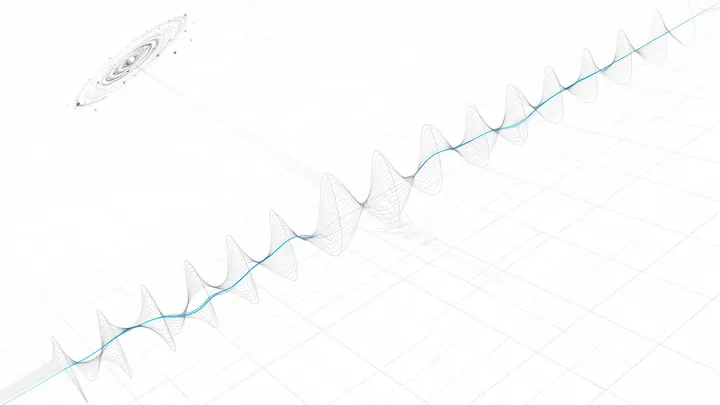
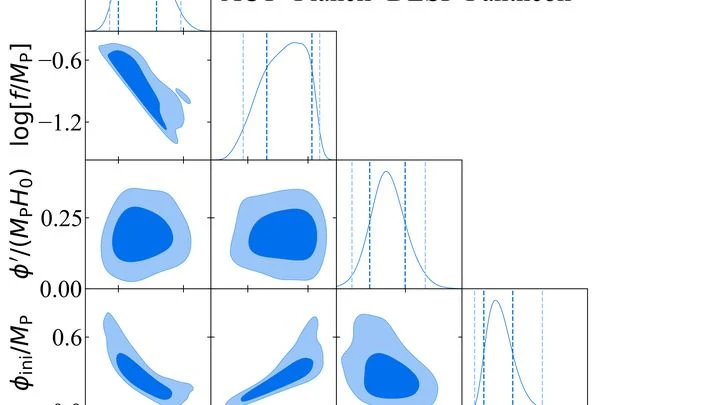
The oldest light in the universe has been traveling toward us for nearly 14 billion years. It was born when the cosmos first became transparent, and since then its plane of oscillation has been rotating ever so slightly. The cause is an invisible ocean permeating all of space: the dark energy field that makes the universe expand faster and faster.
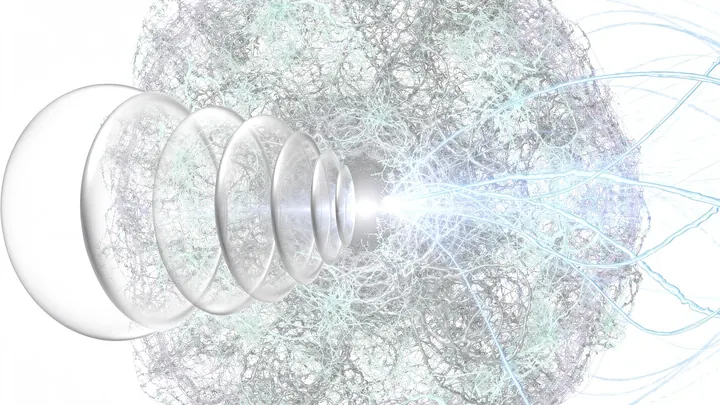
In the first moments after the Big Bang, the cosmos resembled a giant cooling pond. Just as water, when freezing, becomes covered with a network of cracks, so the cooling universe could have cracked — not into ice, but into the thinnest filaments of pure energy. These filaments are called cosmic strings.
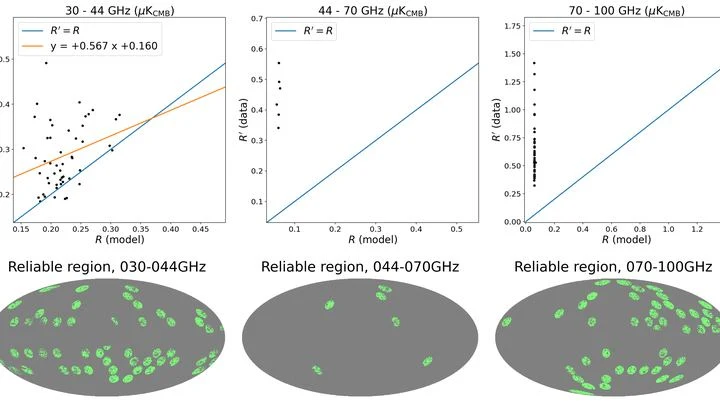
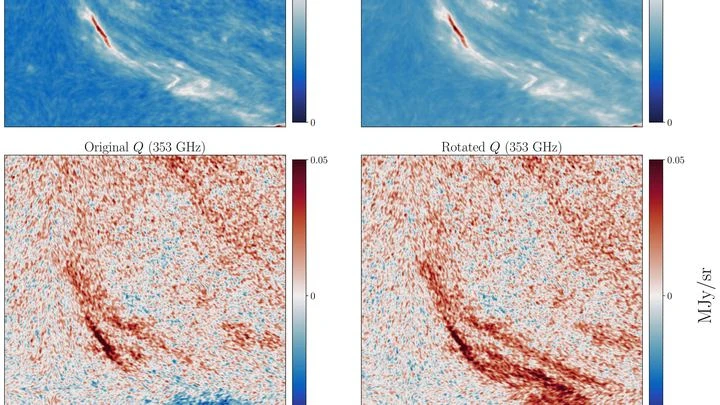
Astronomers are trying to capture the radio echo of the Big Bang — a faint glow that fills the entire universe. But the receiver is choking with noise: our Galaxy is packed with glowing interstellar dust, whose emission can easily be mistaken for a signal from the distant past.
The cosmic microwave background is a faint glow left over from the Big Bang, like the cooling embers of a campfire. It encodes gravitational waves that may have arisen in the first fractions of a second, when the universe inflated faster than light.
Light from a distant lantern reflects off the surrounding fog, and from the delay of the reflection you can infer the distance. If the fog is uneven, the reflection arrives earlier or later, and the distance comes out wrong.
The Einstein Probe space telescope detected a celestial storm: after a short (0.4-second) gamma-ray burst — a cosmic lightning bolt — came a long roll of X-ray thunder. It lasted nearly 10 minutes. This is the first direct proof that such explosions leave a lingering X-ray afterglow.
The night sky is full of stars, but they are only a small part of everything that exists in the universe. Astronomers have long noticed a strange thing: galaxies rotate so fast that they should fly apart, yet they don't. Something invisible holds them together, like invisible threads linking beads on a spinning wheel.
This "something" was named dark matter.
When a massive star exhausts its thermonuclear fuel, its core collapses and the outer layers are blown off in a colossal explosion — a supernova (a term coined by Fritz Zwicky while studying these catastrophes).
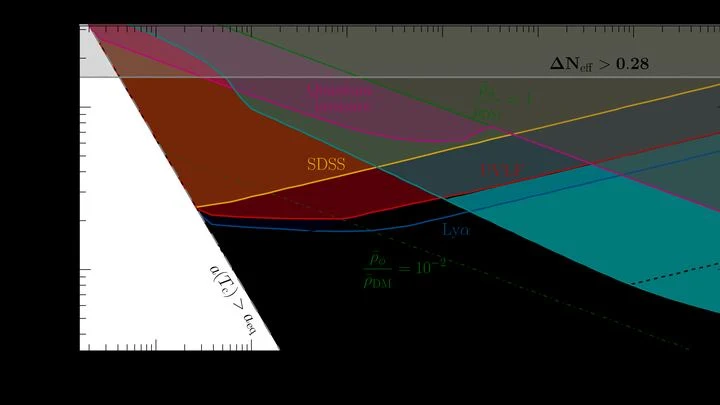
Dark energy and dark matter are the invisible conductors of the cosmos. Usually considered independent, new research proposes seeing them as dance partners. The lead — dark energy — changes the mass of dark matter particles. Like a dancer who lifts and lowers their partner, dark energy increases or decreases the weight of dark matter.
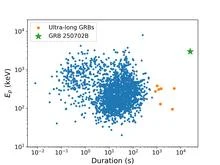
For seven hours straight, a space gamma-ray telescope registered flares that refused to end. That is how the story of GRB 250702B began: the longest gamma-ray burst ever observed. Typical bursts last seconds, rarely minutes. This one stretched to 25,000 seconds, beating the previous record by a factor of two.
On October 9, 2022, detectors on Earth recorded a gamma-ray burst of unprecedented power. GRB 221009A was so bright that its radiation ionized the upper layers of the ionosphere, and satellite instruments were temporarily blinded.
The ACT telescope in Chile's Atacama Desert stared at the sky from 2007 to 2022. Its target: the cosmic microwave background, light that has been traveling toward us for 13.8 billion years. This light is polarized: its waves oscillate in specific planes, like strings stretched in different directions.
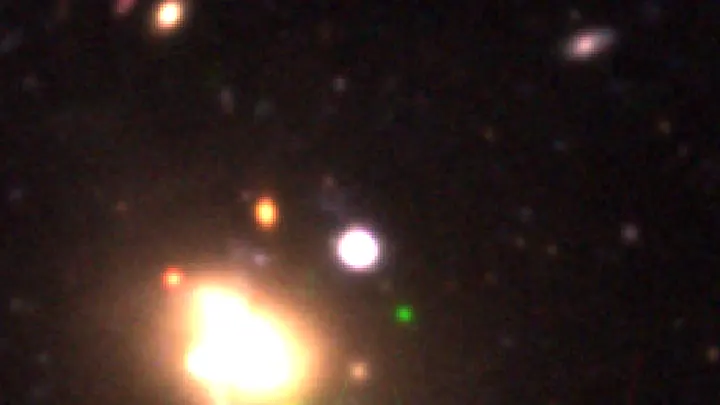
The night of March 4, 2024. The MeerKAT radio telescope in South Africa catches a millisecond pulse: a fast radio burst coming from a depth of 17.4 gigaparsecs. This is light that traveled 10.5 billion years to reach Earth.
At night over the Siberian taiga, a faint blue light sometimes flickers. It's not the aurora borealis but a cosmic-ray shower: a single particle from deep space slams into the atmosphere and shatters into millions of secondary particles. They race toward the ground in a broad front, like a ripple from a stone dropped into water, and make the air glow.