The central engine of a gamma-ray burst (GRB) is the still-unidentified power source that drives the most energetic explosions in the universe. It is thought to be a compact object—likely a newly formed black hole or a highly magnetized neutron star—that accretes matter and launches relativistic jets. The central engine must supply energy for the initial gamma-ray flash and the subsequent afterglow, but its exact nature remains one of the biggest open questions in high-energy astrophysics.
History
The concept emerged in the 1990s after the discovery of GRB afterglows, when it became clear that the bursts originate at cosmological distances and require an extremely compact, energetic source. The term 'central engine' was coined to describe this unseen powerhouse.
How it works
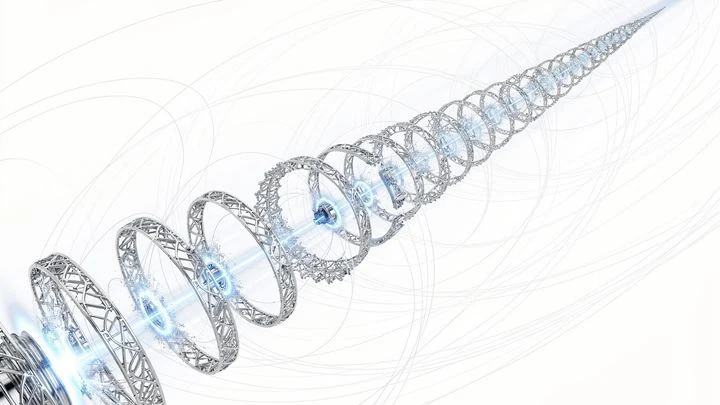
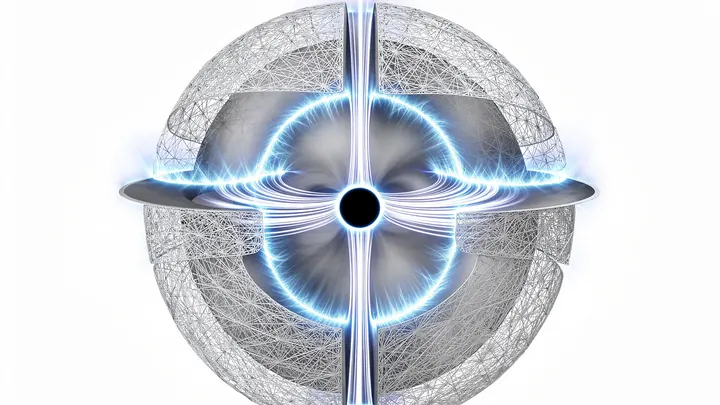
The leading model involves a stellar-mass black hole surrounded by a dense accretion disk. As matter spirals inward, gravitational energy is converted into kinetic and magnetic energy, which powers a pair of oppositely directed jets. These jets, moving at nearly the speed of light, produce the gamma rays via internal shocks, while their interaction with the surrounding medium generates the longer-wavelength afterglow. Alternative models propose a rapidly spinning, highly magnetized neutron star (a magnetar) as the engine, which could delay the collapse to a black hole.
In practice
Understanding the central engine helps researchers probe extreme physics—such as matter at nuclear densities and magnetic fields stronger than any achievable on Earth—and may inform models of gravitational wave emission from collapsars.
Fun fact
The most powerful GRB ever observed, GRB 221009A, was so bright that it temporarily blinded gamma-ray detectors in space, and its central engine likely produced a jet that was pointed almost directly at Earth.
A beacon at the edge of the galaxy blinks without a schedule: sometimes silent for years, sometimes emitting hundreds of flares in a single day. Such a beacon needs a watchman who never sleeps and never gets distracted.
A particle with an energy of $$10^{18}$$ eV hitting Earth's atmosphere is like a tennis ball traveling at 200 km/h slamming into a wall. Astrophysicists have debated for decades where such projectiles come from. Gamma-ray bursts, brief and powerful explosions of gamma radiation, have long been suspected as accelerators.
At the center of the Milky Way, where the supermassive black hole Sagittarius A* churns gas clouds like a millstone, astronomers have caught an irregular pulse. Gamma-ray emission, the most energetic light in the universe, arrives not as a smooth wave but with a break, as if the Galaxy's heart beats with arrhythmia.
Gamma rays are the most energetic light in the Universe. But one part of them, the medium-energy range, long remained invisible: instruments couldn't catch them, leaving a gaping hole in the sky. Scientists call it the "MeV gap," named after the unit of energy these rays carry.
The new camera works like a three-layer detective.
An avalanche in a sandpile starts with a single grain. No one knows exactly where it will slip or how big the slide will be. But if you keep pouring sand, the pile itself reaches a state where avalanches of all sizes, from tiny trickles to massive collapses, follow the same law.
When a star many times heavier than the Sun dies, it collapses and explodes as a supernova. This is not just a flash of light — the entire process, from core collapse to the ejection of the outer layers, makes space itself tremble. These ripples are called gravitational waves.
The universe is like a vast invisible scaffold. We don't see it directly, but we know it's there: galaxies and clusters hold together thanks to it. This scaffold is dark matter. The most popular version says it is "cold," made of heavy, slow-moving particles.
295 000 meters per second. Not even particles in solar coronal ejecta move that fast. But at the center of the galaxy cluster H1821+643, hot gas does exactly that. The quasar at its heart takes a breath, and its breath stirs everything around for 60 thousand light-years.
A star runs out of fuel and rapidly collapses under its own gravity. According to classical ideas, it collapses into a point of infinite density — a singularity. But what if nature abhors infinities? In models of regular black holes, instead of a singularity, a dense core of unknown matter forms at the center.
At the heart of the giant galaxy Hydra-A, there's a hive of activity. A supermassive black hole shoots out two powerful plasma jets. They punch through the surrounding cloud of hot gas and inflate giant bubbles within it.
The mystery of antimatter in space has long puzzled astrophysicists: where do positrons come from, settling like snowflakes into our detectors? The answer might lurk in the most ubiquitous gamma-ray background. The Universe is soaked in diffuse light — the cosmic photon background (CPB).
In the depths of the Universe, when a massive star collapses into a black hole or a magnetar is born, a gamma-ray burst flares up — for an instant, it outshines all the stars in the observable Universe.
For a long time, astronomers searched for the 'factories' of the most energetic cosmic rays — particles that carry the macrocosm compressed to the size of an atomic nucleus. Colossal star-forming regions like Cygnus OB2, where winds from young giants collide, were prime suspects.
A low rumble coming from underground could be the noise of a distant construction site, or it could be the echo of an ancient earthquake. Astronomers faced a similar puzzle in 2023 when they detected ultra-low-frequency gravitational waves — the trembling of spacetime itself, rippling across the universe.
In a recent study, astrophysicists showed how pre-recombination physics, particularly early dark energy, affects the spectral running $$α_s$$ and, consequently, the viability of scenarios forming primordial black holes from an ultra-slow-roll (USR) phase during inflation.
When JWST peered into the young universe at redshifts of 6–10, it revealed a scattering of mysterious 'little red dots' (LRDs). These objects combined features of galaxies and active nuclei, but their spectra refused to fit into familiar patterns.
Somewhere deep in space, a radio beacon flashes for a fraction of a second, and then goes dark. Such signals are called fast radio bursts. They come from other galaxies and last from microseconds to milliseconds.
The enigma of fast radio bursts (FRBs) is not just a question of 'what exploded?' It’s a drama of energy transfer under extreme conditions, where the slightest stumble leads to collapse.
In the constellation Aquila, about 40,000 light-years away, one of the most powerful natural accelerators in the Galaxy is at work. It's the microquasar GRS 1915+105—a pair consisting of an ordinary star and a black hole.
Blazars are long-lasting beams from black holes at the centers of galaxies. Gamma-ray bursts are the briefest flashes from supernova explosions or neutron star mergers. The former act like eternal spotlights, the latter like camera flashes.
At the heart of nearly every large galaxy lives a supermassive black hole — a silent giant around which stars, gas, and other, smaller black holes orbit. From time to time, one of these objects breaks free from its orbit and begins to fall toward the central monster in a tightening spiral.
Two heavy spheres of dark emptiness hurtle toward each other and collide dead-on. This is not billiards: it's the collision of two equal black holes. The impact sends a tremor through space itself — gravitational waves.
Most of this tremor is a low hum that physicists call bremsstrahlung.
Gravitational waves — the cosmic tremors from distant cataclysms — are so faint that detecting them is like trying to hear a whisper in a hurricane. But a black hole can amplify that whisper many times over.
If you squeeze a handful of sand, it gets denser, but at some point the grains press against each other: there's no more room to compress. Some theorists think space behaves similarly at ultra-small distances: it has a limit to divisibility, a kind of 'grain.' In this new study, that principle was applied to the birth of black holes in the early universe — the very ones that…
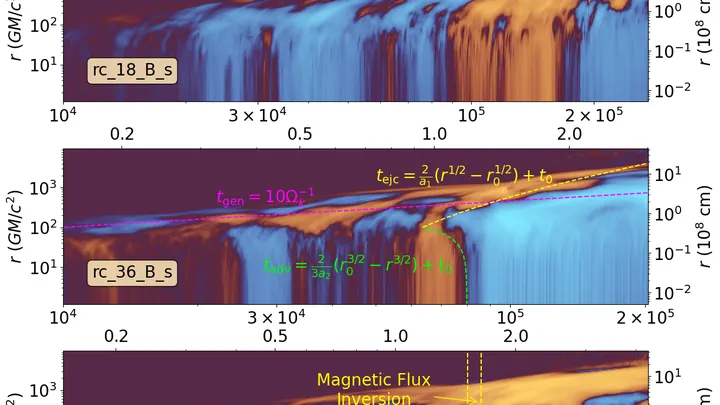
Many black holes are surrounded by magnetic fields. As it spins, the black hole drags curved spacetime along with it, like a machine's flywheel, and sets the cosmic factory in motion.
A flashlight doesn't cast a uniform circle of light; it has a bright spot in the center and a blurred halo at the edges. If you switch it off quickly, the edges are the last to fade, and by how the light dies, you can guess the shape of the reflector.
A massive star collapses, and a black hole is born, surrounded by a disk of incandescent plasma. For narrow jets to burst out of this disk, an ordered magnetic field is needed. But inside the star, it's tangled.
In 2017, detectors picked up a tremor in space — gravitational waves from the merger of two neutron stars. At the same moment, telescopes saw a flash. For the first time, one event spoke in two languages at once: light and gravity.
A tiny black hole — the size of an atom but as massive as a mountain. It wasn't born from a star but in the first instants after the big bang, and it has been quietly losing mass ever since, radiating heat.
A translator gets distracted by every rustle in the hall, and a one-hour meeting stretches into two. Gluons, the particles that carry the strong force inside protons, behave much the same way. Usually, they dart back and forth, holding quarks together.
Every second, invisible projectiles from the depths of space pierce through us. These are cosmic rays — atomic nuclei accelerated to speeds nearly indistinguishable from the speed of light. Their energy is hundreds of millions of times greater than what our most powerful accelerators can achieve. Where does this monstrous force come from?
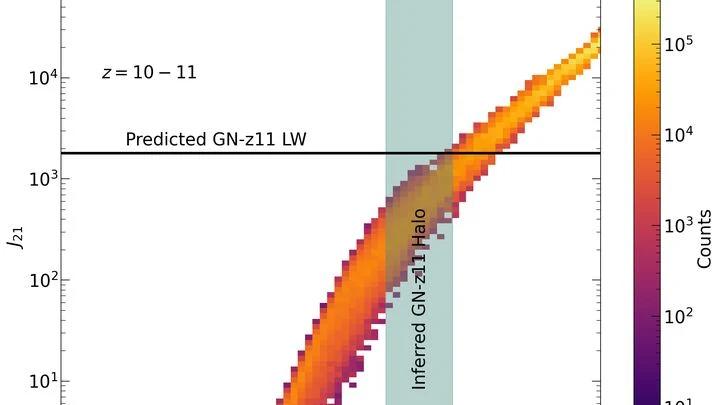
A bonfire built of pure alcohol burns hot and gives off almost no smoke. That's roughly how the first stars shone: they contained no heavy elements, only hydrogen and helium left over from the Big Bang. The James Webb Space Telescope may have caught one such "bonfire" in the galaxy GN-z11.
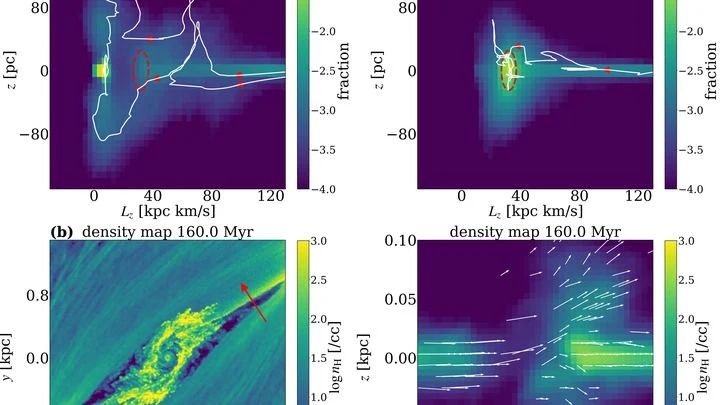
A river flows toward a whirlpool, but a dam with a notch blocks the way. Most water piles up before the dam, but some, gaining height, leaps over it and falls straight into the funnel. So it is with gas in a galaxy: it streams toward the center but hits a ring of stars and gas, like a dam. Usually, everything stops there, swirling into a dense vortex.
The ASKAP radio telescope in Australia has spotted a very faint glowing ring in the southern sky, like a soap bubble the size of several full moons. Inside the ring, exactly at the center, shines a tiny point. Usually, such a picture means one thing: a star exploded here, leaving behind an expanding shell and a collapsed core at its heart.
But this pair has a quirk.
In a distant galaxy, at a distance that light takes 11 billion years to cross, something flashed. The Einstein Probe X-ray telescope caught a brief, needle-prick-like burst: it lasted only a few dozen seconds.
Gamma-ray burst GRB 221009A flared so brightly that it was dubbed the 'brightest of all time.' The LHAASO observatory detected gamma rays from it with energies up to 13 TeV — thousands of times more energetic than particles in an X-ray machine.