How a Record-Breaking Gamma-Ray Burst Line Is Born ✛
Context
Gamma-ray bursts are the most powerful explosions in the universe, yet their internal structure remains a mystery. GRB 221009A, detected on October 9, 2022, broke all brightness records, and for the first time, a series of emission lines was reliably identified in its spectrum, with energies changing over time according to a power law. This discovery posed a challenge for theorists: what mechanism could explain such behavior? Neighboring studies in this field investigate gamma-ray bursts from various angles, from jet geometry to fast radio bursts, but none provided a complete explanation for the line's evolution. This work fills that gap by offering a self-consistent model.
Methods
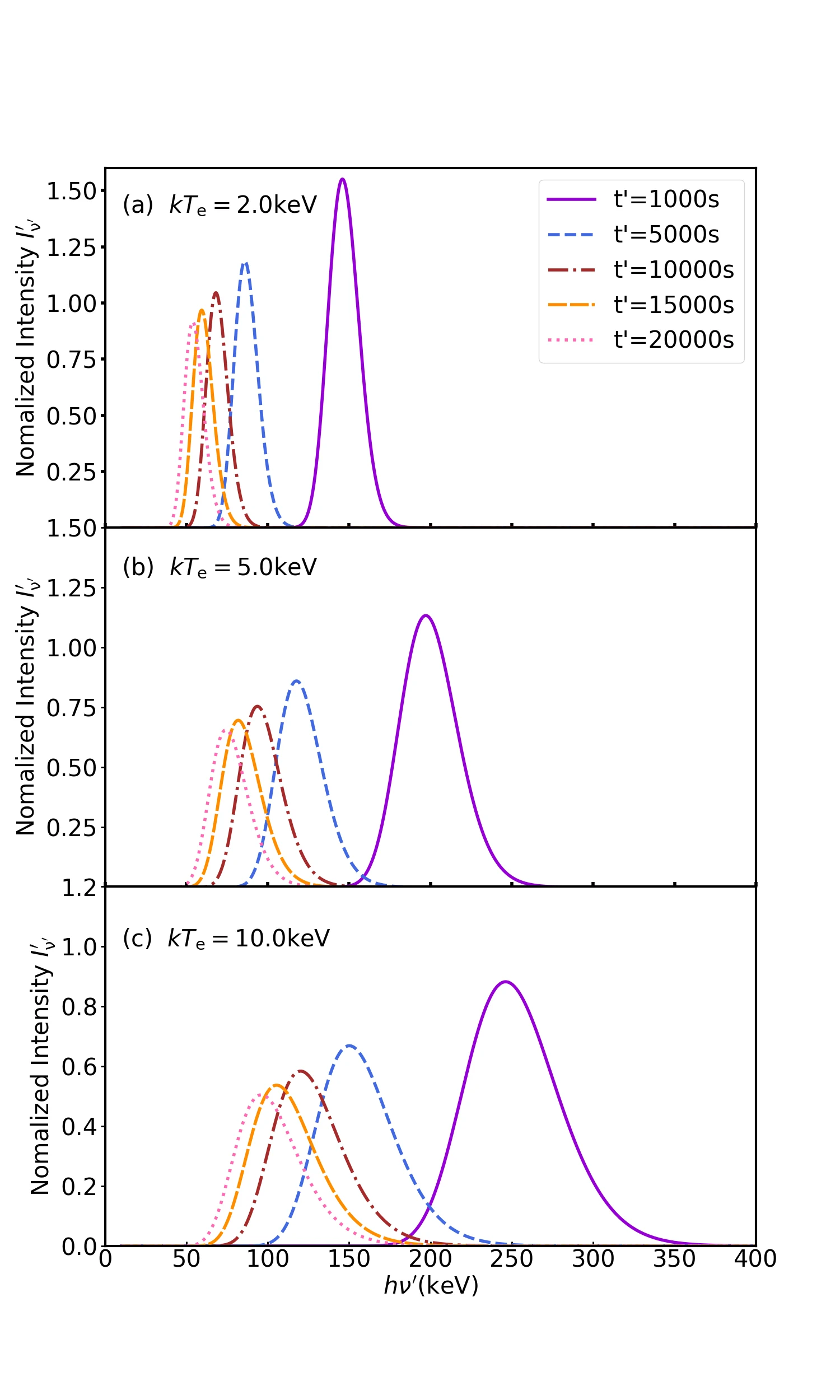
The authors built a model in which an emission line with an initial energy of 511 keV is born from electron-positron annihilation in the jet's subphotosphere. The line photons then pass through a region of dense plasma with an electron temperature of about 2 keV and a density of 2×$10^9$ cm⁻³, where they undergo multiple Compton scatterings, losing energy, a process called down-Comptonization. To describe the spectral evolution, they used the extended Kompaneets equation, solved numerically. The jet dynamics were modeled using hydrodynamic equations with parameters consistent with LHAASO observations: initial Lorentz factor 560, ambient density 0.4 cm⁻³, and opening angle 0.6°.
Results
The model reproduced the observed line evolution: the central energy falls from 37 to 6 MeV following a power law with index -1.11, the line width remains about 10% of the energy, and the flux declines with index -1.94. These values agree with the data within errors. The key result is the constraint on the jet plasma parameters: electron density 2×$10^9$ cm⁻³ and temperature 2 keV. This points to the existence of dense thermal plasma in a relativistic jet, which had not been confirmed by observations before.
Implications
This work is the first to combine down-Comptonization with jet dynamics to explain the evolution of an emission line in a gamma-ray burst. Unlike neighboring studies that focus either on jet geometry or burst statistics, this model provides a direct method to determine physical conditions inside the jet from spectral lines. This opens the possibility of using lines as a diagnostic tool to study the composition and dynamics of relativistic outflows.
Future development
The proposed scenario can be applied to other gamma-ray bursts with detected lines, allowing a test of the mechanism's universality. Further development includes accounting for plasma inhomogeneity, more detailed radiation transport modeling, and joint analysis with polarization data. Also promising is investigating the role of down-Comptonization in shaping the continuous spectrum of gamma-ray bursts.
Impact
The results will impact high-energy astrophysics, plasma physics, and gamma-ray burst theory, providing a new tool for diagnosing relativistic jets.
Next steps
The next step will be to search for similar lines in other gamma-ray bursts and test the model against independent data, including X-ray observations.
Key open problems
This work directly addresses the unresolved problem of the composition and structure of relativistic jets in gamma-ray bursts. The question of the plasma density and temperature in the jet had remained open, and this study provides the first direct constraints. It also contributes to understanding particle acceleration and radiation generation mechanisms in extreme astrophysical conditions.
The knowledge machine's view
This section is addressed to the author of the paper and their colleagues. Neighbouring works were found by meaning-based search across our archive, not by word overlap. We do not review: we show the field around the work.
What the work does
The authors model the evolution of the emission line in GRB 221009A, assuming pair annihilation followed by down-Comptonization in the dense jet plasma. They numerically solve the extended Kompaneets equation, accounting for jet hydrodynamics, and reproduce the observed decrease in line energy from 37 to 6 MeV, as well as its width and flux. The model constrains the plasma parameters: electron density of 2×10^9 cm⁻³ and temperature of 2 keV.
Where its strength is
This work provides a direct method to determine the physical conditions inside the jet from the spectral line evolution, coupling jet dynamics with the down-Comptonization process. This allows lines to be used as a diagnostic tool for relativistic outflows.
Where it could go next
- It might be interesting to compare the model with observations in other bands, for example with LHAASO data discussed in the paper on the record-breaking gamma-ray burst 2509.22792, to refine the jet parameters.based on: Black Hole Dives into a Star: Record-Breaking Gamma-Ray Burst arXiv:2509.22792
- A related paper on the magnetic nature of gamma-ray bursts considers avalanche-like pair production in magnetic fields; comparing with it might help clarify the role of magnetic fields in line formation.based on: Avalanche in Space: How a Gamma-Ray Burst Revealed Its Magnetic Nature arXiv:2608.17964v1
Worth trying
- Test the model on other gamma-ray bursts with emission lines, if any are found, to check the universality of the plasma parameters.
- Use line polarization data, if available, to further verify the down-Comptonization scenario.
- Investigate how the results change when accounting for scattering anisotropy or plasma inhomogeneity along the line of sight.
Why this may matter
If these lines indeed originate in the subphotosphere, they open a window into the physics of gamma-ray burst jet acceleration and composition, enabling measurements of plasma density and temperature under extreme conditions.
Nearby works in our archive
- Record-Bright Flare from a Gamma-Ray Burstsimilarity 0.65
- Echo of a Gamma-Ray Burst: Neutrons Chase the Lightsimilarity 0.65
- Gamma-Ray Burst Wings: What Lies Beyond the Edge of the Beamsimilarity 0.65
- Black Hole Dives into a Star: Record-Breaking Gamma-Ray Burstsimilarity 0.61
- Hunting Cosmic Explosionssimilarity 0.60
- How a Gamma-Ray Burst Diessimilarity 0.58
- Avalanche in Space: How a Gamma-Ray Burst Revealed Its Magnetic Naturesimilarity 0.58
The closest work in the archive sits at 0.65 by meaning — the usual level for our corpus.
GRB 221009A was so bright that its gamma radiation ionized the upper layers of Earth's ionosphere, and detectors on satellites were temporarily blinded.
Key numbers
- initial line energy: 511 keV
- final line energy: 6 MeV
- electron density in jet: 2×109 cm⁻³
- electron temperature: 2 keV
- power-law index of energy decay: -1.11