Photonenergy is the amount of energy carried by a single quantum of light or other electromagnetic radiation. It is directly proportional to the frequency of the radiation, meaning higher-frequency light (like X-rays) carries more energy per photon than lower-frequency light (like radio waves). This concept is fundamental to understanding phenomena such as the photoelectric effect, photosynthesis, and the interaction of light with matter at the quantum level.
History
The concept was introduced by Albert Einstein in 1905 to explain the photoelectric effect, building on Max Planck's earlier work on quantized energy. Einstein proposed that light consists of discrete packets of energy, which he called quanta (later named photons).
How it works
The energy of a photon is calculated using the equation E = hν, where E is energy, h is Planck's constant, and ν (nu) is the frequency of the radiation. Because frequency is inversely related to wavelength, shorter-wavelength light has higher photon energy. When a photon interacts with matter, its energy can be absorbed by electrons, causing them to jump to higher energy levels or even be ejected from atoms, which is the basis for many light-driven processes.
In practice
Photonenergy is used in solar panels to generate electricity, in medical imaging (X-rays), and in photodynamic therapy for cancer treatment, where specific photon energies are used to activate light-sensitive drugs.
A laser hits an atom, and tears out an electron. The brighter the light, the stronger the kick, and the faster the electron flies away. That's how the familiar picture works, where light is a smooth wave. But what if the light isn't smooth but 'squeezed,' with quantum fluctuations, like the trembling of a string?
In a crystal, heat travels on waves. Atoms vibrate, and these vibrations, called phonons, carry energy from the hot edge to the cold one. For a long time, it was believed that if phonons hit resonance (their frequencies exactly match) and can exchange energy, heat would flow like an avalanche. It turns out that's not the case.
An electron is not just a point. It is a probability cloud, smeared out in space. When such a cloud collides with a powerful laser pulse, it can emit a high-energy photon — a gamma quantum. And this photon can be not just ordinary but twisted, like a corkscrew, carrying orbital angular momentum.
A surfer glides across the ocean surface until a big wave comes, and then they're flying forward. Similarly, a free electron interacts with light: usually the energy exchange is barely noticeable, but if the surrounding medium begins to oscillate rhythmically, each wave crest pushes the particle harder and harder.
Understanding the photoelectric effect — where light knocks electrons out of a material — is like learning to cook without a recipe. That’s where digital tools help: games provide intuition, and simulations provide precision.
When an electric charge moves with acceleration, it emits electromagnetic radiation, i.e., light — a familiar phenomenon in physics. However, researchers have found that when moving along a specially chosen trajectory, the radiation acquires unusual properties.
Hydrogen is the most common element. Its atoms are like antennas: they emit and absorb light at very specific frequencies. Einstein predicted that spacetime can ripple: these are gravitational waves.
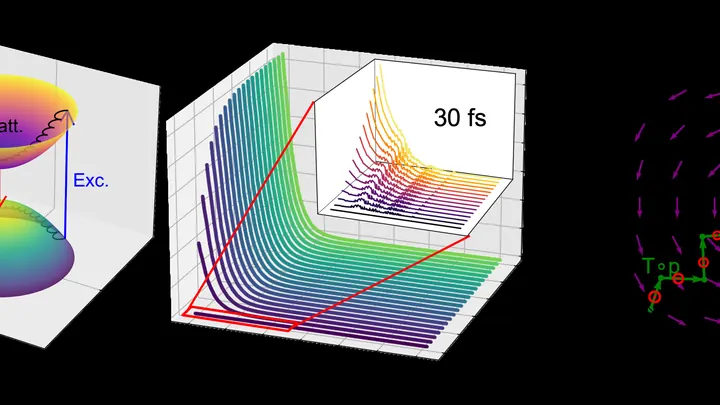
When light hits a semiconductor, it can knock out an electron, leaving behind a hole. The electron and hole attract each other and form a pair — an exciton. This pair can re-emit light, but not immediately: first, it exchanges energy with vibrations of the crystal lattice — phonons.
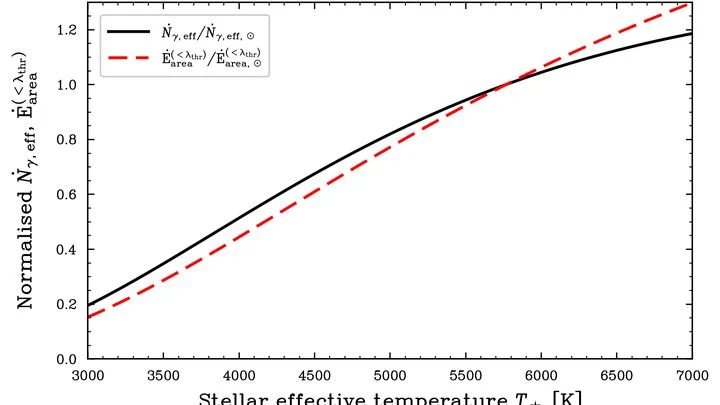
Oxygenic photosynthesis requires splitting water. It's kind of like a water wheel: to make it spin, you need a strong current. Light acts as the current, and light particles are the streams. For red dwarfs, the most common stars, the light is "cool" and weak — the streams barely move the wheel.
In a particle accelerator, electrons race around a ring at nearly the speed of light. When such an electron collides with a photon, a particle of light, the photon bounces off like a ball hitting a moving truck and flies away with much greater energy.
A muon is like an electron, but about 200 times heavier. When it stops in a piece of silicon, it gets pulled into the atomic nucleus like a nail to a magnet. The nucleus gains extra energy and starts to "boil": various particles fly out — protons, deuterons, tritons, and alpha particles.
A crystal without a center of symmetry is like a staircase where all the steps are tilted in the same direction: electrons, given a kick by light, roll predominantly in one direction. This is how a direct current is born — the photogalvanic effect.
Plants employ an army of perfect couriers to deliver energy. Each photon of sunlight is absorbed, and its energy is instantly, with almost no loss, transferred to reaction centers where nutrient synthesis occurs.
High above the Antarctic ice sheet, a balloon with a detector floated for twenty days. It caught tiny particles that had been traveling toward us for millions of years from distant stellar explosions. Now scientists have sorted through the catch and reported how much energy the protons and nuclei of different elements carried.