A Cosmic Blast Showed How Its Light Is Born ✛
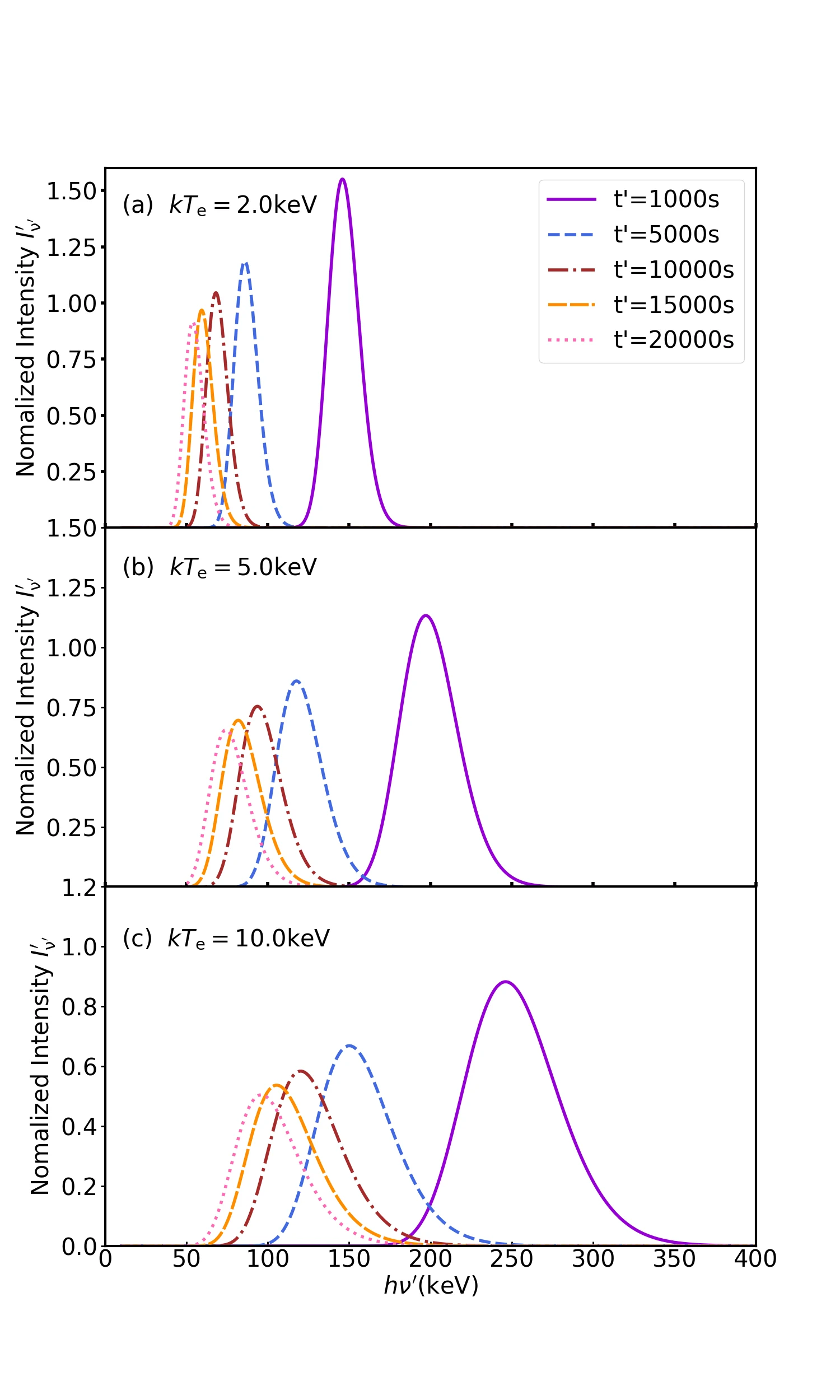
In October 2022, the brightest gamma-ray burst GRB 221009A left clear light fingerprints — emission lines, by which chemical elements are identified. Their energy dropped from 37 to 6 megaelectronvolts (millions of times higher than the energy of visible light) — like a billiard ball losing speed after a cascade of hits. Unlike stars, where light usually gains energy, here it was rapidly cooling.
The birth of photons was triggered by the annihilation of electrons with positrons — a complete conversion of matter into radiation, which Paul Dirac pondered. Then comes the 'billiards': each photon repeatedly collided with electrons and lost a portion of energy. This scattering, discovered by Arthur Compton, here works to lower energy. The model precisely reproduced how the brightness and width of these lines changed.
This mechanism sets the rules for similar signals in other cosmic explosions — from mergers of neutron stars to collapses into supernovae.
The gamma-ray burst GRB 221009A was so bright that for a few seconds its afterglow could be seen even through amateur telescopes — a record for such events.