Ultrahot planet hides under a gas blanket ✛
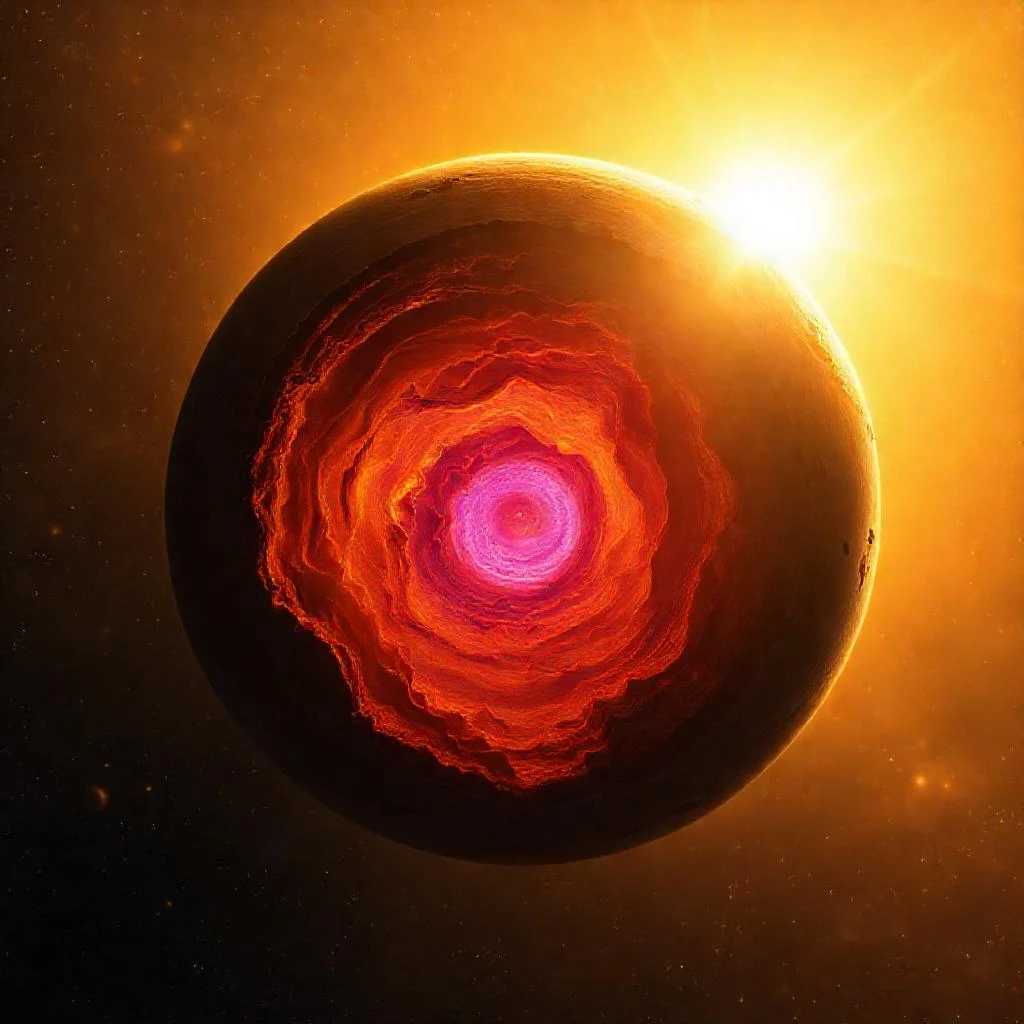
For a long time, planets squeezed right up against their star were thought to be bare rocky spheres. Temperatures in the thousands of degrees strip away any gas envelope. But the James Webb Space Telescope showed: the ultrahot exoplanet TOI-561 b is wrapped in a dense blanket of gases.
The planet completes a full orbit around the star in just 10 hours. It was expected that its dayside would heat up to 3000 °C and glow in infrared light like a furnace. But the spectrum, the splitting of light into colors, revealed a much fainter glow. This means a warm layer of atmosphere, like a blanket, traps the heat near the surface.
Where did it come from? The likely source is an ocean of molten magma.
So the planet acquired a new gas envelope that lasts longer than expected. The surprise is that, at nearly the size of Neptune, this world weighs as much as Mars, a fluffy giant among scorching rocks.
At Neptune's size, TOI-561 b weighs as much as Mars — one of the fluffiest super-Earths.
The magma ocean on TOI-561 b brings to mind Mustafar, the fiery world from Star Wars.