A Thermos with a Loose Lid: Super-Hot Super-Earth Has a Thick Atmosphere ✛
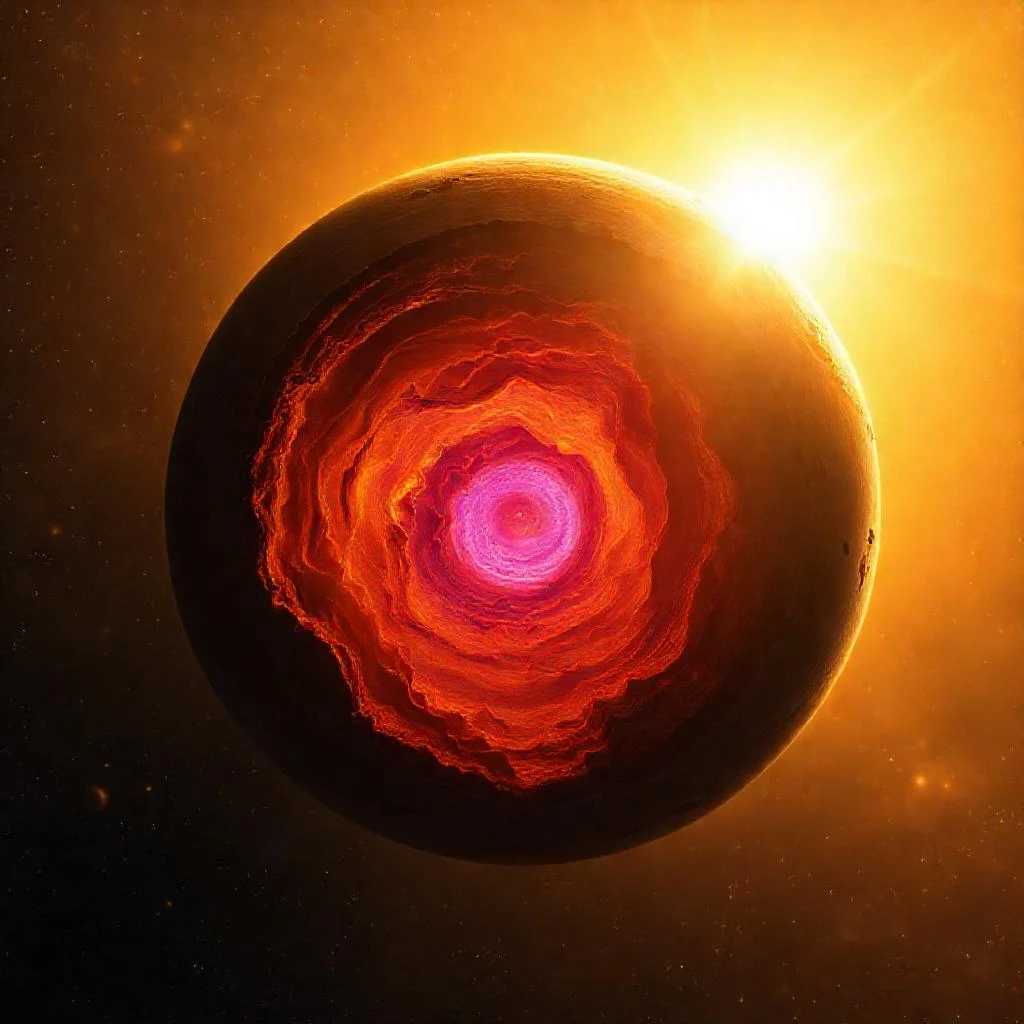
The super-hot super-Earth TOI-561 b completes an orbit around its star in just 10.7 hours. It is a scorched rocky sphere, so close to its star that its dayside should heat up to 2950 K, a temperature at which many minerals melt. But when the James Webb Space Telescope looked at that side, it saw not a bare rock radiating heat but something noticeably cooler: 1800–2150 K. The difference of a thousand degrees is not a measurement error. It is the signature of a thick atmosphere that acts like a thermos with a loose lid: it holds in heat but keeps the surface from overheating.
Astronomers have long debated whether ultra-short-period planets (with orbital periods under a day) can retain volatiles such as water, oxygen, and carbon dioxide. Logic suggested that such intense irradiation would evaporate any atmosphere within a few million years. But TOI-561 b, with its anomalously low density of 4.3 g/cm³ (0.68 of Earth's density at the same mass), hinted otherwise. Now observations of a secondary eclipse, when the planet passes behind its star, have provided a direct answer. The spectrum of its dayside emission in the 3–5 μm range matches neither a bare rock nor a thin atmosphere of rock vapor. It corresponds to a dense envelope of water vapor or a mixture of water and oxygen. Carbon dioxide fits less well: its absorption band at 4.5 μm is not seen in the data.
The key is a magma ocean. Under the star's ferocious radiation, the planet's surface melts into a global layer of molten rock. This ocean acts as a reservoir: it soaks up volatiles from the interior and slowly releases them into the atmosphere, limiting loss to space. Just as a thermos with a loose lid keeps boiling water from instantly evaporating, vapor escapes, but slowly, while the interior stays hot. For TOI-561 b, this means that even after 10 billion years of stellar evolution, the atmosphere has not completely vanished.
This discovery changes our view of the "cosmic shoreline," the empirical boundary thought to separate planets with atmospheres from bare rocks. Previously, TOI-561 b would have been expected to fall on the bare-rock side. Now it is clear that the boundary is not universal. Moreover, the result confirms that magma oceans can be long-lived reservoirs of volatiles, meaning even the most irradiated rocky planets have a chance to keep an atmosphere. Next steps include analyzing the full phase curve to understand how heat is distributed to the nightside, and comparing with planets around stars of different compositions. We may be on the verge of a new chapter in studying the geophysics of distant worlds: their atmospheres will reveal the composition of their interiors, their formation history, and even how planetary systems are born and die.
TOI-561 b orbits a star that is about twice as old as the Sun, roughly 10 billion years old. Yet the planet is so close to its star that its year lasts only 10.7 hours, and the dayside is hot enough to melt many minerals.