Popular

A Shivering Disk Cooled to Quantum Stillness ⚡ экспресс

Original: "Optomechanical disk resonator in the quantum ground state of motion"
arXiv:2511.15492 · 2025-11-19 · CC BY 4.0 · ⏱ 1 min · Quantum Physics
A grain-sized semiconductor disk has been cooled to quantum rest for the first time: its trembling became less than a single quantum of sound.
Abstract

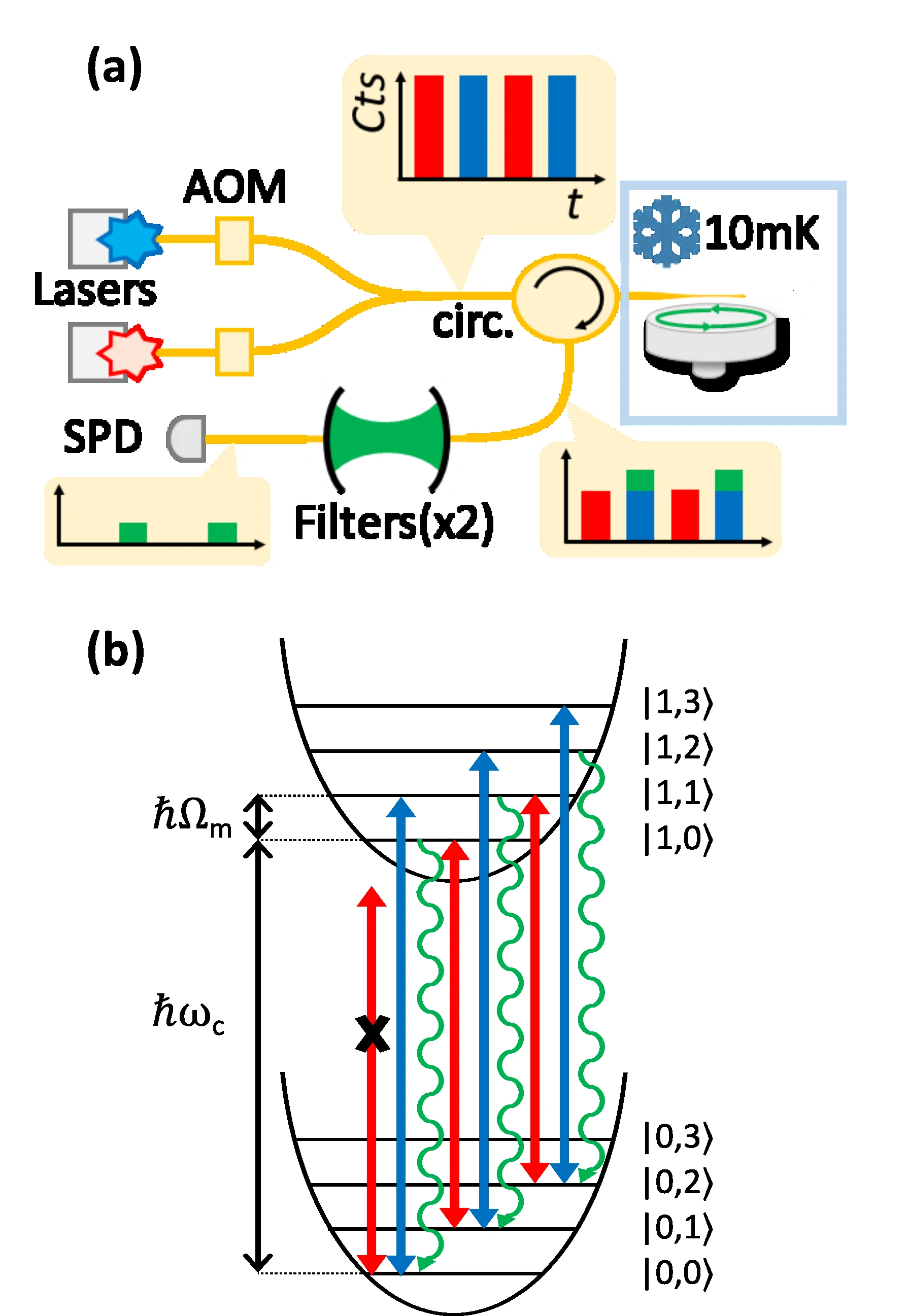
For the first time, an optomechanical disk resonator has been brought to its quantum ground state: the mechanical "breathing" of the disk at gigahertz frequency is cooled to an excitation of less than one phonon. The phonon number was measured using Brillouin spectroscopy, counting photons scattered by whispering gallery modes through an optical fiber. The occupancy was found to be 0.66±0.20 phonons, confirming suppression of absorption. Additional laser heating discovered in the work points to sensitivity limits of future quantum devices.

Links in the knowledge graph 1

📄 Showing the "Simple" version — "Popular" is not ready yet. Add it to favorites to help prioritize it.

Cooled nearly to absolute zero with liquid helium, the semiconductor disk reached such a low level of entropy that its thermal trembling became less than one phonon — a quantum of sound. An ordinary guitar string plucked produces billions of phonons; here, it's less than one, like a string frozen in quantum uncertainty: both moving and not.

To measure this microscopic motion, researchers brought a thin optical fiber close to the disk. Light grazing the disk scattered and revealed phonons. This technique — Brillouin sideband spectroscopy — showed an average of 0.66 phonons in the disk. However, the measuring light itself slightly heated the disk, hindering complete cooling — like a bow that adds tremble instead of calming the string.

Such control over a large object blurs the line between our world and the quantum one. Quantum-cooled systems will become the heart of sensors that can hear gravitational waves or single molecules.

🎯 The disk cooling uses a mixture of liquid helium-3 and helium-4: separating the mixture extracts heat — much like evaporating sweat cools your skin, but far more efficient.

Scientists
Christian DopplerD. B. McLaughlinDidier QuelozMichel MayorR. A. RossiterJacob Bekenstein
Tags
spectroscopy helium entropy
Laws
second law of thermodynamicsDoppler effectBekenstein-Hawking entropyMaxwell's equationsPlanck's lawPlanck–Einstein relation
Original: arXiv:2511.15492 · CC BY 4.0 · bridge42worlds