An optical resonator is a device that confines light in a closed path, typically between mirrors, allowing it to bounce back and forth and build up intensity through constructive interference. Resonators are fundamental to lasers, where they provide the feedback needed for light amplification, and to optical cavities used in precision measurement, quantum optics, and sensing. They enable enhanced light–matter interactions by trapping photons for many round trips, effectively increasing the interaction length by orders of magnitude.
History
The concept of an optical resonator dates back to the early 20th century with Fabry–Pérot interferometers, developed by Charles Fabry and Alfred Pérot in 1897. The application to lasers was realized in the 1950s–1960s, with the first working laser by Theodore Maiman in 1960 using a simple resonator.
How it works
Light circulating in a resonator forms standing waves at specific frequencies determined by the cavity length and mirror reflectivity. When the round-trip phase shift is a multiple of 2π, the cavity is on resonance and light builds up coherently. The quality factor Q measures how long photons persist in the cavity, with high-Q cavities confining light for microseconds or longer, enabling extremely sensitive measurements of frequency shifts, absorption, or mechanical motion.
In practice
Optical resonators are used in laser technology, gravitational wave detectors like LIGO, optical frequency combs, and cavity quantum electrodynamics experiments for quantum computing and communication.
Fun fact
The LIGO gravitational wave detectors use Fabry–Pérot resonators with mirrors that are so reflective that light bounces back and forth about 280 times, effectively extending the detector's arm length from 4 km to over 1,100 km.
A magnetic vortex is like a tiny whirlpool in the sea, except that instead of water, it's magnetization that swirls. Such vortices could become memory cells in future computers, but to write and read information, you need to be able to move each vortex individually. So far, this is done crudely — shifting a whole bunch at once.
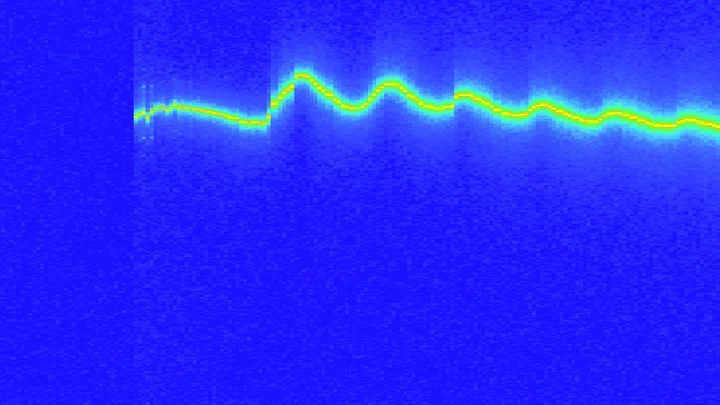
A weak laser beam falls onto a tiny structure — a hybrid cavity made of metal and glass. Inside is trapped a single light-emitting molecule. Normally, such light only slightly changes color as it scatters off thermal vibrations of atoms.
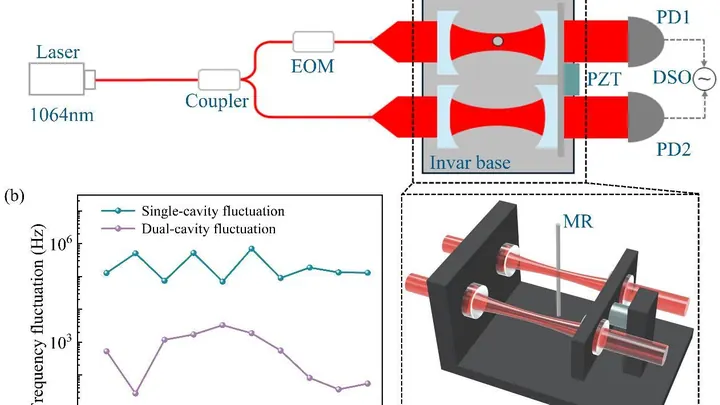
A guitar string is stretched between two mirrors. A beam of light bounces back and forth between them, and the string shudders at every touch. Sometimes the light loses energy — the string takes it and dissipates it as heat, like a fading sound. Other times, the string shifts the pitch of the light itself, changing its color but barely dimming it.
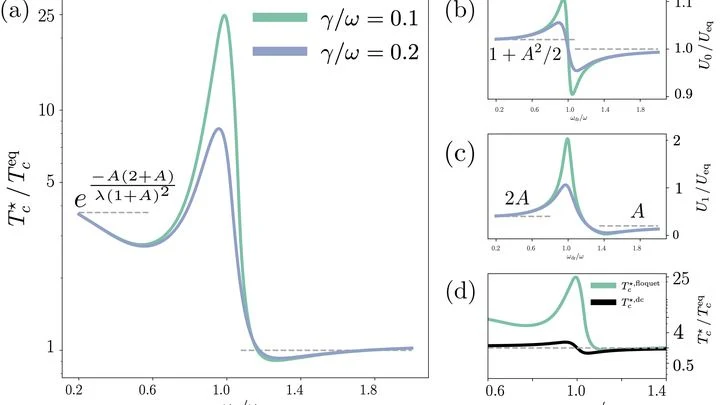
In a dark room, an infrared laser flashes, and a speck of black K3C60 powder conducts electricity without resistance for a split second. The light strikes at 10 terahertz — a thousand times faster than a microwave oven. The effect is a hundred times stronger than at other frequencies. Why this particular frequency?
A tiny diamond bridge vibrates so strongly that it starts to 'sing' at many frequencies at once. Previously, such vibrations would dampen themselves: the harder the resonator swung, the harder it was to add energy. Physicists found a loophole in this rule.
They used light to drive the diamond. Light pushes on the bridge, making it tremble.
An ordinary superconductor works only in nature's freezer — at temperatures below minus one hundred degrees. The carbon-ball material K₃C₆₀ is no exception: without cold, it resists current like a crowd in a narrow corridor. But physicists noticed something strange: if you shine a laser on it, it starts conducting without loss even in warmth.
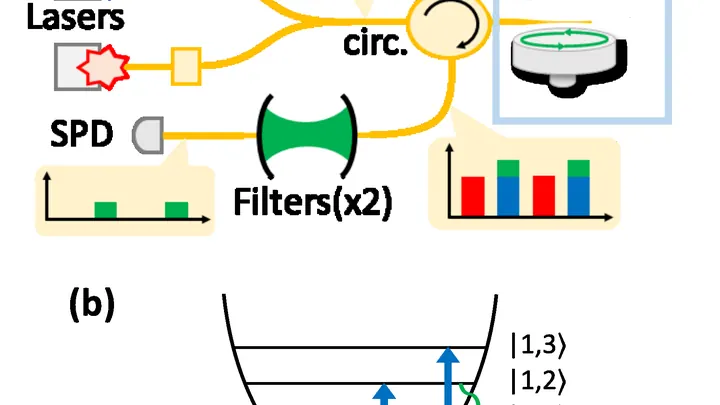
Cooled nearly to absolute zero with liquid helium, the semiconductor disk reached such a low level of entropy that its thermal trembling became less than one phonon — a quantum of sound.