A Shivering Disk Cooled to Quantum Stillness express
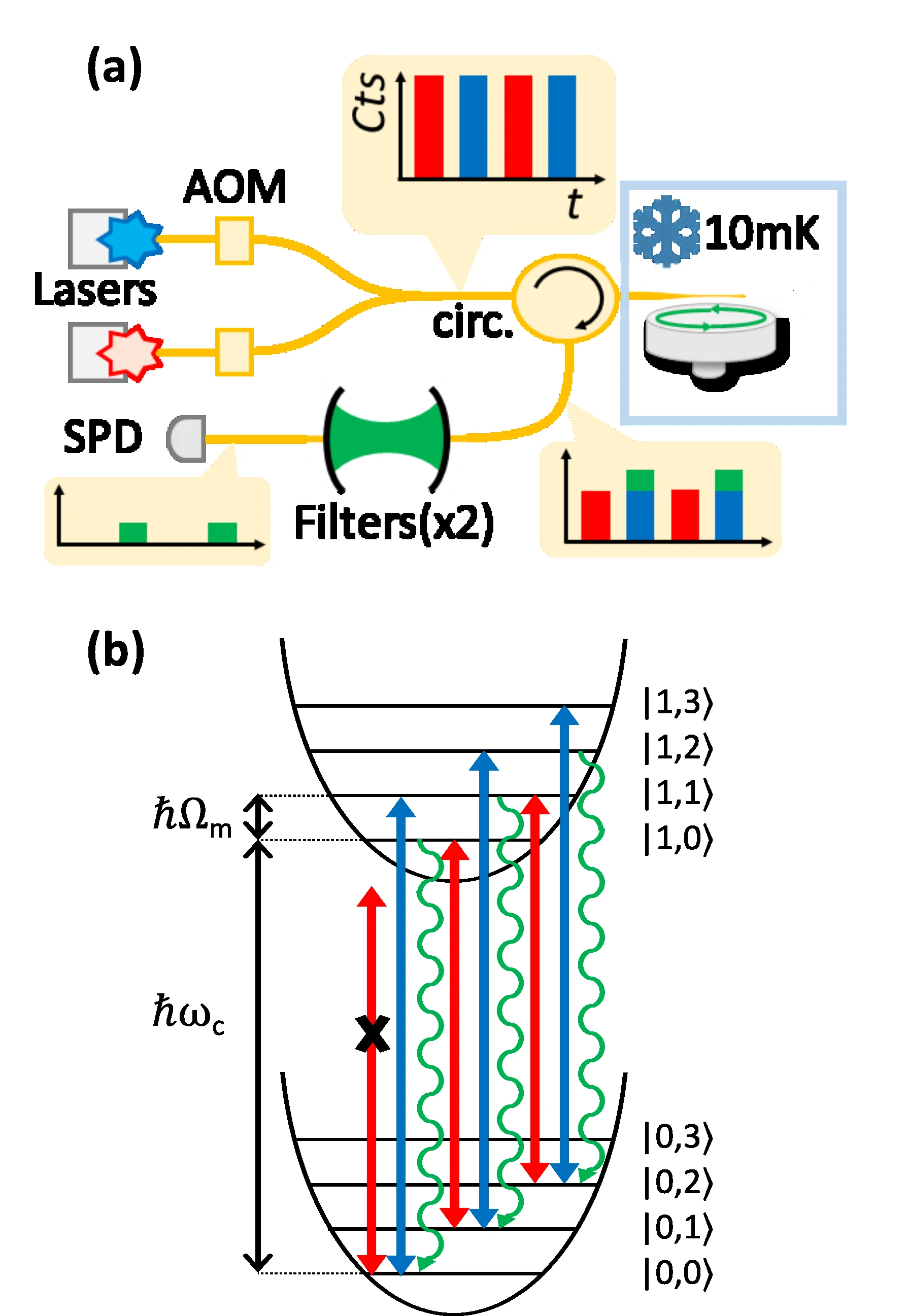
Cooled nearly to absolute zero with liquid helium, the semiconductor disk reached such a low level of entropy that its thermal trembling became less than one phonon — a quantum of sound. An ordinary guitar string plucked produces billions of phonons; here, it's less than one, like a string frozen in quantum uncertainty: both moving and not.
To measure this microscopic motion, researchers brought a thin optical fiber close to the disk. Light grazing the disk scattered and revealed phonons. This technique — Brillouin sideband spectroscopy — showed an average of 0.66 phonons in the disk. However, the measuring light itself slightly heated the disk, hindering complete cooling — like a bow that adds tremble instead of calming the string.
Such control over a large object blurs the line between our world and the quantum one. Quantum-cooled systems will become the heart of sensors that can hear gravitational waves or single molecules.
The disk cooling uses a mixture of liquid helium-3 and helium-4: separating the mixture extracts heat — much like evaporating sweat cools your skin, but far more efficient.