Deadly Resonance: How Stars Toss Out Planets express
Two stars, drawing together in a cosmic dance, experience an extra wobble — a consequence of spacetime curvature (an effect predicted by Einstein). A planet orbiting them also wobbles. Sometimes the rhythms align: the gravitational tugs from the stars fall in step with the planet’s orbit, like hands pushing a swing. That’s resonance — the orbit stretches, and the planet gets launched from its place.
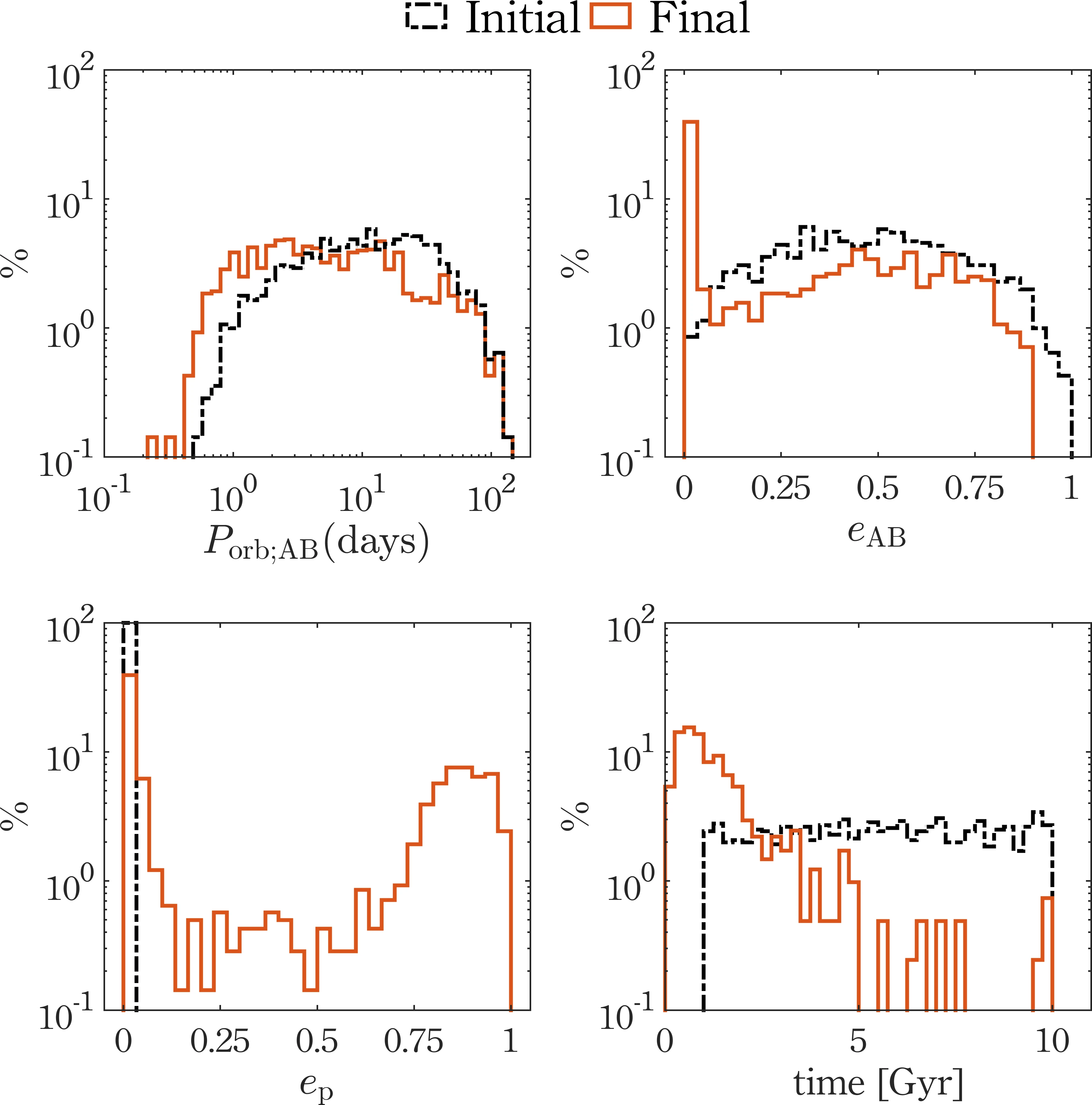
This is how rogue planets are born: eight out of ten planets around close binary systems fall into this deadly resonance, and three quarters perish. The rest hide far away. That’s why no planets have been found around stellar pairs with orbital periods shorter than seven days — their tight co-habitation mercilessly sweeps everything around away.
Original abstract
as written by the authors arXiv:2512.03940
Transiting circumbinary planets (CBPs) are conspicuously rare, and entirely absent around stellar binaries with periods $$\leq 7$$ days. Here, we exploit a secular resonance to stimulate the orbit of a CBP into strong, disruptive interactions with the host binary. The process requires no tertiary companion and is triggered when the general-relativistic precession of a tightening binary matches the Newtonian precession it induces in its companion planet. Adiabatic capture in this resonance sees the binary draining angular momentum from the CBP's orbit which grows steadily in eccentricity until destabilization, and eventual ejection or engulfment. We map this resonance in phase space, then investigate the dynamical outcomes of encounter in the course of tidally shrinking binaries. With the help of orbit averaged simulations of a suite of systems, we find that, around tightening binaries: eight out of ten CBPs encounter and are captured in the resonance; three out of four are `destroyed'; and survivors lurk on remote, low-transit-probability orbits. This suggests that the very process which forms tight binaries effectively clears the region where transiting CBPs could reside.
Some binary stars complete a full orbit in just a few hours — their “day” is shorter than a workday. And the distance between them is smaller than from the Sun to Mercury.