Radio Beacons with a Minute-Long Rhythm: Who Lights Them Up
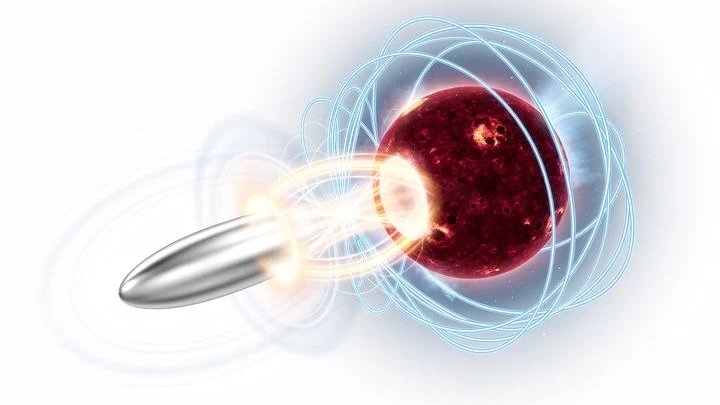
A lighthouse that blinks not every second but once every few minutes or even hours. That is exactly how long-period radio transients behave — cosmic sources discovered only recently.
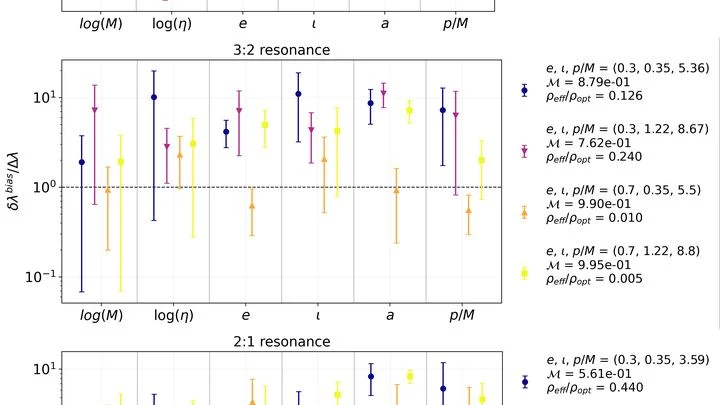
Synchronized orbital periods among exoplanets, revealing system formation and stability.Exoplanetary orbital resonance occurs when two or more planets exert regular, periodic gravitational influences on each other, locking their orbital periods into exact integer ratios, such as 2:1 or 3:2. This synchronization is a fingerprint of planetary system formation, revealing how planets migrated and interacted in the early disk of gas and dust. Resonant chains, where multiple planets are linked in a sequence of ratios, are particularly valuable for understanding system architecture and stability.
The concept of orbital resonance was first applied to the solar system, notably by Laplace in the 18th century for the Galilean moons of Jupiter. The first exoplanetary resonances were discovered in the late 1990s and early 2000s, with systems like GJ 876 showing a 2:1 resonance.
When planets orbit close to a resonance, their gravitational pulls repeatedly occur at the same orbital phases, creating a cumulative effect that can either stabilize the configuration or drive it into chaos. Convergent migration, where planets move toward each other due to disk interactions, naturally captures them into resonances. Once locked, the planets exchange energy and angular momentum in a coordinated way, maintaining the ratio over long timescales.
Resonant systems are used to constrain planetary migration models and to measure planetary masses and orbital parameters with high precision, aiding in the characterization of exoplanet demographics.
The TRAPPIST-1 system, with seven Earth-sized planets, is a remarkable example of a resonant chain where all planets are linked in a series of near-integer orbital ratios.
| e | variable | Orbital eccentricity — eccentricity |
| ω | variable | Argument of periastron — argument of periapsis radian |
| Δt | variable | Time offset in eclipse timing — time offset second |
| P | variable | Orbital period — period second |
| cos | operator | Computes the cosine of an angle — cosine |
| K | variable | radial velocity semi-amplitude — velocity metre per second |
| a | variable | semi-major axis — length metre |
| υ | variable | orbital velocity — velocity metre per second |
| ω | variable | angular frequency — angular frequency radian per second |
| P | variable | orbital period — time second |
| f_ISCO | variable | orbital frequency at ISCO — frequency hertz |
| M | variable | mass of the central object — mass kilogram |
| c | constant | speed of light in vacuum — speed of light = 299792458 metre per second |
| G | constant | Newton's constant of universal gravitation — gravitational constant = 6.67430e-11 cubic metre per kilogram per second squared |
| E(B-V) | variable | Color excess between B and V bands — color excess |
| k(λ) | variable | Extinction curve at wavelength λ — extinction curve |
| F_λ | variable | Flux at wavelength λ — flux watt per metre squared |
| λ | variable | Wavelength — wavelength metre |
| log10 | operator | Base-10 logarithm — logarithm base 10 |