Gravitational perturbation refers to the deviation of a celestial body's orbit from a perfect Keplerian ellipse due to the gravitational influence of another body or a non-uniform mass distribution. These perturbations are crucial for understanding the dynamics of planetary systems, binary stars, and galaxies. They can cause orbital elements like eccentricity, inclination, and semi-major axis to change over time, leading to phenomena such as orbital resonances, secular variations, and even chaotic behavior.
History
The study of gravitational perturbations began with Isaac Newton, who noted that the Moon's orbit deviates from a simple ellipse due to the Sun's influence. Later, Pierre-Simon Laplace and Joseph-Louis Lagrange developed sophisticated mathematical techniques to analyze perturbations in the solar system.
How it works
When a third body (or a non-spherical mass distribution) exerts a force on a two-body system, the resulting acceleration is not purely radial, causing the orbit to precess or oscillate. The perturbation can be treated mathematically using methods like perturbation theory, where the unperturbed Keplerian orbit is taken as a reference and the additional forces are treated as small corrections. Over time, these small corrections can accumulate, leading to significant changes in the orbit.
The orbit of Mercury precesses due to gravitational perturbations from other planets, but a small unexplained residual in its precession was a key clue that led to the development of general relativity.
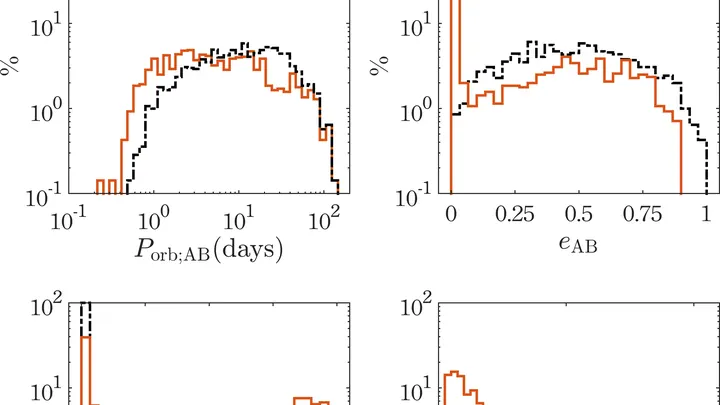
A gas disk with a mass of four hundred thousand suns encircles the black hole at the center of the Milky Way. Its gravity works like a gravitational rudder: slowly but inexorably turning the orbits of binary stars, driving them into the region where tidal forces tear the pair apart.
For over a century, astronomers puzzled over the capricious behavior of RR Lyrae stars: their brightness periodically waxed and waned with unpredictable amplitude, like a lighthouse with a faulty mechanism. The Blazhko effect, discovered in 1907, taunted scientists for decades.
A radio telescope is not just an antenna, but a computing machine that builds an image from millions of equations. This mathematical prism is as fragile as glass: one wrong digit in the calibration, and the real sky splits, spawning phantom sources.
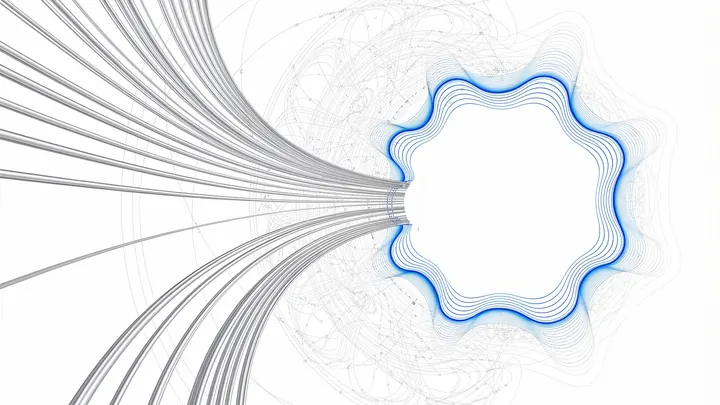
At the heart of an active galaxy, where interstellar gas spirals into a dazzling accretion disk around a supermassive black hole, a boundary is born through which even sound cannot break. This acoustic horizon was long considered frozen ripples on water.
A balloon in your hand springs back equally in all directions. But a bottle of soda behaves differently: along the neck it is stiff, while across it is easily squeezed. This is roughly how pressure works inside some stars: it can be unequal in different directions. Such stars are called anisotropic, and their behavior has so far been described by disparate methods.
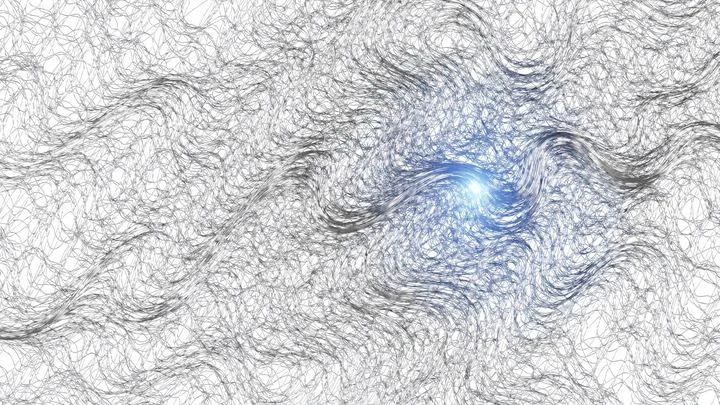
Drop two identical pebbles from a mountain peak: one lands a centimeter to the left, and a minute later they end up in different valleys. A galaxy is the same mountain, only with billions of pebbles and a slope that stretches over millions of years. The authors of a new study simulated a disk of 40 million point-like stars and tested how quickly it forgets where it started.
A black hole can torment a star for years, rather than rip it apart immediately. Tidal forces are when the hole's gravity stretches the star: the near side is pulled harder than the far side. Usually, getting too close rips the star apart instantly — that's a tidal disruption event.
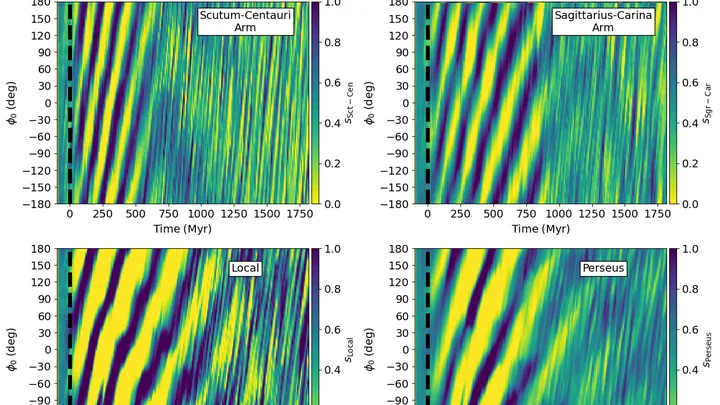
The Sagittarius galaxy plunged into the disk of the Milky Way and passed through again and again, like a stone thrown into a still pond. Each strike left ripples: waves and warps in the star field.
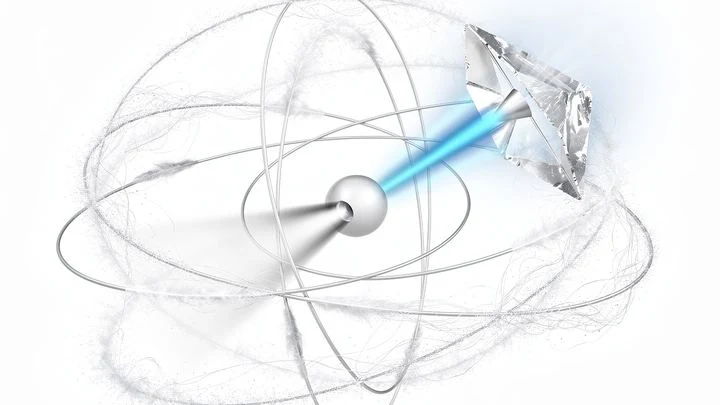
Two stars, drawing together in a cosmic dance, experience an extra wobble — a consequence of spacetime curvature (an effect predicted by Einstein). A planet orbiting them also wobbles. Sometimes the rhythms align: the gravitational tugs from the stars fall in step with the planet’s orbit, like hands pushing a swing.