Invisible Donors in Binary Stars express
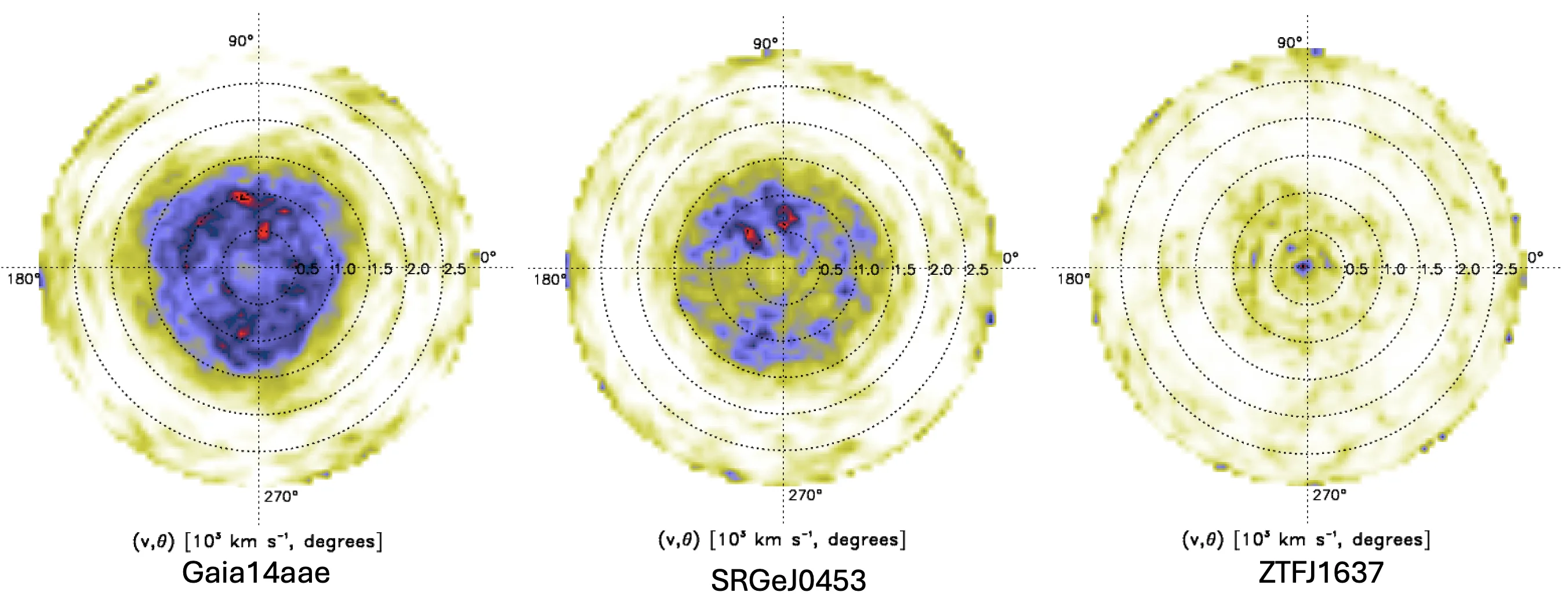
In three binary systems, a white dwarf, the dead core of a star, steals gas from its companion. The companion is so dim that it cannot be seen with an ordinary telescope. The James Webb Space Telescope looked at these pairs in infrared light, like a night-vision camera. And for the first time, it caught the light from the donor stars themselves.
Previously, astronomers thought that in the infrared, it was the donor star that shone. It turns out the light comes from a disk of hot gas swirling around the white dwarf. This disk, like a whirlpool, spirals in the stolen matter. It shows bright helium lines — two peaks, like twin flames at the edges of the whirlpool. The donor, in contrast, leaves only a faint sodium trace, like a glint on a cheek.
Such a magnetic field prevents the disk from getting too close. Gas stalls at a distance, like a car stopped at a barrier. This explains why the spectra show no fast jets: the matter simply never gets a chance to accelerate. The three donor stars turned out to be similar to each other, even though they were previously thought to be different.
Now it is clear: the infrared excess in such systems points to the disk, not the donor star. This means the donor stars are even fainter than previously assumed. They are like quiet partners in a dance, visible only in the glint of sodium.
Original abstract
as written by the authors arXiv:2601.00945
We present JWST/NIRSpec high-cadence infrared spectroscopy of three long-period, eclipsing AM CVn binaries, Gaia14aae, SRGeJ0453, and ZTFJ1637. These systems have orbital periods of 50-62 minutes and cool donors that are undetectable in the optical. The data cover a wavelength range of 1.6-5.2 $$\mu$$m at resolution $$R=1000-2000$$. We obtained 150-200 spectra of each system over two orbits, split between the G235M and G395M gratings. All three systems show strong, double-peaked He I emission lines dominated by an accretion disk. These lines are nearly stationary but contain radial velocity (RV) variable sub-components that trace stream-disk interactions. In Gaia14aae and SRGeJ0453, we detect two Na I doublets in emission whose RVs track the irradiated face of the donor, marking the first direct detection of the donors of long-period AM CVns. No absorption lines from the donors are detected, implying that the IR excesses observed in many long-period AM CVns primarily trace disks, not donors. The He I emission profiles in all systems lack high-velocity wings and show no emission beyond $$\approx 1500,\rm km,s^{-1}$$. The morphology of the disk eclipses and Doppler tomograms are best reproduced by models in which the disk is truncated well outside the white dwarf and only material at $$r \gtrsim 0.07,R_{\odot}$$ contributes to the disk emission. We interpret this as possible evidence of magnetized white dwarf accretors. For plausible mass transfer rates, the truncation radii imply surface magnetic fields of $$B = 30-100$$ kG, consistent with recent constraints based on X-ray periodicity. The absence of cyclotron humps out to 5 $$\mu$$m rules out stronger MG-level fields. We make the data from the program publicly available to the community.
The orbital periods of these pairs are 50–62 minutes. In the time it takes you to read this paragraph, the white dwarf completes a full orbit around the common center of mass.