unit

gauss

A unit of magnetic flux density, commonly used in astrophysics to measure field strength.
9 related articles

Description

The gauss (symbol G) is a unit of magnetic flux density, also known as magnetic induction, in the centimeter-gram-second (CGS) system of units. It measures the strength of a magnetic field — specifically, how many field lines pass through a given area. In astrophysics, the gauss is the standard unit for describing magnetic fields across cosmic scales, from the faint fields in interstellar space (microgauss, 10⁻⁶ G) to the intense fields on the surfaces of neutron stars and white dwarfs (up to 10⁹ G or more). One tesla, the SI unit, equals 10,000 gauss, so the gauss is convenient for the relatively weak fields found in most astronomical environments.

History

The unit is named after Carl Friedrich Gauss, the German mathematician and physicist who made foundational contributions to the theory of magnetism in the 1830s. The name was formally adopted in the late 19th century as part of the CGS system.

How it works

Magnetic flux density is defined by the force a magnetic field exerts on a moving charge: a charge of one statcoulomb moving at one centimeter per second perpendicular to a field of one gauss experiences a force of one dyne. In practice, astronomers infer magnetic field strengths indirectly. They measure the Zeeman splitting of spectral lines, the polarization of light, or the synchrotron radiation from charged particles spiraling in the field. Each technique yields a value in gauss, allowing comparisons across different objects and phenomena.

In practice

Beyond astrophysics, the gauss is used in magnetometry for geophysical surveys, in the calibration of magnetic sensors, and in the design of magnetic shielding for sensitive equipment.

Fun fact

The Earth's magnetic field at the surface is about 0.5 gauss, while a typical refrigerator magnet is around 100 gauss — a thousand times stronger.
Concept graph →

Related articles · 9

Stellar2026-07-224 minarXiv:2607.19642
Methane Dwarf Beacon: Cutoff Frequency Reveals Magnetic Field
Radio astronomy began with the mysterious noise caught by the antenna of Karl Jansky and the rhythmic pulses that Jocelyn Bell Burnell playfully called 'little green men'.
HEP Phenomenology2026-06-242 minarXiv:2606.26229express
Magnetic Monopoles Straighten the Path of Gamma Rays
Light from a distant blazar, an active galactic nucleus whose jet points our way, travels for billions of years. Along the way, it triggers cascades of charged particles that the intergalactic magnetic field deflects sideways. This creates a blurred gamma-ray glow around the blazar: a secondary halo.
Mesoscale2026-04-231 minarXiv:2604.21500express
A Magnetic Compass the Size of a Dust Speck
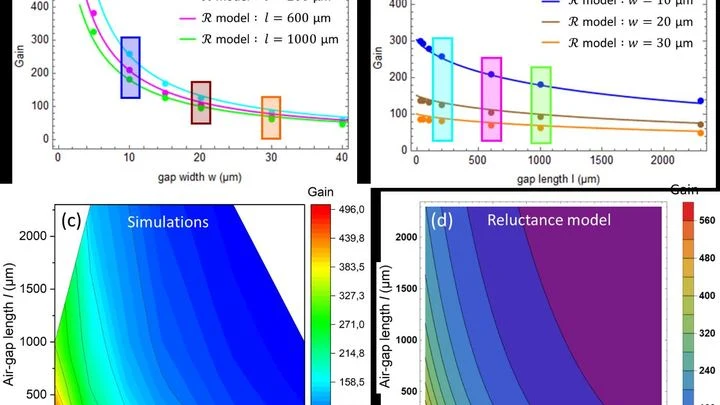
Magnetic sensors smaller than a match head can already detect weak fields — from a beating heart or a distant planet. But making them even more sensitive involves a trade-off: improve one part, and you lose performance in another.
Galaxies2026-03-172 minarXiv:2603.16425express
An Hourglass in a Dark Cloud
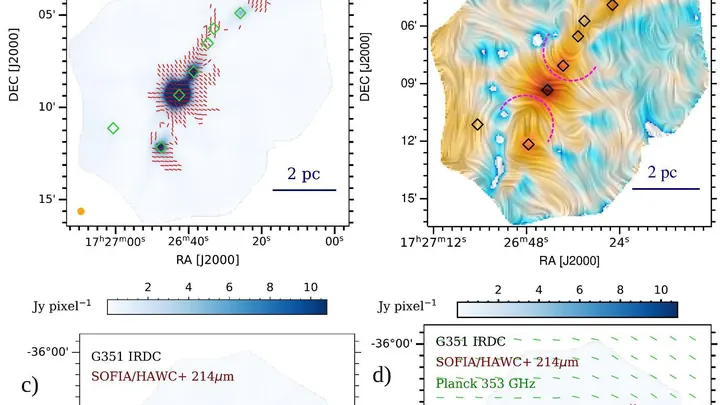
In the dark cloud G351, where new stars are about to emerge from gas and dust, the magnetic field has bent into an hourglass shape. Such a shape is a sign that the field is not just watching star birth from the sidelines but is actively taking part. Scientists used the SOFIA telescope, mounted on an airplane, to see the dust in the cloud.
Stellar2026-03-122 minarXiv:2603.11945express
The Hidden Magnets of White Dwarfs
A white dwarf is what remains of a star like the Sun after it sheds its outer layers. What's left is a hot core the size of Earth but with a mass close to that of the Sun. A teaspoon of this material would weigh as much as a truck. Some of these stars have extremely strong magnetic fields — a billion times stronger than Earth's.
Galaxies2026-03-021 minarXiv:2603.01882express
Galactic Wind: How Stars Blow Gas Out of a Galaxy
A distant galaxy, similar to our Milky Way, is blowing gas into space like a hair dryer blowing dust off a table. Seven beams of light from an even more distant object pierced this gas cloud, and astronomers saw that the gas flow is narrow, like a jet from a hose, not wide like a fan.
High Energy2026-02-122 minarXiv:2602.11847express
Cosmic Rays as a Thermometer and Magnetic Compass
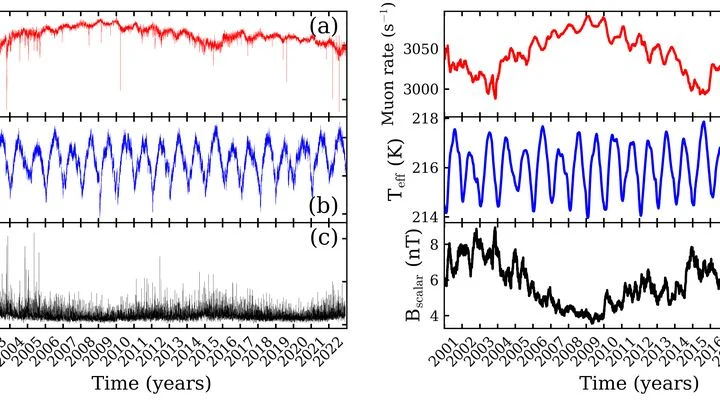
Every second, invisible particles from space, cosmic rays, strike Earth's atmosphere. Colliding with air molecules, they produce showers of secondary particles, among which muons are especially abundant. A muon is a heavy cousin of the electron that lives only a couple of microseconds but still manages to reach the ground.
Stellar2026-01-182 minarXiv:2601.12546express
Magnetic Fields Are Born in the Dance of Stars
Two stars orbit so closely that their outer layers merge into a shared envelope. Matter flows from one to the other, like water spilling from an overfull cup into its neighbor. In this cosmic dance, where stars literally touch each other, astronomers have for the first time detected magnetic fields in large numbers.
Stellar2025-09-193 minarXiv:2509.16453
Fireflies in a Solar Cloud
On the night of March 9–10, 2024, a cloud of plasma ejected by the Sun raced away from the star. It had already passed a distance of five solar radii when a ground-based array of 352 antennas in California's Owens Valley caught a brief radio signal from it.