Cosmos Trained to Predict express
Thousands of universes were born in a computer, all to tell us about our own. Each one has its own galaxy clusters, arranged by the laws of gravity like peas in a jar shaken with varying force. From how the peas settle, you can tell what kind of hand shook the jar. Same here: from the pattern of clusters, scientists want to determine how much dark matter the universe holds and how quickly it clumped together.
Previously, all we could extract from these patterns were a couple of numbers — how many clusters there are in total and how much they like to sit at certain distances. That's like judging a painting by its average color and brushstroke count. Now, the neural network looks at the whole picture: a three-dimensional map where each point is a galaxy cluster. And it learns from thirty-two thousand such maps, generated under different scenarios.
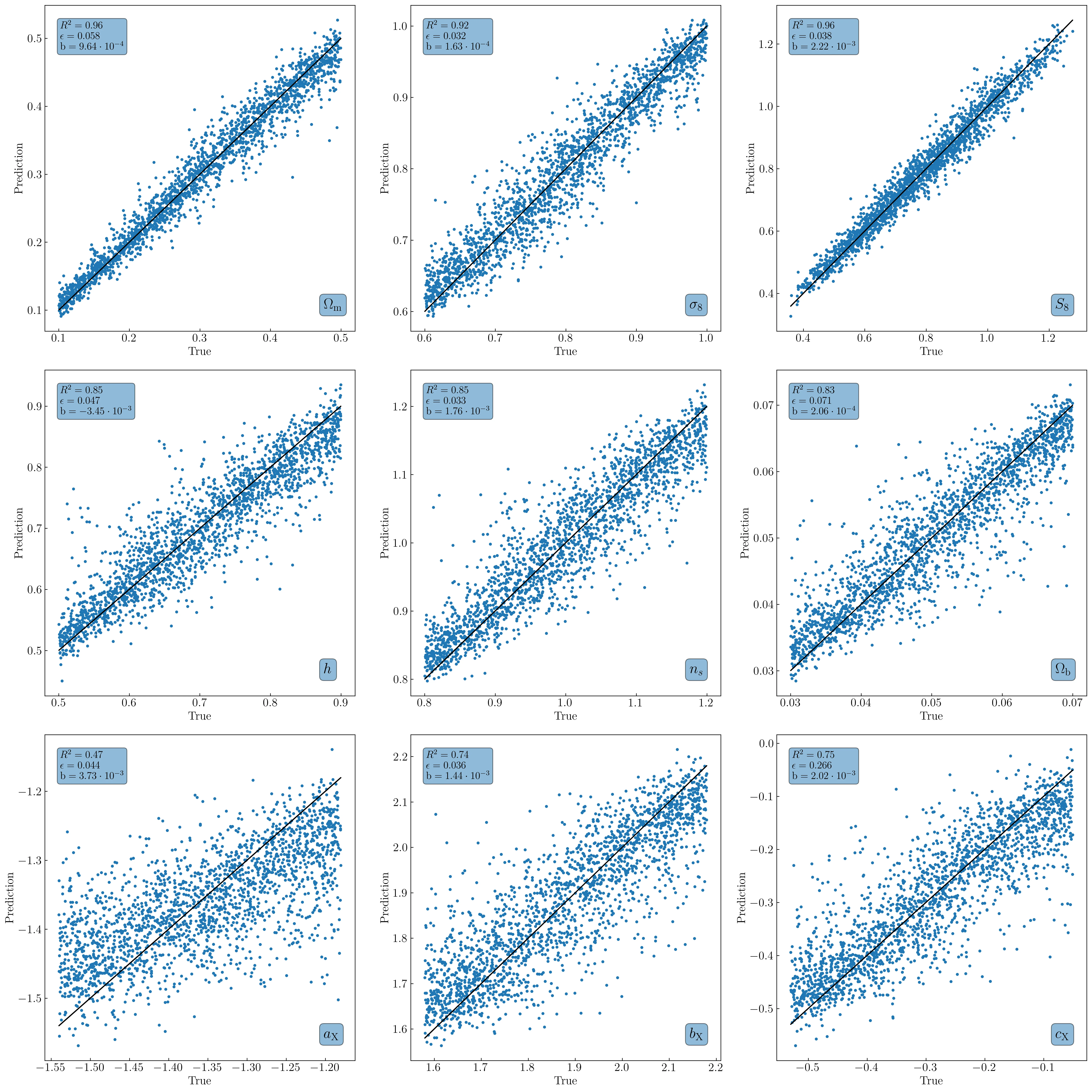
The results are encouraging: the new approach makes ten percent smaller errors in estimating matter density than the old method, and twenty percent smaller errors in estimating clumpiness. If the neural network is also given the brightness of each cluster, accuracy improves by another factor of two. Brightness here is like pea size: it also depends on how much dark matter surrounds it.
In this way, computer universes become a textbook for reading our own. The better the textbook, the more precisely we learn what the cosmos is made of and where it is heading.
Original abstract
as written by the authors arXiv:2601.03894
The possibility to constrain cosmological parameters from galaxy surveys using field-level machine learning methods that bypass traditional summary statistics analyses, depends crucially on our ability to generate simulated training sets. The latter need to be both realistic, as to reproduce the key features of the real data, and produced in large numbers, as to allow us to refine the precision of the training process. The analysis presented in this paper is an attempt to respond to these needs by (a) using clusters of galaxies as tracers of large-scale structure, together with (b) adopting a 3LPT code (Pinocchio) to generate a large training set of $$32\,768$$ mock X-ray cluster catalogues. X-ray luminosities are stochastically assigned to dark matter haloes using an empirical $$M-L_X$$ scaling relation. Using this training set, we test the ability and performances of a 3D convolutional neural network (CNN) to predict the cosmological parameters, based on an input overdensity field derived from the cluster distribution. We perform a comparison with a neural network trained on traditional summary statistics, that is, the abundance of clusters and their power spectrum. Our results show that the field-level analysis combined with the cluster abundance yields a mean absolute relative error on the predicted values of $$\Omega_{\rm m}$$ and $$\sigma_8$$ that is a factor of $$\sim 10 \%$$ and $$\sim 20\%$$ better than that obtained from the summary statistics. Furthermore, when information about the individual luminosity of each cluster is passed to the CNN, the gain in precision exceeds $$50\%$$.
The training set contained 32,768 virtual universes — exactly 2 to the 15th power, a computer's "round" number.