Neural networks have become a cornerstone of modern astrophysics, serving as powerful pattern-recognition tools that sift through vast datasets from telescopes and detectors. They are used to identify subtle signals buried in noise, classify celestial objects, and even map invisible components like dark matter. The titles in the corpus highlight their versatility: from cleaning stellar noise in exoplanet searches to decoding the chemical composition of stars in seconds, and from mapping gravitational lensing to interpreting gravitational wave signals.
History
The application of neural networks to astronomy began in the 1990s, but their widespread adoption accelerated in the 2010s with the rise of deep learning and larger datasets. The specific techniques vary widely, so no single inventor is credited.
How it works
A neural network is trained on labeled examples — for instance, simulated or known signals — to learn the statistical features that distinguish a real event from noise. Once trained, it can process new data rapidly, flagging anomalies or extracting parameters. In astrophysics, this often involves convolutional or recurrent architectures that handle images or time series, and the training data may come from physical models, making the network a fast surrogate for expensive simulations.
In practice
Neural networks are used in real-time gravitational wave detection pipelines, exoplanet candidate vetting, and automated classification of galaxies and supernovae in large sky surveys.
Fun fact
Some neural networks used in astrophysics are trained on simulated data generated by supercomputers, allowing them to recognize patterns that have never been observed directly.
At the end of a massive star's life, its core collapses in a fraction of a second, giving birth to a supernova flash. This cataclysm shakes spacetime itself, emitting gravitational waves — ripples that race across the Universe.
An artist makes a quick charcoal sketch, and the face in the portrait is already recognizable. Astrophysicists face a similar challenge: the spectrum of a star is its individual portrait, revealing temperature, composition, and gravity.
An electron microscope is a giant pipe organ: instead of pipes (electromagnetic lenses, instead of air) a stream of accelerated electrons. It once merely painted mute frescoes of the atomic world, condemning scientists to grueling decipherment.
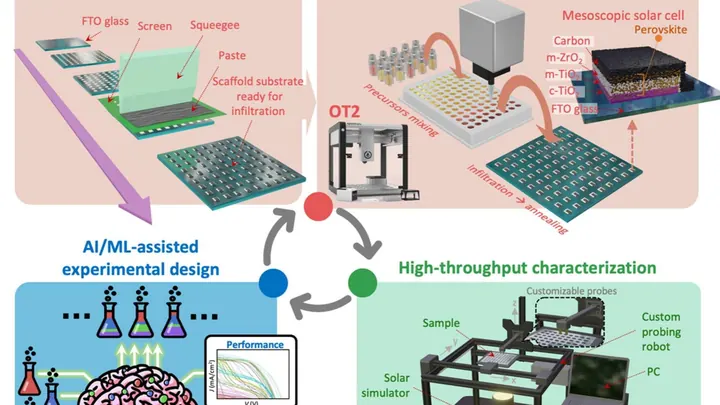
Perovskite crystals harvest sunlight almost as well as silicon, but cost pennies. Their trouble is an inborn fragility: from warmth and ordinary water in the air, they “get sick.” Inside, disorder builds up, and the shiny plate turns cloudy, losing its abilities within a couple of days.
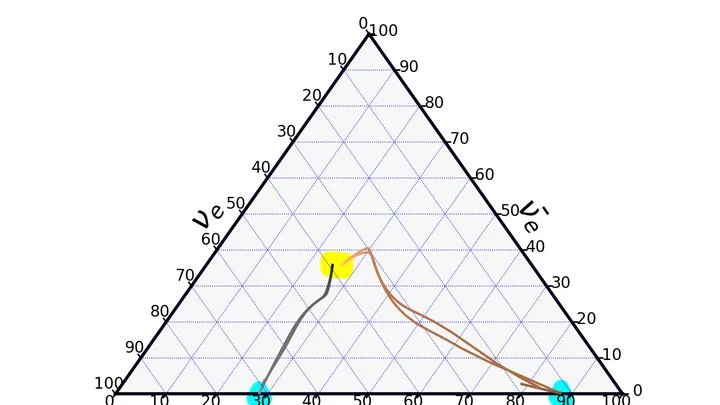
A pot of soup simmering with three ingredients. The chef adjusts the proportions on the fly, and the progress is tracked by the position of a point on a triangular scale. That's roughly how physicists tackle neutrinos from a supernova explosion.
A doctor stares at a gray-white smudge on the screen. It's the face of an unborn child. One shadow in the right place, and you can plan surgery in time. But not everyone sees that shadow: cleft lip or palate is rare, and a young specialist might go years without ever spotting one.
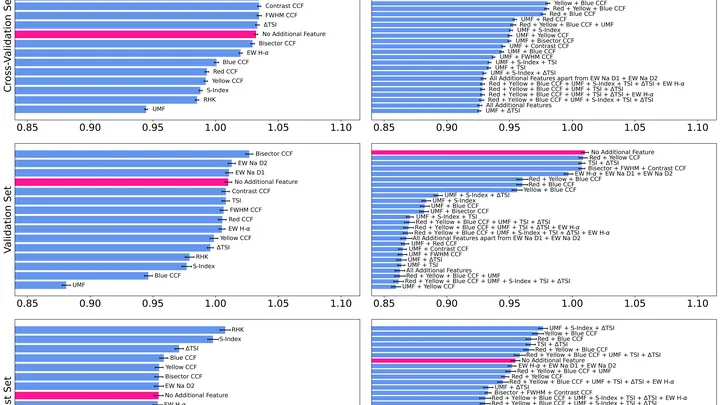
For six straight years, the HARPS-N telescope on La Palma island stared at the Sun as if it were a distant star — taking spectra, tracking brightness, and recording every quiver of spectral lines. All this was to understand how to distinguish a star's subtle sway from a genuine planetary signal.
A star doesn't sit still: its surface boils like a pot of soup.
Cosmic particles with energies millions of times greater than anything our accelerators can produce slam into the atmosphere and create a shower of secondary particles. This shower emits radio waves that antennas on the ground pick up. But the signal is weak: it's swamped by the radio noise of our galaxy and the receivers' own noise.
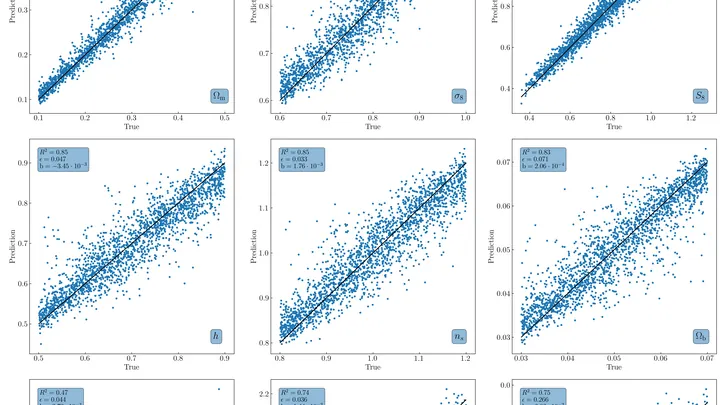
Thousands of universes were born in a computer, all to tell us about our own. Each one has its own galaxy clusters, arranged by the laws of gravity like peas in a jar shaken with varying force. From how the peas settle, you can tell what kind of hand shook the jar.
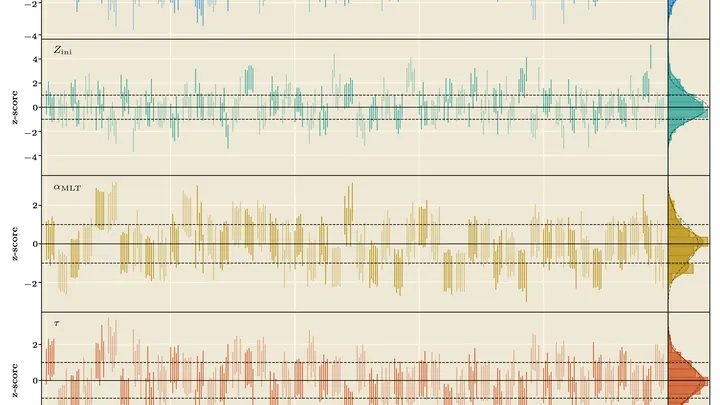
A star trembles like a bell after being struck. These tremors, tiny fluctuations in brightness and surface, can be caught by a telescope. From the frequencies of these 'stellar notes,' astronomers infer what's happening inside: how old the star is, how it's structured.