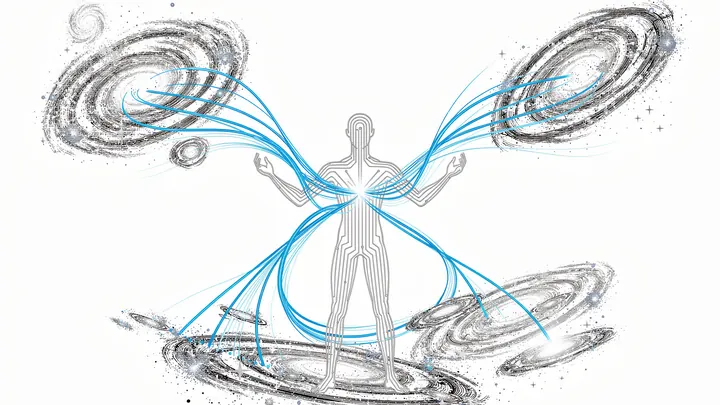
Markov chain Monte Carlo (MCMC) is a computational technique for exploring probability distributions that are too complex to analyze directly. Instead of calculating the distribution exactly, it generates a sequence of random samples that, after enough steps, approximate the distribution. This is invaluable in physics and statistics when estimating parameters of a model from data, such as the cosmological parameters of the universe from observations of the cosmic microwave background.
History
The technique was developed in the 1940s by physicists at Los Alamos, including Stanislaw Ulam and Nicholas Metropolis, for nuclear weapons research, and later generalized by W.K. Hastings in 1970.
How it works
The method combines two ideas: a Markov chain, where each step depends only on the current state, and Monte Carlo sampling, which uses randomness. Starting from an initial guess, the algorithm proposes a new state, then accepts or rejects it based on a rule that ensures the chain converges to the target distribution. Over many iterations, the visited states form a representative sample, from which averages and uncertainties can be computed.
In practice
MCMC is used in cosmology to fit models of the universe to data, in particle physics to extract signal from background, and in machine learning for Bayesian inference.
Fun fact
The name 'Monte Carlo' was coined by Ulam, referencing his uncle's gambling habits in the Monte Carlo Casino, because the method relies on random numbers like a roulette wheel.
Catching light one particle at a time is like hearing a whisper in a roaring factory. An electron-multiplying camera (EMCCD) can do exactly that: it turns a single photon hitting a pixel into an avalanche of electrons that can be measured. These cameras are mounted on telescopes to spot a barely visible planet next to a dazzling star.
Two galaxies (our Milky Way and its satellite, the Large Magellanic Cloud) slowly circle each other. Their gravitational pull stirs the distant outskirts of the Milky Way, like a pebble thrown into a pond makes the water ripple.
Inside a crystal, an invisible ballet unfolds: the magnetic moments of atoms, like dancers, sometimes align in unison, sometimes scatter in antiphase. The choreography is dictated by quantum exchange — music sensitive to the geometry of bonds.
Galaxy clusters are the greatest gravitational ensembles in the Universe. In X-ray glow from hot plasma, the story of cosmic expansion, hidden dark matter, and enigmatic dark energy is encoded.
When a massive star dies, its core collapses, and a supernova explosion occurs. The cataclysm births streams of particles — like ripples from a thrown stone. The first to arrive are swift neutrinos, which pierce the Earth, hardly interacting. Then, hours later, ghost particles with a tiny charge appear.
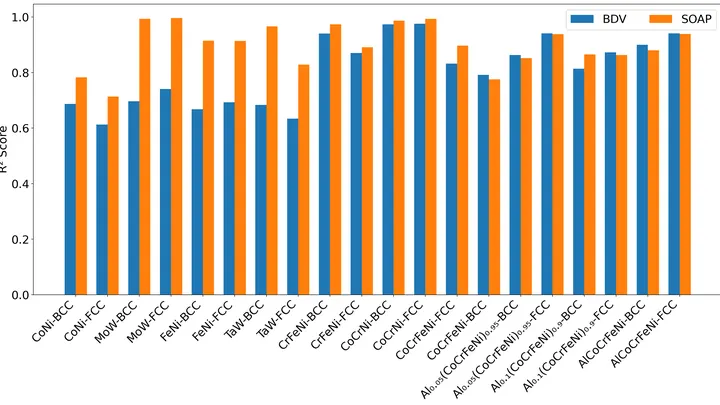
Creating an alloy from several metals is like cooking a soup from mysterious ingredients: guessing the final texture without trial and error is nearly impossible. Conventional models often get it wrong when there are more than three different kinds of atoms.
Pairs of black holes dance in three different styles before merging. The first is a neat waltz: the objects swirl in the same direction, like partners facing the same way. Such pairs are born from binary stars and often have unequal masses. The second is chaotic disco: spins are scattered, masses nearly equal.
A census that only records the distance between houses misses a lot. You can tell where the cities are and where the villages are, but you can't distinguish a skyscraper from a single-family home. That's roughly how astronomers study the universe with the standard two-point correlation function: they count how many pairs of galaxies are separated by a given distance.
A lightning strike splits the sky in a fraction of a second, leaving a branched trail. At the same moment, in a tiny superconducting crystal cooled to near absolute zero, an avalanche of magnetic field rushes through — thin fingers of magnetization piercing the material.
Imagine a factory where hundreds of tiny assembly lines run nonstop. Each line is a molecular motor that converts chemical fuel into motion. To make the motor go faster or in the right direction, an engineer tweaks the settings — the shape of parts, the strength of interactions.
Cosmic rays are particles from deep space, accelerated to colossal energies. Smashing into the atmosphere, they trigger particle showers with radio waves. These waves are fingerprints, revealing the energy and direction of the intruder.
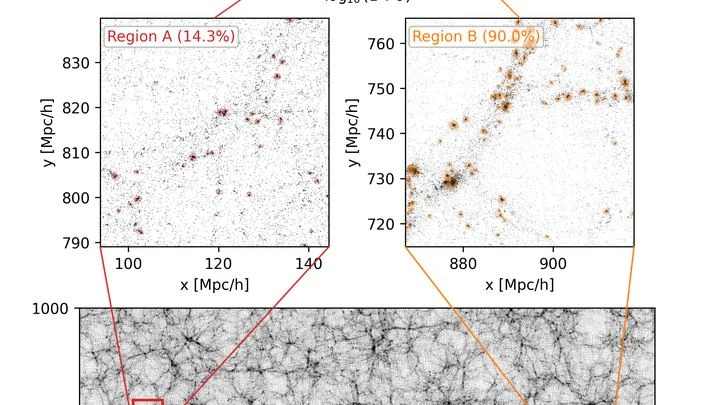
The Universe is vast, and figuring out how galaxies and dark matter are distributed within it is no easy task. Usually, scientists run computer simulations that "play out" the evolution of entire regions of space billions of light-years across. But such calculations demand colossal resources and time.
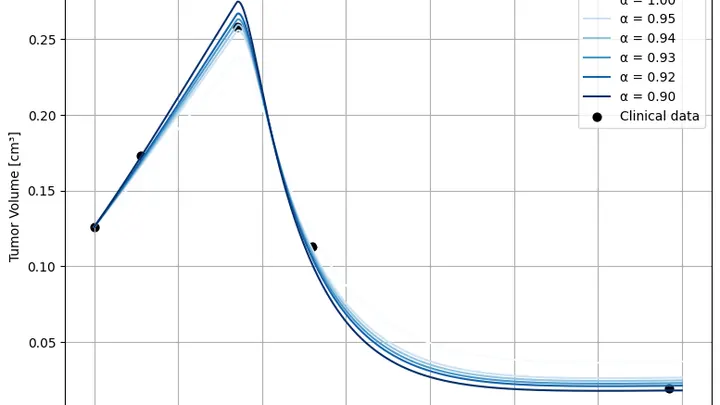
A tumor doesn't grow like a tree; it grows like a city: today's skyline is shaped by yesterday's construction and the fires of the day before. Standard tumor growth equations don't account for this: they only look at the current moment, as if the city were rebuilt from scratch every day. The authors added "memory" to the model: now the equation remembers what came before, and that changes the forecast.
Light born at the moment of the Big Bang has traveled to us for almost 14 billion years. But along the way, it passed through the gravitational fields of galaxies and clumps of dark matter, which bent its rays. To an observer, this looks like an image stretched and smudged by an old window pane.
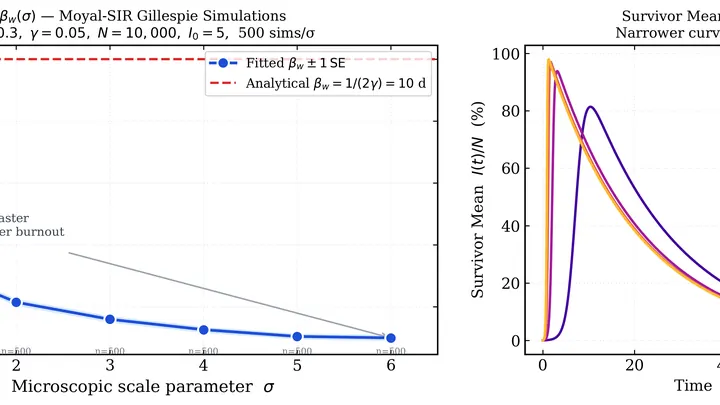
An epidemic is not a steady stream but a series of hits. One carrier may infect no one, while another infects fifty people at once. Such rare but powerful events are called 'dragon kings': they stand out from the overall pattern and determine how severe a disease wave will be.
In the new study, the virus is compared to a billiard ball.
A quantum walk is like a drunk person who turns randomly at every intersection. Except instead of streets, there are graph nodes, and instead of steps, there are quantum transitions. Scientists have discovered that such a walk has a hidden measure — Krylov complexity.
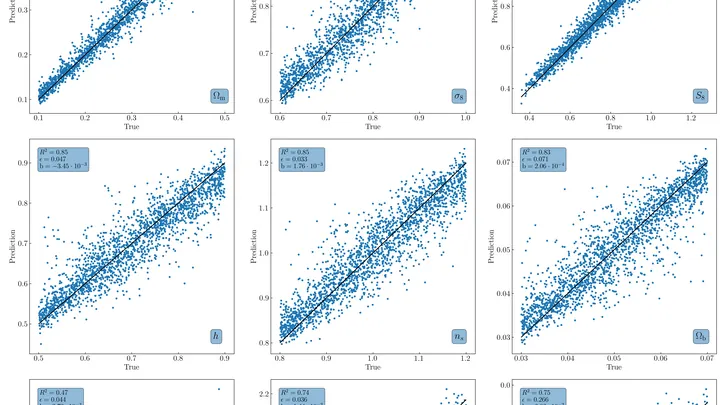
Thousands of universes were born in a computer, all to tell us about our own. Each one has its own galaxy clusters, arranged by the laws of gravity like peas in a jar shaken with varying force. From how the peas settle, you can tell what kind of hand shook the jar.
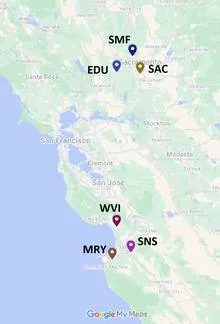
The ocean doesn't always stick to the same schedule. Sometimes the warm El Niño current strengthens, sometimes it weakens, and each regime dictates its own reaction speed to the past. These hidden regimes are like shifts in currents that remember their path with different depths.
A rough sketch of a portrait: a few confident lines define the shape, but the details are not yet refined. That is how a parametric model, such as vector autoregression (VAR), describes a time series: it captures the main structure, but if the real data deviate from its assumptions, the portrait comes out distorted.