Planet's Air: Recipe from a Star express
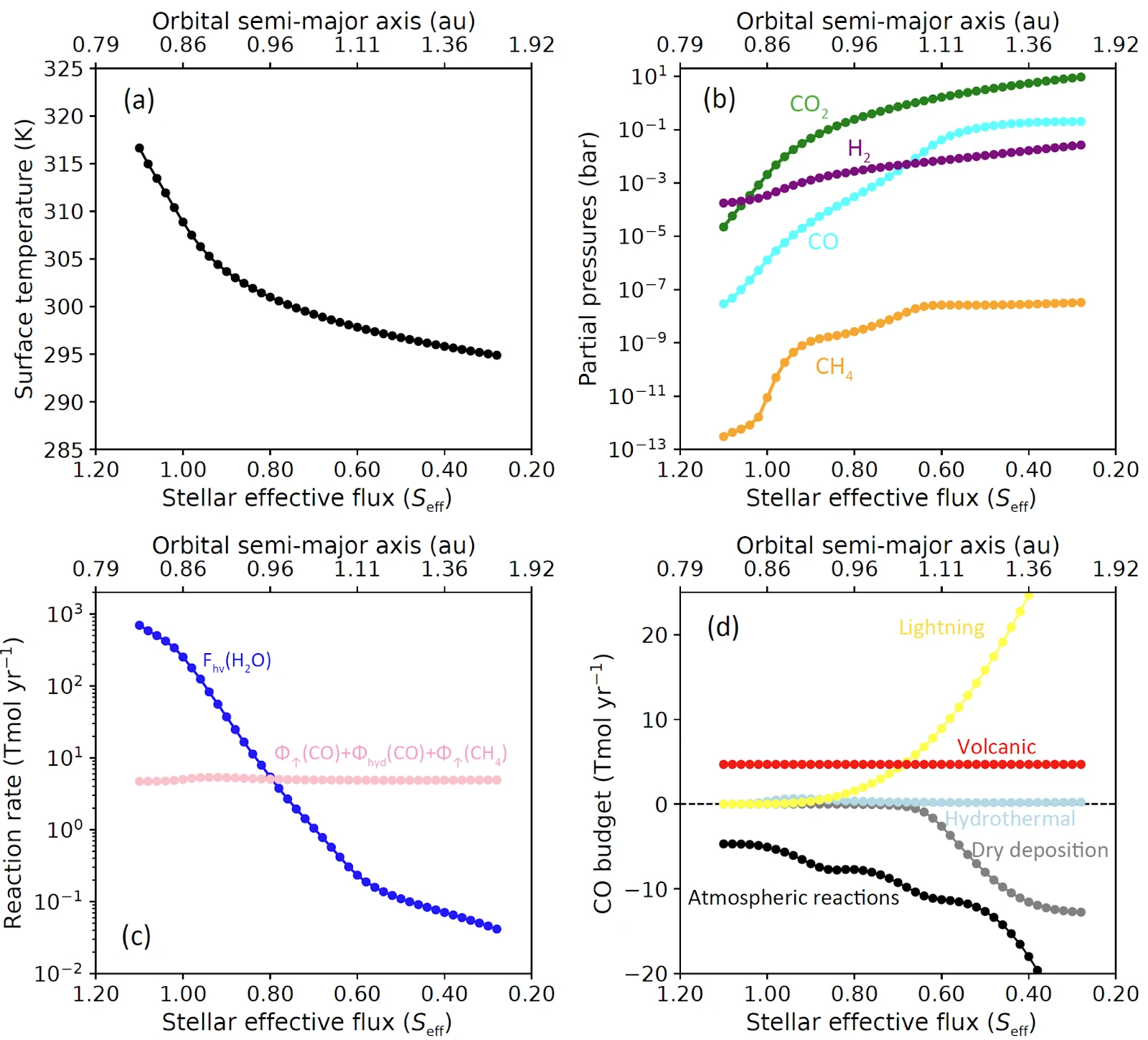
A rocky planet around another star is like a dish in an oven. The star sets the temperature: the farther away, the colder. The mix of gases with carbon in the air — carbon dioxide, carbon monoxide, methane — depends on the heat mode and the star's type (like our Sun or dimmer ones).
Formaldehyde — a building block for sugars and amino acids — is best 'baked' around hot stars, just before the collapse. Telescopes like James Webb will analyze the light of distant worlds and find places where the recipe for life has almost come together.
Original abstract
as written by the authors arXiv:2601.05480v1
The abundances of atmospheric carbon species--carbon dioxide (CO2), carbon monoxide (CO), and methane (CH4)--exert fundamental controls on the climate, redox state, and prebiotic environment of terrestrial planets. As exoplanet atmospheric characterization advances, it is essential to understand how these species are regulated on habitable terrestrial planets across a wide range of stellar and planetary conditions. Here, we develop an integrated numerical model that couples atmospheric chemistry, climate, and the long-term carbon cycle to investigate the atmospheric compositions of lifeless, Earth-like planets orbiting Sun-like (F-, G-, and K-type) stars. Our simulations demonstrate that CO2, CO, and CH4 generally increase with orbital distance, and that planets near the outer edge of the habitable zone may undergo CO runaway--a photochemical instability driven by severe depletion of OH radicals. The threshold for CO runaway depends strongly on stellar spectral type and is most easily triggered around cooler, lower-mass stars. In contrast, the atmospheric production of formaldehyde (H2CO)--a key precursor for prebiotic organic chemistry--peaks around planets orbiting more massive, UV-luminous stars and is maximized at orbital distances just interior to the CO-runaway threshold. These results establish a quantitative framework linking observable system properties--stellar type and orbital distance--and the atmospheric carbon chemistry of lifeless Earth-like planets, providing new context for interpreting future spectroscopic observations and for evaluating the potential of such planets to sustain prebiotic chemistry.
On lifeless planets, carbon monoxide can build up to levels hundreds of times higher than Earth's — all because of the star's light characteristics.