Planet's Air: Recipe from a Star express
Original: "Stellar control on atmospheric carbon chemistry, CO runaway, and organic synthesis on lifeless Earth-like planets"
Gases with carbon in the atmospheres of lifeless planets depend on the star and distance, astronomers have found.
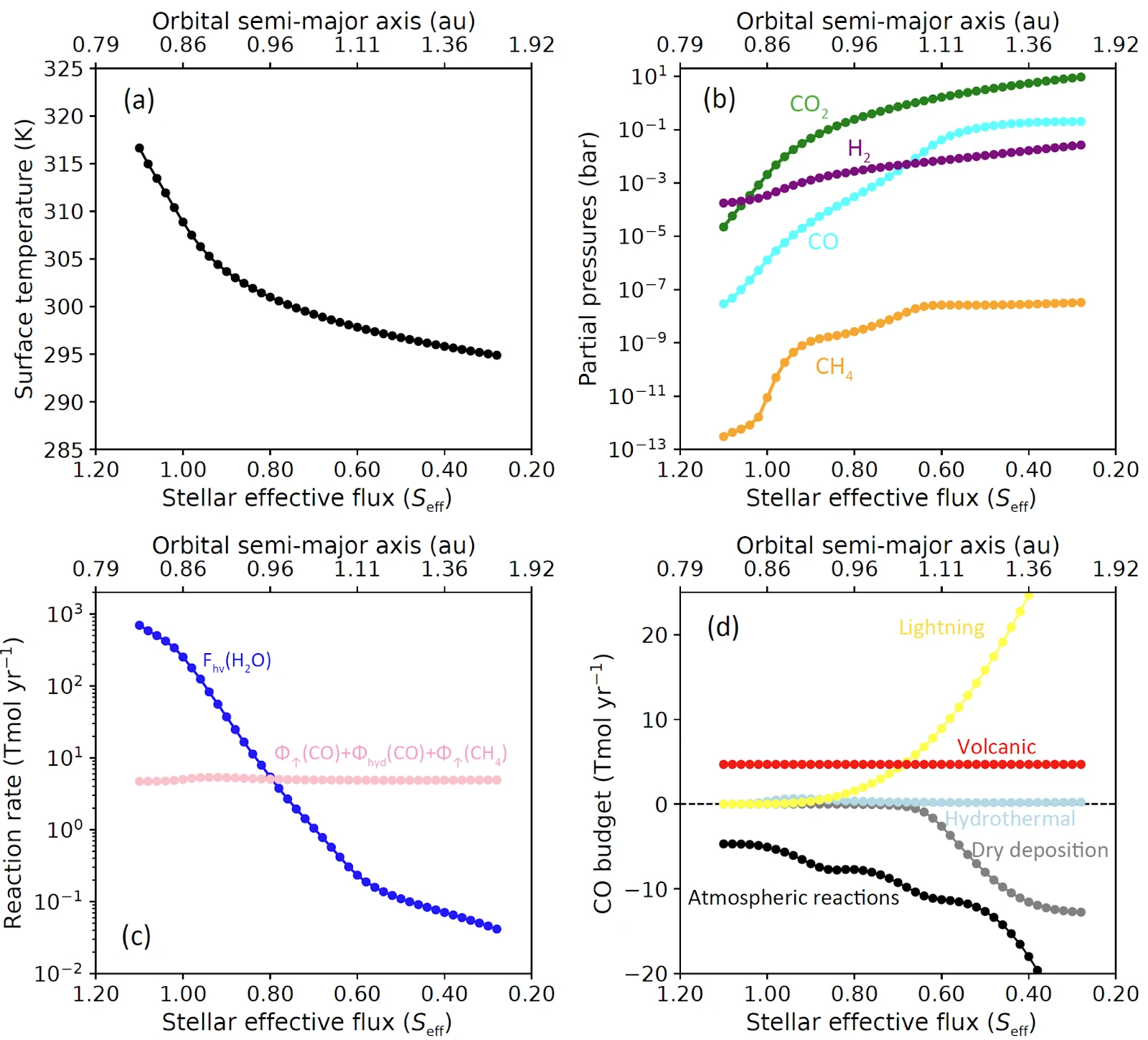
A rocky planet around another star is like a dish in an oven. The star sets the temperature: the farther away, the colder. The mix of gases with carbon in the air — carbon dioxide, carbon monoxide, methane — depends on the heat mode and the star's type (like our Sun or dimmer ones).
At the outer edge of the zone, where the light barely warms, a 'carbon monoxide collapse' occurs. The cleaner molecules OH stop working, and toxic CO floods the air to hundreds of times Earth's level.
Formaldehyde — a building block for sugars and amino acids — is best 'baked' around hot stars, just before the collapse. Telescopes like James Webb will analyze the light of distant worlds and find places where the recipe for life has almost come together.
On lifeless planets, formaldehyde can be millions of times more abundant than in Earth's air. It has no smell, but without it, you can't assemble sugars and amino acids — the foundation of all living things.
On lifeless planets, carbon monoxide can build up to levels hundreds of times higher than Earth's — all because of the star's light characteristics.
Scientists
Ludwig BoltzmannSubrahmanyan ChandrasekharJames JeansCecilia Payne-GaposchkinMichael FaradayHendrik Lorentzcarbon monoxide
carbon dioxide
atmospheric chemistry
planetary composition formation
planetary atmospheric loss
sulfur dioxide
exoplanet atmospheres
terrestrial exoplanet
hydrocarbon
earth
hydrogen atmosphere
gas
stellar chemical abundances
protoplanetary disk chemistry
habitability
methane
nitrogen
habitable zone
rocky planet
methanol