A Crystal That Smells Solvent express
In the air of factory floors and laboratories, invisible solvent molecules drift. One of them, acetonitrile, has a faint smell, but at high concentrations it can harm health. Typical sensors for it are bulky and expensive, but here we have a thin crystalline film that responds on its own to the presence of vapor.
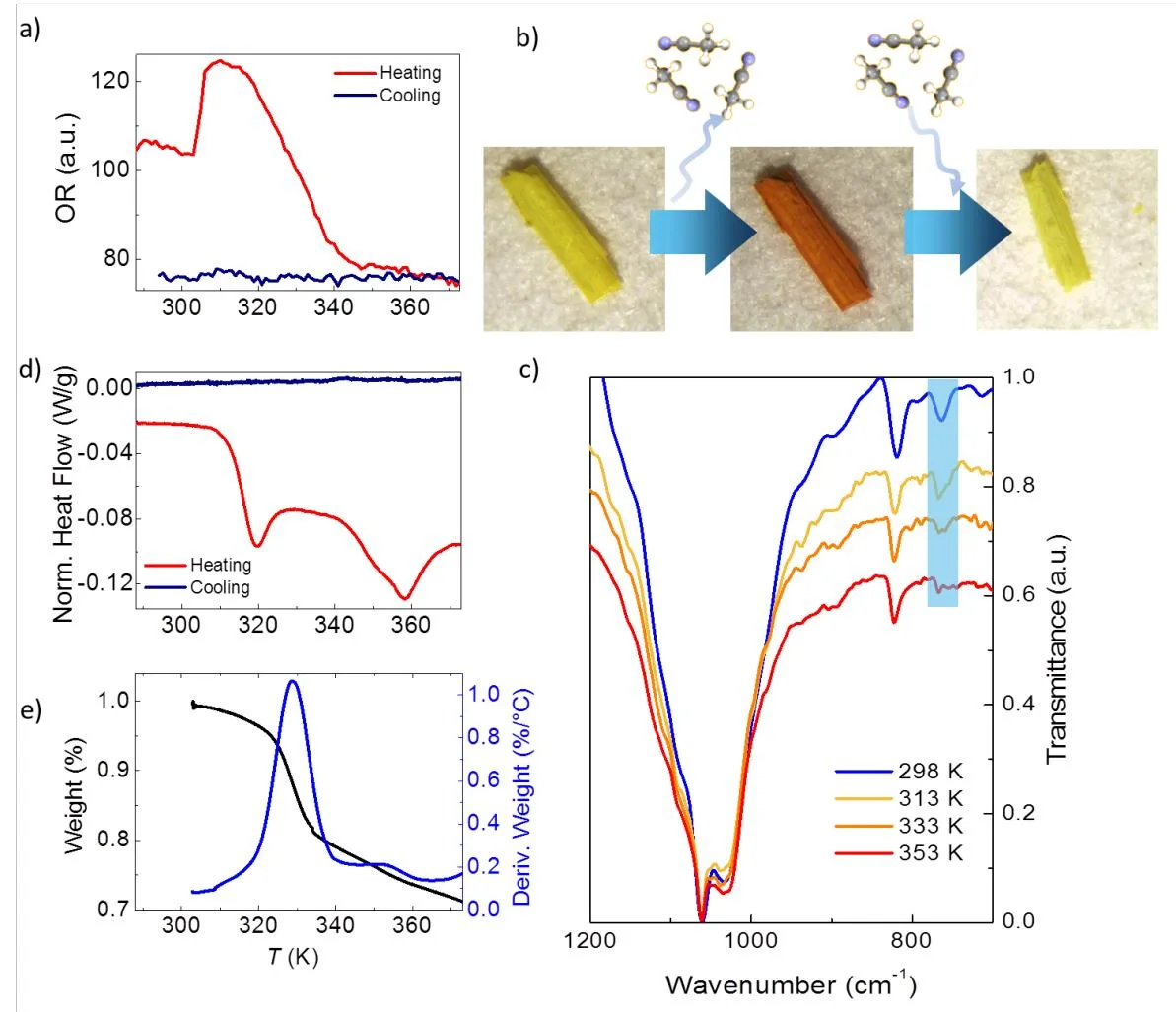
This crystal is no ordinary one; it's made of chains of iron atoms and organic molecules. Between the chains are voids where acetonitrile molecules slip in, like guests squeezing into a cramped entryway. When a "guest" arrives, the chains nudge apart slightly, and the crystal changes color and its ability to conduct electricity. Remove the vapor, the molecules leave, and the crystal reverts to its former self.
This material is a coordination polymer, meaning long chains in which metal atoms are linked by organic "bridges." Its main advantage is reversibility: the cycle of "capture vapor, signal, release vapor — return" repeats many times without degradation. Potentially, the same approach could detect other volatile organic compounds by simply tweaking the composition of the "entryway."
Original abstract
as written by the authors arXiv:2601.09370
Efficient detection of harmful organic volatile compounds is a major health and environmental need in industrialized societies. Tailor-made metal-organic frameworks and other coordination polymers are emerging as promising sensing molecular materials thanks to their responsivity to a wide variety of external stimuli, and could be used to complement conventional sensors. Here, a non-porous crystalline 1D Fe(II) coordination polymer acting as a porous acetonitrile host is presented. The desorption of interstitial acetonitrile is accompanied by magneto-structural transitions easily detectable in the optical and electronic properties of the material. The structural switch and therefore its (opto)electronic readout are reversible under exposition of the crystal to acetonitrile vapor. Coordination polymers can be versatile sensors for volatile acetonitrile and potentially other organic compounds.
Acetonitrile is used in pharmaceutical manufacturing and laboratories, and its vapor at high concentrations causes headaches and nausea. So a fast, inexpensive sensor isn't a luxury: it's a safety essential.