A molecularquantum system is a collection of molecules whose quantum properties — such as energy levels, spins, or vibrational states — are harnessed for a specific purpose, often in sensing or quantum information processing. In the context of dark matter detection, certain molecules can act as sensitive probes: their rotational or spin states can be perturbed by passing dark matter particles, and this perturbation can be read out as a signal. More broadly, molecular quantum systems are being explored for quantum computing, precision measurements, and simulating complex quantum phenomena.
History
The use of molecules as quantum sensors emerged in the 2000s, building on decades of work in molecular spectroscopy and laser cooling. The specific proposal to use molecular quantum systems for dark matter detection was advanced in the 2010s, as part of a broader effort to find new ways to probe the elusive particle.
How it works
Molecules offer a rich set of internal degrees of freedom — electronic, vibrational, and rotational — that can be controlled with lasers and electromagnetic fields. For dark matter detection, the idea is to use molecules with a permanent electric or magnetic dipole moment, which couples to the weak interactions of dark matter particles. When a dark matter particle scatters off a molecule, it can change the molecule's rotational state or spin orientation, and this change can be detected via spectroscopy. In quantum sensing, molecules can be prepared in superposition states that are exquisitely sensitive to external fields, allowing measurements of magnetic fields, electric fields, or even forces at the quantum limit.
In practice
Molecularquantum systems are used in atomic clocks, magnetometers for medical imaging (like magnetoencephalography), and in the search for dark matter, where they offer a complementary approach to traditional detectors.
Fun fact
Some molecularquantum systems can be used to create 'quantum batteries' — devices that store energy in the quantum states of molecules, potentially charging faster than classical batteries.
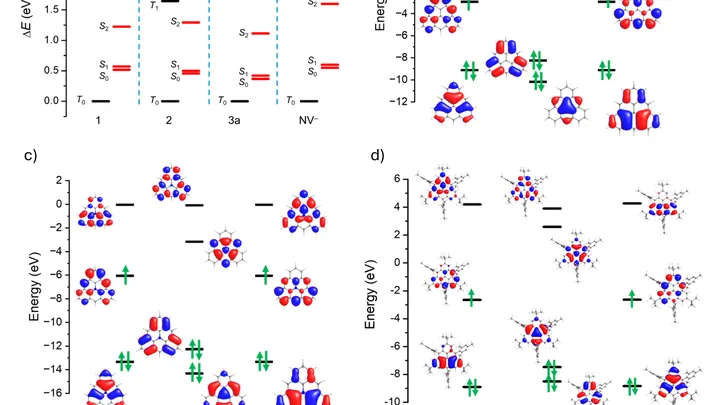
At the heart of a future quantum computer might lie a tiny organic molecule shaped like a triangle. It has two 'extra' electrons that don't pair up. Such molecules are called diradicals, and their electrons can store information in a special, quantum way.
Drop two pebbles into a pond at the same time — the ripples will spread evenly and in sync. The same happens in a quantum interferometer: a particle is split into two waves that travel along different paths and then meet. Ideally, their crests align.
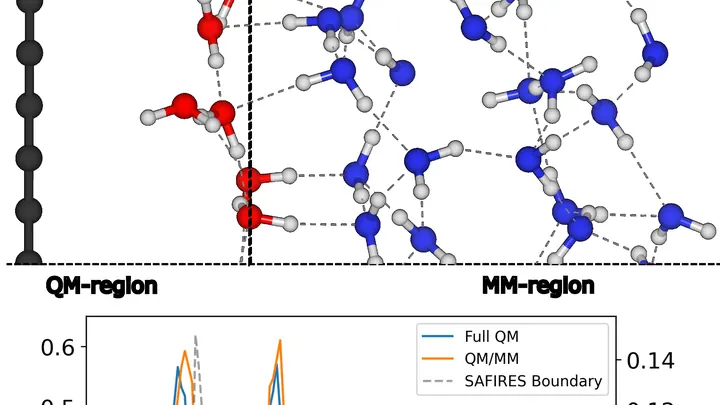
Imagine a huge swimming pool. In one corner, a chemical reaction is underway that needs to be calculated with jeweler-like precision. But the surrounding water is not just decoration: its molecules jostle, attract, and influence the reaction. How do you account for this endless dance of particles without drowning in calculations?
A fridge magnet attracts a paperclip: we can feel that field with our hands. Now shrink that field by a billion times. Atoms inside our bodies emit such weak signals, and they are very hard to catch.
Scientists built the sensor from special molecules that themselves behave like tiny magnets.
Magnetic fields are all around us, from the compass in your phone to the MRI machine at the hospital. To measure them with high precision, you need special materials that respond to the slightest changes in the field. One such material is molecular crystals, where electron spins, think of them as tiny tops, can hold their state for a long time.
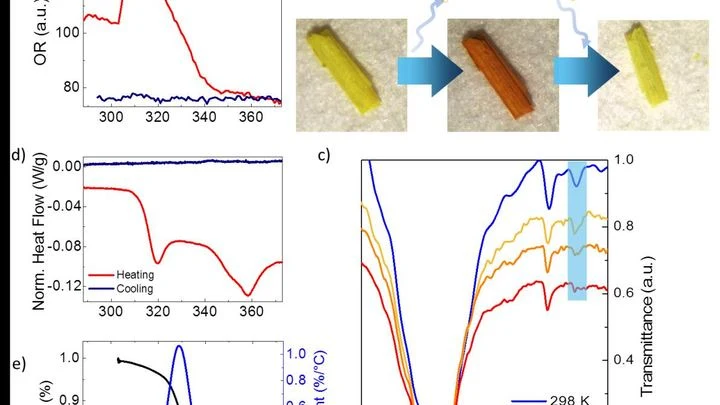
In the air of factory floors and laboratories, invisible solvent molecules drift. One of them, acetonitrile, has a faint smell, but at high concentrations it can harm health. Typical sensors for it are bulky and expensive, but here we have a thin crystalline film that responds on its own to the presence of vapor.
Dark matter is invisible, but according to calculations, it holds galaxies together. Catching its particles is like hearing a whisper in a noisy room. You need a material that responds loudly and noticeably to the slightest nudge.
Molecular magnets could be such a material — substances where each molecule acts as an independent tiny magnet.