Light Trapped in a Wire express
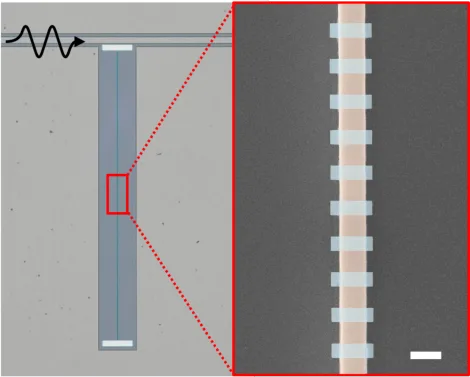
An ordinary wire at high frequencies is like a road full of potholes: the signal jumps, and some energy is lost as heat. A superconducting chain made of aluminum and indium arsenide (a semiconductor) turned out to be a smooth highway for microwaves.
The chain consists of many identical links — Josephson junctions, where current flows without resistance thanks to quantum pairs of electrons. Such a structure stores magnetic energy like a spring and passes the signal almost without distortion up to 12 GHz — higher than most counterparts.
But every silver lining has a cloud: as frequency increases, losses grow. The authors describe this with a simple model: part of the energy goes into heating the contacts, and the faster the oscillations, the greater the losses. Possibly, the contact material itself (superconductor-semiconductor) contributes.
Such chains are needed for quantum computers: they store information in the form of microwave photons, preventing them from 'escaping.' The lower the losses, the longer the quantum state lives.
Original abstract
as written by the authors arXiv:2601.10023
We report microwave spectroscopy of Josephson junctions chains made from an epitaxial Al/InAs heterostructure. The chains exhibit superinductance, with characteristic wave impedance exceeding $$R_{Q} = \hbar/(2e)^{2}$$. The planar nature of the junctions results in a large plasma frequency, with no measurable deviations from ideal dispersion up to $$12~\mathrm{GHz}$$. Internal quality factors decrease sharply with frequency, which we describe with a simple loss model. The possibility of a loss mechanism intrinsic to the superconductor-semiconductor junction is considered.
A Josephson junction is two superconductors with a thin layer of insulator or semiconductor in between. Cooper pairs tunnel through it, and the junction behaves like an inductor, but a quantum one.