Light Trapped in a Wire express
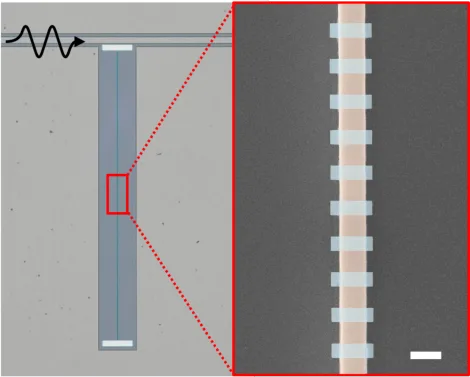
An ordinary wire at high frequencies is like a road full of potholes: the signal jumps, and some energy is lost as heat. A superconducting chain made of aluminum and indium arsenide (a semiconductor) turned out to be a smooth highway for microwaves.
The chain consists of many identical links — Josephson junctions, where current flows without resistance thanks to quantum pairs of electrons. Such a structure stores magnetic energy like a spring and passes the signal almost without distortion up to 12 GHz — higher than most counterparts.
But every silver lining has a cloud: as frequency increases, losses grow. The authors describe this with a simple model: part of the energy goes into heating the contacts, and the faster the oscillations, the greater the losses. Possibly, the contact material itself (superconductor-semiconductor) contributes.
Such chains are needed for quantum computers: they store information in the form of microwave photons, preventing them from 'escaping.' The lower the losses, the longer the quantum state lives.
A Josephson junction is two superconductors with a thin layer of insulator or semiconductor in between. Cooper pairs tunnel through it, and the junction behaves like an inductor, but a quantum one.