A Thread Thinner Than a Hair Holds 87 Grams express
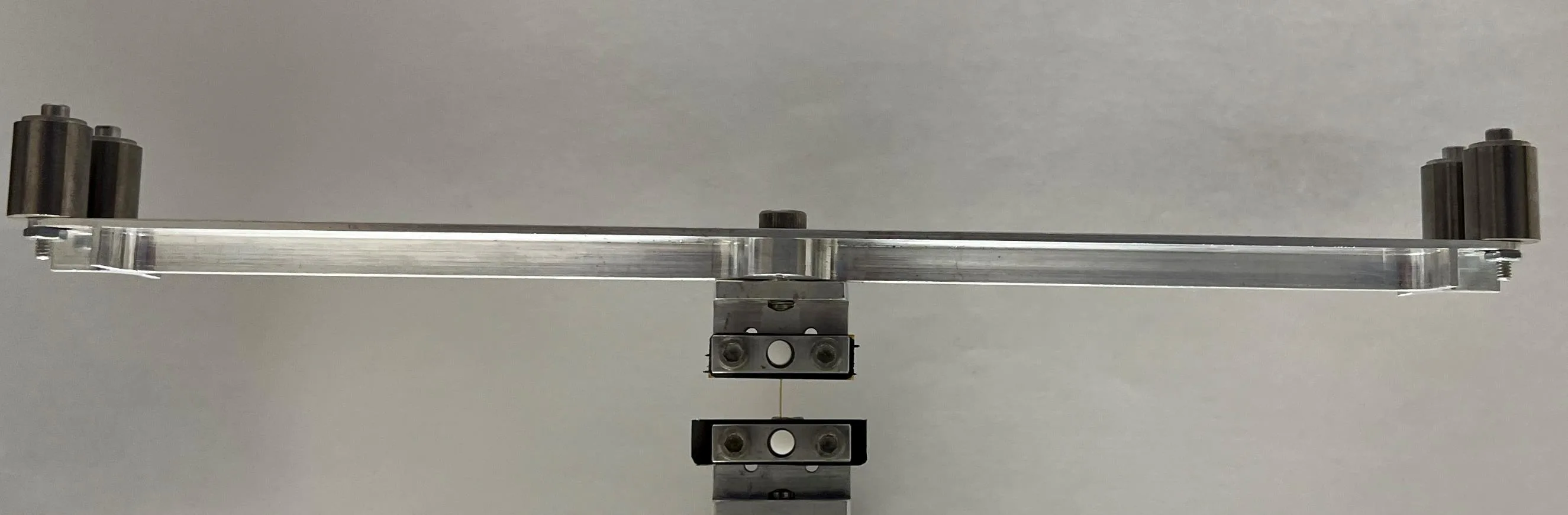
A weight about the size of a small apple hangs from a thread hundreds of times thinner than a human hair. The thread doesn't snap and barely interferes with the weight's swinging. This setup is the heart of a new lab scale for measuring gravitational attraction.
Ordinary gravity scales suffer from jitter: heat makes their parts vibrate, and precision drops. Here, the thread is made of silicon nitride, a material that dampens unwanted oscillations. The weight swings on the thread like a pendulum, and its motion depends only on the attraction of nearby objects.
Such a scale sits on a table to measure how two bodies attract each other. If made sensitive enough, it could pick up quantum effects of gravity — something currently seen only in science fiction. For now, this is a first step: the largest silicon nitride thread that holds such a load while barely hindering its swing.
Original abstract
as written by the authors arXiv:2601.11366
Measurement of mutual gravitation on laboratory scales is an outstanding challenge and a prerequisite to probing theories of quantum gravity. A leading technology in tabletop gravity experiments is the torsion balance, with limitations due to thermal decoherence. Recent demonstrations of lithographically defined suspensions in thin-film silicon nitride with macroscale test masses suggest a path forward, as torsion pendulums dominated by gravitational stiffness may achieve higher mechanical quality factors through dilution of material losses. Here we demonstrate a 250 micron by 5 mm by 1.8 micron torsion fiber supporting 87 grams and forming a Cavendish-style torsion pendulum with tungsten test masses that -- to our knowledge -- is the largest thin-film silicon-nitride-based oscillator to date. Torsion pendulums with thin-film, nanofabricated suspensions provide a test bed for near-term tabletop experiments probing classical and quantum gravitational interaction between oscillators.
The thread in this scale is 50 times thinner than a human hair, yet it can support the weight of a small apple.