Nanomaterials are materials whose structural units — grains, layers, pores, or other features — are measured in nanometers, typically below 100 nanometers. At this scale, the surface-to-volume ratio becomes enormous, and quantum effects start to dominate, giving rise to properties that differ dramatically from the same material in bulk form. For example, gold nanoparticles melt at lower temperatures than bulk gold, and carbon nanotubes are stronger than steel while being far lighter.
History
The concept emerged gradually in the 1980s, popularized by physicist Richard Feynman's 1959 talk 'There's Plenty of Room at the Bottom,' but the term 'nanomaterial' came into common use in the 1990s with the advent of scanning probe microscopy and the discovery of fullerenes and carbon nanotubes.
How it works
The key mechanism is that at the nanoscale, a large fraction of atoms reside on surfaces or interfaces, where their bonding environment is different from the interior. This alters thermal, electrical, and mechanical behavior. Additionally, quantum confinement — when electron wavelengths become comparable to the material's dimensions — changes the electronic band structure, affecting optical and conductive properties.
In practice
Nanomaterials are used in electronics (transistors, memory), medicine (drug delivery, imaging), energy (batteries, solar cells), and consumer products (sunscreens, coatings).
Fun fact
A single gram of nanomaterial can have a surface area larger than a tennis court.
Table salt makes food taste better in the kitchen, but in the lab it helps grow crystals just a few atoms thick. Scientists took tin selenide and, with the help of salt, grew ultra-thin flakes from it, so thin they're called two-dimensional. The salt acted as a separator: it kept the flakes from clumping together and made them lie flat on the substrate, like pancakes on a griddle.
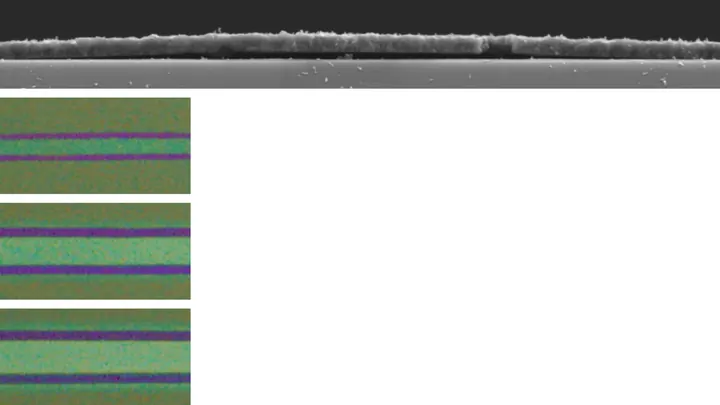
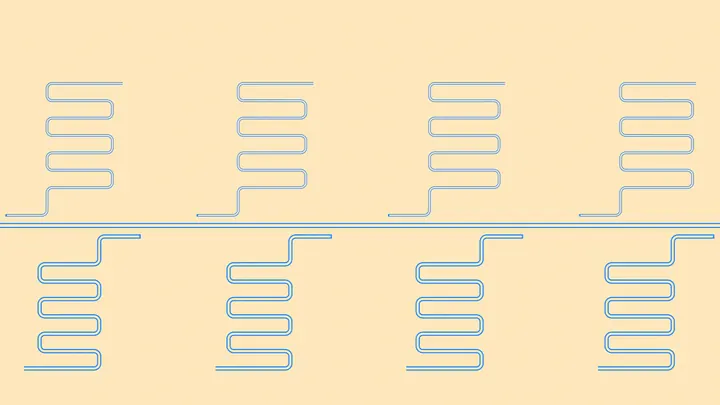
Conventional photolithography, used to make chips, hits a fundamental limit: light cannot draw features smaller than its wavelength. Here, they took a different route. First, they made sparse vertical ridges of oxide, then deposited layers of aluminum oxide, each one atom thick, onto them.
In a narrow gap between two plates, water from humid air collects on its own: this is capillary condensation. If the gap is only a few nanometers wide, water no longer behaves like a continuous liquid: every molecule counts.
Bismuth is a metal used to make low-melting alloys and additives to steel. But when you sputter it onto a substrate in a very thin layer, its behavior depends on how cold the substrate is. Physicists compared two methods: one at ordinary room temperature, the other at liquid nitrogen temperature, about −196 °C.
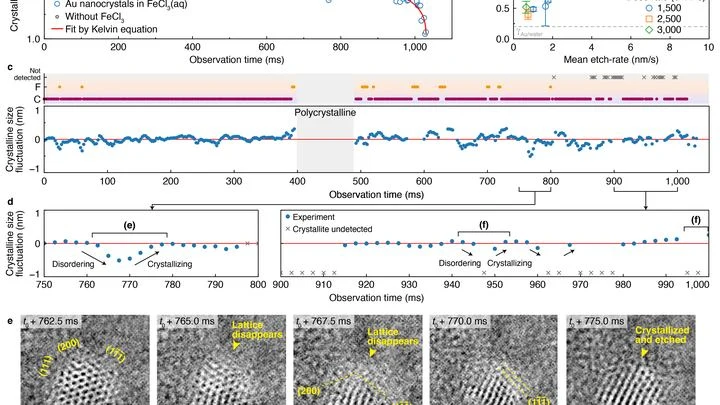
Gold nanoparticles in liquid are like tiny living creatures: they constantly change their internal structure, as if breathing. Scientists managed to peek into this process using an electron microscope that takes snapshots every millisecond, and a neural network that cleans the images from noise.
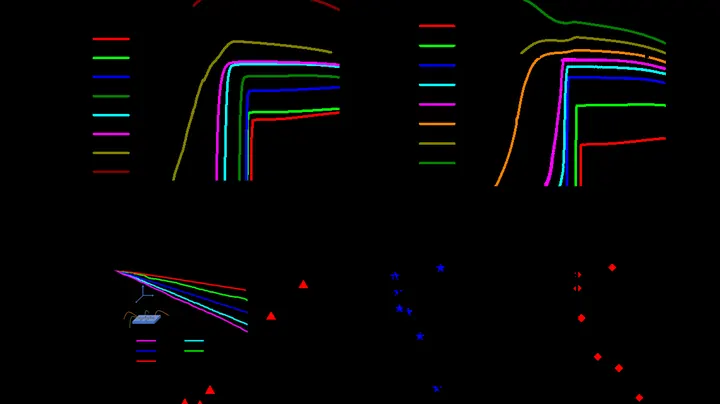
A thin film of niobium and tin conducts electricity without resistance — until you make it really thin. Then it suddenly becomes an insulator. A team of physicists tested what happens when you add a bit more tin to the film than the formula calls for.
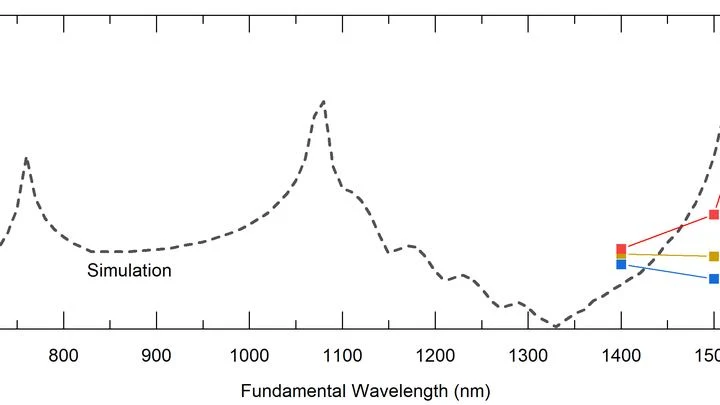
An ordinary piece of semiconductor weakly changes the color of light passing through it. For decades, physicists worked around this limitation by placing the crystal in clever surroundings, but the material itself remained the same.
Now researchers have assembled a "sandwich" of alternating thin layers of gallium arsenide and aluminum gallium arsenide.
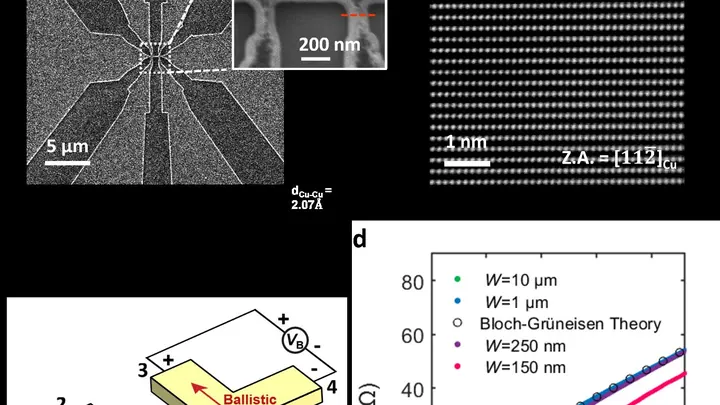
An electron in a metal is usually like a person in rush hour: it constantly bumps into others and loses its way. But if you remove the obstacles, it can fly in a straight line, like a car on an empty night highway. This kind of motion is called ballistic — from the word "ballista," an ancient catapult that hurled a stone without interference.
A laser beam passes through glass and touches a thin diamond film. At the point of contact, the film turns into a narrow strip that lifts slightly. We place a second strip next to it, and between them remains an empty corridor. That's the channel: its width can be fifty times its height, like a sheet of paper lying on a table.
An ordinary rubber pad dampens vibration the way a thick blanket muffles sound: the thicker and heavier, the better. Engineers have long dreamed of a material that is light yet "eats" oscillations as well as a massive damper.
Tiny particles, smaller than a hundredth of the thickness of a human hair, can be magnets that don't lose their strength even at 600 degrees Celsius. These particular particles were made from a nickel-iron-aluminum alloy. The alloy has been known for a long time, but in nanoparticle form it was produced without templates — simply by mixing solutions of metal salts.
A tiny vanadium oxide particle behaves like a window with adjustable transparency: in one state it lets infrared light through, and in another it starts absorbing it. The switch doesn't happen abruptly but smoothly, like turning a dimmer knob to adjust a lamp's brightness.
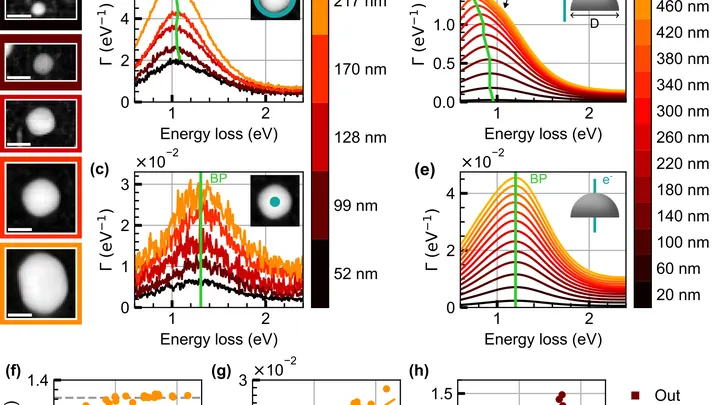
Tiny particles that look like flowers can do two things at once: heat up and tell you how hot they are. This isn't science fiction: it's the result of working with nanoparticles made of cobalt ferrite, a magnetic material that responds to magnetic fields.
A crystal one atom thick is like a sheet of paper you can write on with electricity. Such a material promises to become the foundation for tiny, fast microchips. But before putting it into production, you need to know exactly what it's made of. And that's where the usual formula falls apart.
A tiny crystal flake rests on a substrate like an autumn leaf on a palm. It's thinner than a human hair, yet inside it quantum effects are simmering: superconductivity, magnetic order, quantum spin liquid.
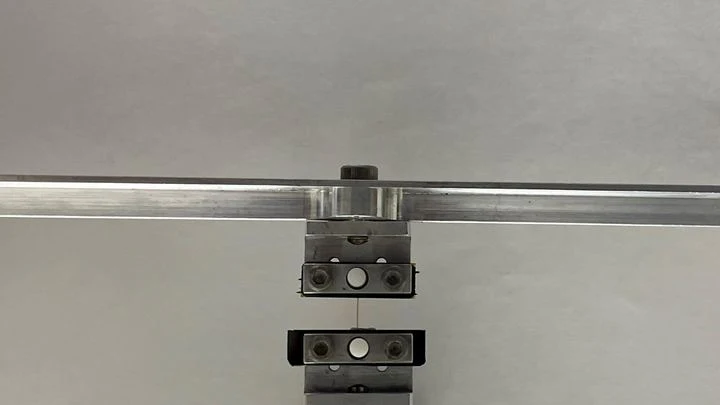
A weight about the size of a small apple hangs from a thread hundreds of times thinner than a human hair. The thread doesn't snap and barely interferes with the weight's swinging. This setup is the heart of a new lab scale for measuring gravitational attraction.
The temperature in a room drops by a few degrees while the refrigerator runs without a single moving compressor. Inside, there is no Freon, but a piece of metal that is alternately magnetized and demagnetized.