Quantum gravity probes are experimental setups that use quantum systems — such as atoms, photons, or even macroscopic superpositions — to test how gravity behaves at the quantum scale. While gravity is well described by general relativity for large objects, its interaction with quantum particles remains untested territory. The core question is whether the equivalence principle — the idea that all objects fall the same way regardless of their composition — holds for quantum superpositions, and whether gravity itself must be quantized. These probes aim to catch the first deviations from classical gravity that would signal a deeper quantum theory.
History
The idea of testing gravity with quantum systems dates back to the 1970s, with the first atom interferometry experiments in the 1990s. The concept of using entanglement to probe quantum gravity was proposed in the 2010s, and current experiments are just reaching the required sensitivities.
How it works
A typical probe involves atoms in a state of superposition, where a single atom exists in two places at once. By letting these two 'branches' evolve under gravity and then recombining them, physicists can measure tiny phase shifts caused by gravitational potential differences — this is the basis of atom interferometry. More ambitious proposals involve creating entanglement between two masses purely through gravitational interaction, which would prove that gravity is quantum. Other approaches use photons: sending light through a gravitational field and looking for quantum correlations, or observing how the shadow of a black hole deviates from classical predictions. Each experiment pushes the sensitivity to gravitational effects on quantum systems, testing the universality of free fall at the quantum level.
In practice
Quantum gravity probes are primarily research tools, but the ultra-precise atom interferometers they use also serve as next-generation sensors for measuring gravitational fields, with applications in geodesy and inertial navigation.
Fun fact
A single rubidium atom in a superposition of two heights falls at exactly the same rate as a macroscopic object — a fact that has been verified to a precision of one part in a hundred million.
Two tiny diamonds float in a vacuum, separated by a distance that light cannot cross during the experiment. Inside each, like a frozen spark, resides an entangled spin — a quantum state linking them into a single whole. Now the diamonds begin to move, but not just any motion: each one seems to split, existing in two places at once.
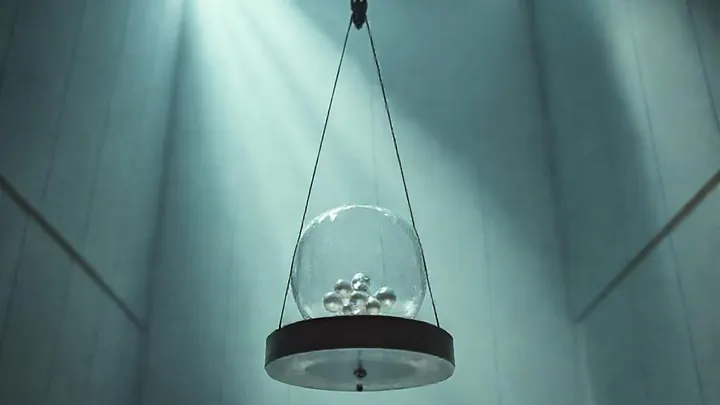
Ultra-sensitive scales try to detect the difference between two nearly identical grains of sand. One is a perfect mirror reflection of the other. In the world of elementary particles, such mirror reflection is called P-parity, and its violation is one of the great mysteries of physics.
The shadow of a black hole is not just a silhouette. It's the edge of the abyss, where space and time are twisted so tightly that even light is forced to swirl like a wood chip in a whirlpool. This 'cosmic whirlpool' arises from the monstrous mass warping spacetime.
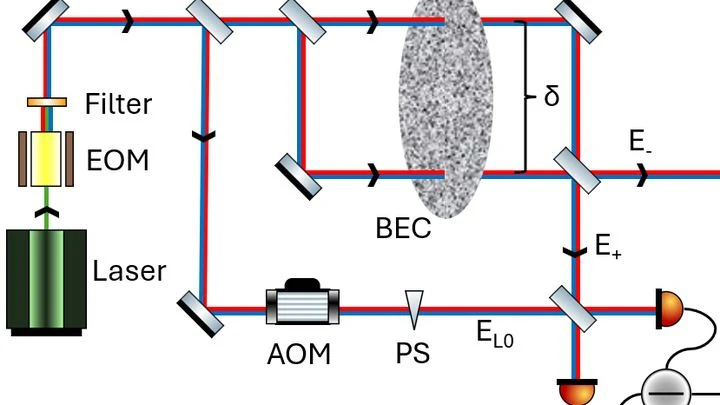
Physicists have proposed an experiment: a laser beam acts as a quantum detector and splits into two beam-ears. Each ear is directed through a tiny cloud of ultracold atoms — in this state, atoms merge into a single wave.
An ice cube in a glass of water doesn't just float: it gets pushed. Water molecules bombard it from all sides, and this bombardment gives rise to a force you can measure. In physics, there's a similar force, but it acts not on ice but on anything with mass, and it arises not from molecular jostling but from information. It's called entropic force.
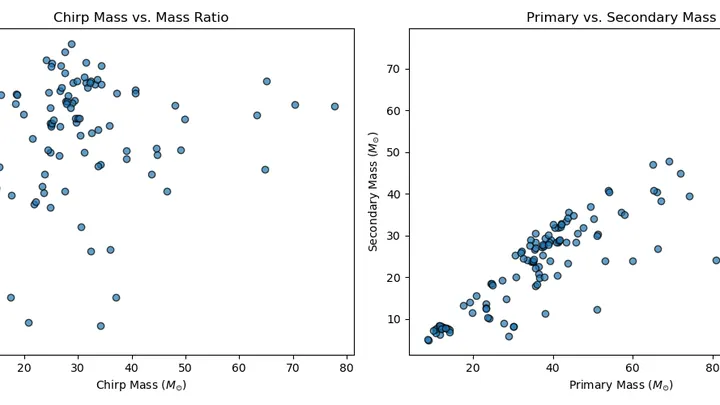
The symphony plays, but a barely perceptible wrong note has crept into the score. This is roughly how physicists search for deviations from general relativity in the 'sounds' of the universe — gravitational waves from merging black holes.
Light bends around massive bodies: this has been known since Einstein's time. But what if gravity itself is not a smooth fabric of space but a stream of tiny carrier particles? Then a beam passing near a particle should not just bend but enter into a special quantum relationship with it.
This relationship is called entanglement.
A stone falls into a pond, and ripples spread in all directions. In much the same way, a massive body creates ripples in spacetime. Only it's not water that oscillates, but the very fabric of reality, and instead of circles, there are gravitational waves.
Galileo, legend has it, dropped balls from the Tower of Pisa to prove that heavy and light objects fall equally. This law formed the foundation of Einstein's theory of gravity. Today, scientists have turned an entire space station into such a tower.
A spring scale in a geologist's backpack responds sensitively to every mountain and valley beneath their feet. But springs get tired, and their readings drift — the instrument needs frequent recalibration against a reference. An atomic gravimeter measures gravity flawlessly, but it's the size of a refrigerator and doesn't like being jostled.
Since the days of Galileo, it was believed that in a vacuum all bodies fall identically. Einstein elevated this to a principle: gravity travels at the speed of light and is the curvature of spacetime.
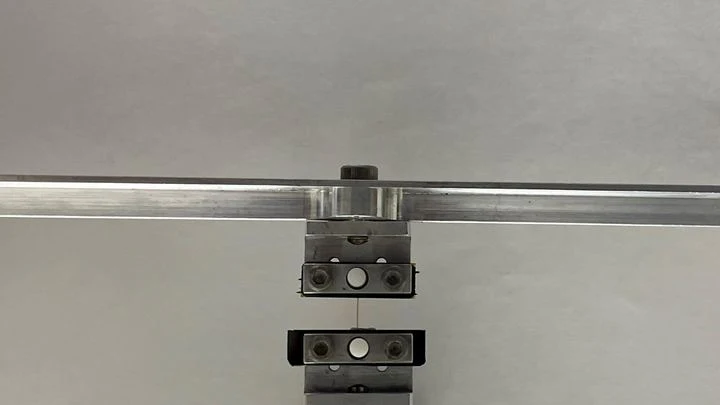
A weight about the size of a small apple hangs from a thread hundreds of times thinner than a human hair. The thread doesn't snap and barely interferes with the weight's swinging. This setup is the heart of a new lab scale for measuring gravitational attraction.
All bodies fall the same: this was first observed by Galileo. Einstein elevated the observation to the equivalence principle: gravity and acceleration are indistinguishable, giving birth to curved spacetime.