The Layer That Blocks Heat express
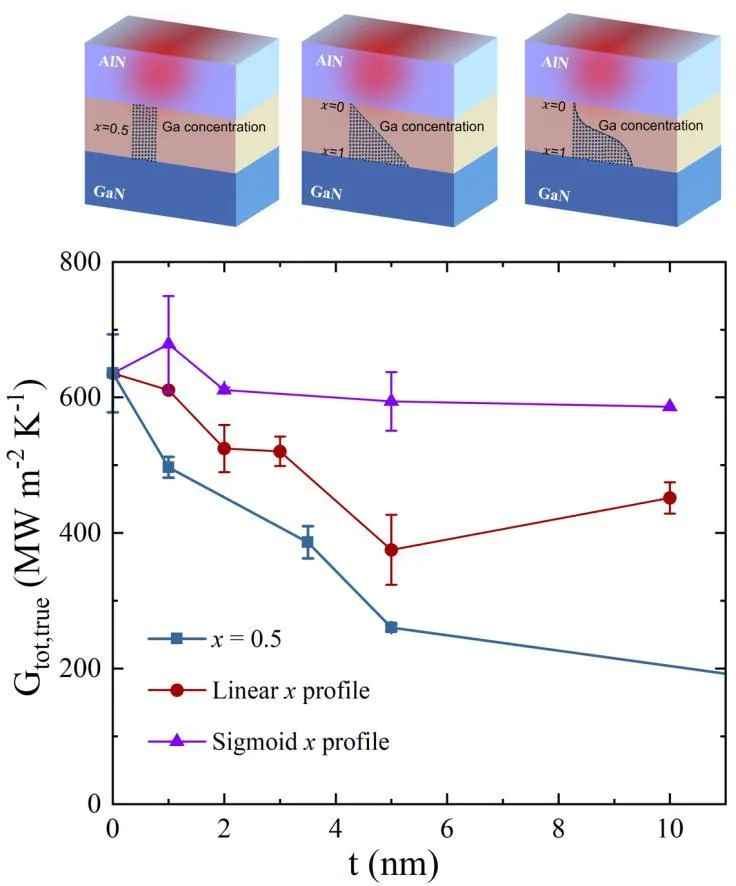
Inside a high-power transistor, heat escapes through junctions between different crystals, like water through narrow locks. For aluminum and gallium nitrides, key materials in power electronics, that lock is often a thin layer of their alloy. It is added deliberately or forms on its own during crystal growth. Until now, no one knew whether it helped or hindered heat dissipation.
Physicists built a computer model based on quantum calculations and tested it for all possible alloy compositions. They found that such a layer does not improve but noticeably worsens heat transfer — by up to a factor of two. The reason is that aluminum and gallium atoms in the alloy are arranged randomly, and thermal vibrations scatter on these irregularities, like waves on a rocky shoal.
But there is good news too. If the alloy composition is changed not abruptly and not uniformly, but along a smooth S-shaped curve (first slowly, then quickly, then slowly again) the heat flow crosses the interface almost without loss. Such a transition works like an acoustic horn: sound does not reflect off a step but gently flows into another medium. This discovery gives engineers a simple recipe: to keep a powerful chip from overheating, you need to properly "smear" the interface between materials.
Original abstract
as written by the authors arXiv:2601.12151
AlN-GaN heterostructures are central to high-power and high-frequency electronics, including RF devices, power converters, and AI accelerators. An intermediate Al1-xGaxN (AlGaN) layer is often present, either unintentionally during growth or intentionally to induce a 2D electron gas, yet its impact on the interfacial thermal boundary conductance (TBC) remains unknown due to the lack of reliable measurement or modeling methods. Here, we report a first principles-based evaluation of the TBCs of AlN-AlGaN, AlGaN-GaN, and AlN-AlGaN-GaN interfaces over the full alloy range. This is realized by the development of accurate deep learning interatomic potentials based on first-principles simulations. Contrary to other material systems where mixed interlayers enhance thermal coupling, we find that an AlGaN interlayer markedly degrades TBC between GaN and AlN, explaining the observation in experiments. Finally, we show that if the Al composition is sigmoidally transitioned from 0 to 1 across the AlN-GaN interface, it can remarkably increase the TBC, compared to an abrupt or a linear transition. This work is expected to shed light on an accurate thermal analysis and electro-thermal co-design of future AlGaN-based devices.
The thermal resistance of a single interface between crystals can be greater than the resistance of a whole micrometer of the material itself, as if a single rail joint slowed a train more than a kilometer of track.