Powerelectronics is the engineering discipline concerned with controlling and converting electrical power efficiently, using semiconductor devices as switches. It is the technology behind everything from the chargers for your phone to the inverters in solar panels and the motor drives in electric vehicles. The field has been revolutionized by the introduction of wide-bandgap semiconductors like silicon carbide (SiC), which can operate at higher voltages, temperatures, and switching frequencies than traditional silicon, making power conversion more efficient and compact.
History
The field began with mercury-arc rectifiers in the early 20th century, but modern powerelectronics started with the invention of the thyristor in 1957. Silicon carbide power devices have been developed since the 1990s and have become commercially significant in the 2010s.
How it works
Powerelectronic circuits use semiconductor switches (transistors, thyristors) that turn on and off rapidly to shape the flow of electrical energy. By varying the duty cycle of these switches, the circuit can step up or step down voltage, convert DC to AC or vice versa, and regulate power delivery with minimal loss. Silicon carbide devices reduce losses because they have lower resistance when conducting and can switch faster, which also allows for smaller passive components like inductors and capacitors.
In practice
Powerelectronics is used in electric vehicle inverters, renewable energy converters, uninterruptible power supplies, and industrial motor drives, where silicon carbide components are increasingly preferred for their efficiency and durability.
Fun fact
Silicon carbide power devices can operate at junction temperatures above 200°C, far beyond the limit of silicon, which is why they are used in electric vehicles and aerospace applications.
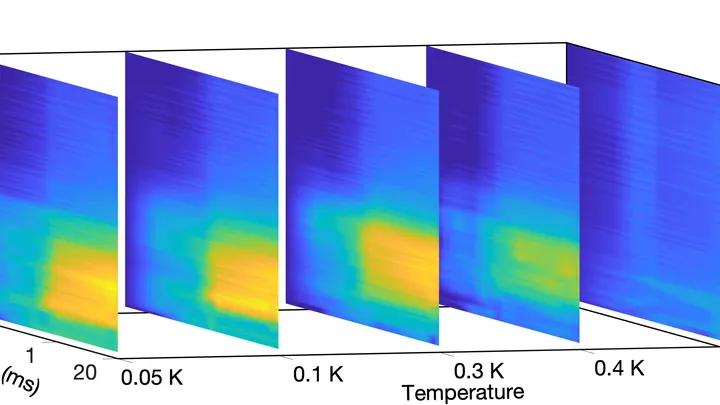
In some crystals, electrons are not spread uniformly but arrange themselves into a strict checkerboard: one cell has more electrons, the neighboring cell has fewer. Such a pattern is called charge order, and for a long time it was considered something frozen, like a pattern on frosty glass.
In a quiet room with no magnets anywhere, two electrons in a silicon trap still feel a faint trembling. It comes from the nuclei of silicon and germanium atoms, which spin randomly like the needles of broken compasses. This trembling was once considered noise, but now it has become a measuring instrument itself.
An empty dance floor where people occasionally appear. Each moves on their own, chaotically, with no connection to the others. But when the right music starts and the hall cools down a bit, the dancers suddenly begin to form long chains and move in unison. That's roughly how electrons behave in a dilute three-dimensional gas.
A light switch clicks, and the light comes on. But imagine a switch that, with the same press, can either turn on the lamp or leave the room dark. It also remembers what it did last time, and sometimes it seems to flip a coin to decide whether to light up.
This kind of behavior was found in a crystal of black phosphorus — a semiconductor just a few atomic layers thick.
A lone erbium atom sits on a silver substrate, and its spin, the electron's internal rotation, stores quantum information. Previously, flipping this spin required a magnetic pulse: a blunt tool that disturbs neighbors and works slowly. Now physicists from Germany and Korea have shown that a single electric voltage suffices.
Organic light-emitting materials are like a busy intersection without traffic lights. Molecules receive energy but, instead of honestly giving it back as light, they often turn into dead ends: they form dark pairs (exciplexes — short-lived complexes that do not emit) or collide with each other, losing charge.
Crystals glued to the outside and inside of a metal wall act as an invisible channel. One, receiving current, starts to tremble, and these vibrations, like ripples on water, spread out in all directions through the metal. The inner crystal catches this tremor and generates electricity again.
The ocean acts as a giant battery for solar energy, converting it into the kinetic energy of waves. Devices that harvest this energy (wave floats, or converters) turn oscillatory motion into electric current. Their performance hinges on three parameters: geometric shape, spatial arrangement, and tuning parameters (e.g., damping).
The book is open to the middle. Current runs along the spine, while the pages remain cool. That's roughly how a two-dimensional topological insulator works — a material where electricity flows only along the edges, while the interior stays still.
A solid electrolyte is not just a crystal lattice: it’s a bustling metropolis for ions. Each act of conduction resembles a trip through the city: there are wide highways with low energy barriers, gridlocks in bottlenecks, and tricky detours where an ion can get stuck.
Imagine a carousel with two types of seats: some spin clockwise, others counterclockwise. If you push all of them at once, the carousel jerks but stays in place. That's how a Weyl semimetal crystal works: electrons are born in pairs—'left' and 'right'—and their contributions to current cancel each other, like two identical motors running in opposite directions.
A rug lies flat, but if you push it from the edge, wrinkles run across it. In a thin film of tantalum sulfide (1T-TaS2), wrinkles made of electrons, charge waves, freeze as if the rug were stuck to the floor. To move them, you need to apply force. Scientists have found a way to control this force using an electric field and a magnet.
A typical accelerator is like an assembly line where electrons are the workpieces. To get the desired X-ray pulse, the workpiece is fine-tuned after it's already on the line: squeezed, filtered, corrected. In the new work, engineers decided to take a different approach — shaping the workpiece before it even hits the conveyor.
At LCLS-II, electrons are knocked out of a metal by a short laser pulse.
A power transistor made of silicon carbide operates under voltages thousands of times higher than what comes out of a wall outlet. If the field inside it becomes uneven, the device burns out. Previously, this field was invisible: it is too strong for ordinary sensors, and the device must remain under voltage.
When two different materials are pressed together and then pulled apart, a spark jumps between them. Anyone who has pulled off a wool sweater in the dark or gotten a shock from a doorknob knows the feeling. For a long time, it was thought that charges simply hop from one surface to another due to differences in material properties.
Ordinary computer memory constantly uses energy to store ones and zeros. Superconductors, on the other hand, carry current with zero loss — if you could build memory from them, it would barely draw any power. The catch is that superconductors can't remember: their state changes too easily.
Uranium ditelluride crystals turned out to be the exception.
Light passing through a thin crystal can change color and the direction of its oscillations. In a molybdenum disulfide flake just hundreds of atoms thick, an infrared beam turns green, and its polarization, the way the light wave oscillates, obeys the crystal's geometry.
When light hits a semiconductor, it can knock out an electron, leaving behind a hole. The electron and hole attract each other and form a pair — an exciton. This pair can re-emit light, but not immediately: first, it exchanges energy with vibrations of the crystal lattice — phonons.
Silicon is like a universal building block: it goes into the chips in your phone, solar panels, and lasers. But if you squeeze it with immense force, the atoms rearrange into new patterns: these forms are called allotropes. One of them, Si-XIII, was first spotted more than twenty years ago, but its exact pattern remained a mystery.
An ordinary solar cell does one thing: when the sun shines, current flows. Here, when the sun shines, the current flows differently depending on which side you bring the magnet.
An old T-shirt was dissolved in alkali to produce a gel, and it became the heart of an energy storage device. The second component was made from chitosan, a substance derived from shrimp shells. No metals: just recycled cotton and seafood.
The gel was soaked in ammonium salt, and its conductivity nearly doubled: from 17.1 to 37.8 millisiemens per centimeter.
In the ocean, sometimes a huge solitary wave appears out of nowhere and then vanishes. Such rogue waves are rare but dangerous. Similar rare and intense spikes occur in other systems, from financial markets to lasers. The problem is that they are hard to predict, let alone trigger on demand.
Superconductors are materials that conduct electricity without loss, but their properties are usually fixed. In the new work, scientists made a device resembling a crossroads of two superconducting tracks. By applying a weak magnetic field perpendicular to this crossroads, they were able to change the current the device can carry by a factor of four.
A quantum computer is like an orchestra, where each qubit is a musician and the control signals are the conductor. If the conductor waves the baton imprecisely, the musicians fall out of sync. In a real device, signals pass through power amplifiers, like loudspeakers that add noise and distortion.
Ordinary computer memory constantly consumes energy to avoid forgetting what's stored. A superconductor could store data without loss, but it's hard to make it switch.
In the new work, a superconductor is sandwiched between two magnetic insulators.
A laser on a lithium niobate crystal comes to life with a current of 40 milliamps. Its light splits into two streams, each passing through a six-millimeter waveguide, where twin photon pairs are born. One stream rotates the polarization of its twins, after which both flows merge into a common channel.