Thermal vibrations are the constant, random oscillations of atoms and molecules caused by their thermal energy. At any temperature above absolute zero, particles in solids, liquids, and gases jiggle around their equilibrium positions, with the amplitude of these vibrations increasing with temperature. These vibrations are fundamental to many physical phenomena, including heat conduction, sound propagation, and the limits of measurement precision in sensitive instruments.
History
The concept of thermal vibrations was developed in the 19th century with the kinetic theory of gases, and later refined by Albert Einstein (1907) and Peter Debye (1912) who modeled vibrations in solids using quantum mechanics.
How it works
In a crystal lattice, atoms are held in place by interatomic forces, but thermal energy makes them vibrate around their equilibrium positions. These vibrations are quantized as phonons—quasiparticles that carry heat and sound. When a temperature gradient exists, phonons diffuse from hot to cold regions, transporting energy. Thermal vibrations also scatter electrons and other particles, which is why electrical resistance increases with temperature. In precision measurements, thermal vibrations create noise that sets a fundamental limit on sensitivity, such as in gravitational wave detectors or neural sensors.
In practice
Understanding thermal vibrations is essential for designing low-noise electronics, cryogenic cooling systems, and ultra-sensitive detectors like LIGO, which must isolate mirrors from thermal jitter to detect gravitational waves.
Fun fact
At absolute zero, atoms would still have 'zero-point' vibrations due to quantum uncertainty, a phenomenon predicted by quantum mechanics and confirmed by experiments.
Picture a guitar string stretched between two frets. When you pluck it, a standing wave forms: some points on the string oscillate strongly, while others, the nodes, remain almost still. The chromosphere, a layer of the solar atmosphere sandwiched between the photosphere and the corona, behaves in much the same way.
A laser beam passes through a glass cell filled with cesium vapor. The atoms in the vapor dart around chaotically, like a crowd at a train station: each one enters the beam, spends a moment there, and flies back out. Their internal state, something like the orientation of a tiny magnet, changes under the influence of light. If all atoms were identical and stationary, the signal would be steady.
Drop a pebble into a pond, and ripples spread across the water. Something similar happens when a black hole merges with another: it emits gravitational waves that resemble the fading ring of a bell.
The early Universe was like a tightly coiled spring. In the first moments, it expanded at an unimaginable rate — a phase called inflation. Usually, this is attributed to a special field, but there's another idea: spacetime itself twists like a spring, and this twisting (in physics, torsion) becomes the engine of expansion.
A stone falls into still water, and smooth rings spread across the surface. If the stone doesn't just fall but also spins, tiny whirlpools, vortices, appear on the surface. Light can do the same, only instead of water, it's space and time themselves.
A seismometer is the planet's ear. It picks up the faintest tremors in the ground and turns them into an electrical signal. But this ear isn't perfect: its sensitivity depends on temperature. In the cold and in the heat, the instrument hears slightly differently, and that introduces error into measurements.
In the standard cosmological model ΛCDM, galaxies recede under the pressure of dark energy — an invisible spring. However, different methods of measuring the expansion rate give different numbers, as if the ruler's scale is off.
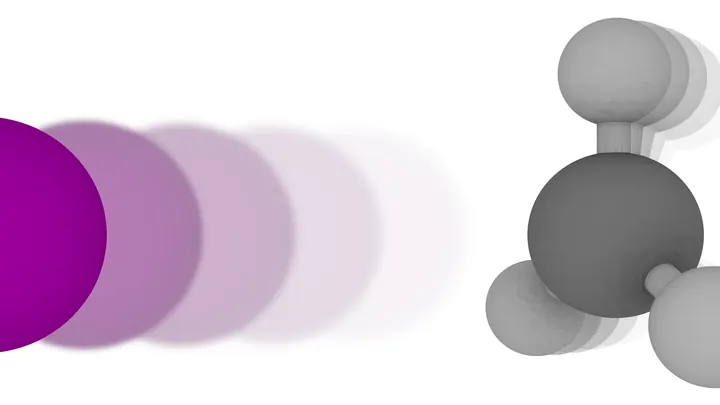
A chemical bond is like a stretched spring between atoms. When it's snapped, the molecular fragments fly apart, but they don't freeze: they keep vibrating, like a plucked string. That's exactly the vibration a team of researchers caught when they broke a methyl iodide molecule with an ultraviolet laser.
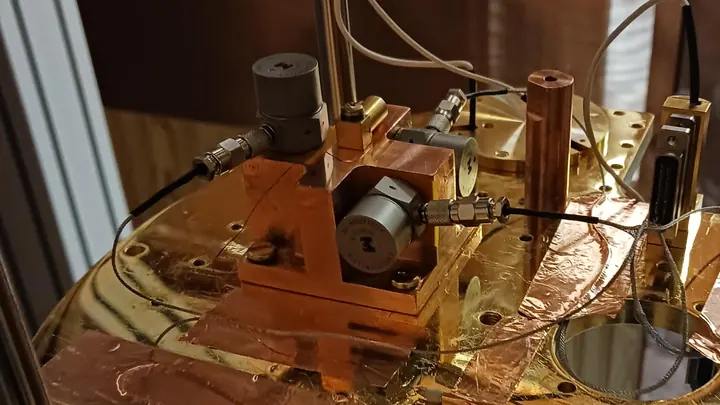
Inside a refrigerator that cools matter to near absolute zero beats a mechanical heart — the pulse tube. It pumps gas and extracts heat, but along with the cold it brings tremors. Each beat of this heart shakes the instruments sitting next to the sample and ruins delicate measurements.
Water in a kettle heats to 100 degrees, and stops being water, turning into steam. Something similar happens to atomic nuclei when they are smashed together at enormous speeds in the Large Hadron Collider.