How Planets Are Born: Turbulence in the Gas Disk express
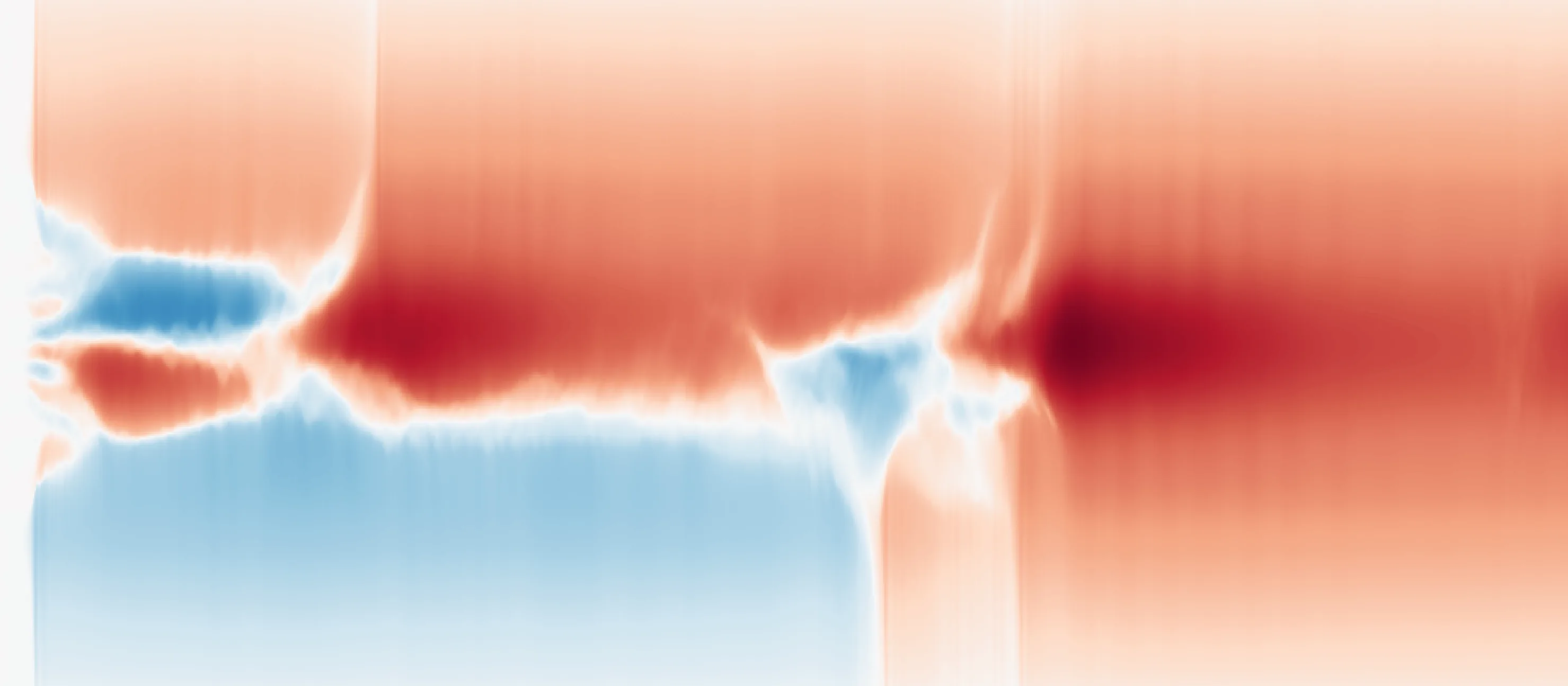
Around young stars, flat clouds of gas and dust swirl: these are the birthplaces of planets. For matter in such a disk to clump together, it must be constantly stirred. But what makes the gas move chaotically when it would otherwise be calm? Part of the answer lies in the fact that the gas in the disk barely conducts electricity: it is weakly ionized.
Scientists built a computer model of a patch of such a disk at a distance of 5 astronomical units from the star (that's like from the Sun to Jupiter). They added two effects that arise from weak ionization: Ohmic diffusion and ambipolar diffusion. It's as if in a crowd of people, some could push through others while others get stuck. It turned out that ambipolar diffusion doesn't dampen disturbances but can actually amplify them. An instability emerges, similar to ripples on water, that feeds itself.
Later, in regions where the magnetic field is weak, the magnetorotational instability could also kick in: it also stirs the gas. Together, this paints a picture: even a weakly ionized disk is not a quiet place. Turbulence there can arise from the subtle interplay between magnetic fields and gas motion. And that means dust grains have plenty of opportunities to collide and stick together to form future planets.
Original abstract
as written by the authors arXiv:2601.13391
Identifying the mechanisms responsible for angular momentum transport in protoplanetary disks, and the extent to which those mechanisms produce turbulence, is a crucial problem in understanding planet formation. The bulk of the gas in protoplanetary disks is weakly ionized, which leads to the emergence of three non-ideal effects, Ohmic diffusion, ambipolar diffusion, and the Hall effect. These low-ionization processes can in some cases suppress turbulence driven by the magnetorotational instability (MRI). However, it has recently been shown that these non-ideal terms can also affect the dynamics of the gas in fundamentally different ways than simple diffusion. In order to further study the role of low-ionization on disk gas dynamics, we carry out a 3D local shearing box simulation with both Ohmic diffusion and ambipolar diffusion and an additional simulation with the Hall effect included. The strength of each non-ideal term, when present, is representative of gas at a radius of 5 AU in a realistic protoplanetary disk. We find the Hall effect increases the saturation strength of the magnetic field, but does not necessarily drive turbulence, consistent with previous work. However, interactions between ambipolar diffusion and the Keplerian shear lead to the ambipolar diffusion shear instability (ADSI), which can drive the initial growth, not damping, of magnetic perturbations. To our knowledge, this is the first work that explicitly demonstrates the viability of the ADSI in the non-linear regime within protoplanetary disks. At later times in the disk, the MRI (reduced in strength by ambipolar-diffusion), may also be present in regions of weak magnetic field between strong concentrations of vertical magnetic flux and sustain turbulence locally in protoplanetary disks.
A distance of 5 astronomical units is roughly where Jupiter sits in our solar system. It's in such zones that gas giants are most often found around other stars.
In Arthur C. Clarke's novel '2010: Odyssey Two,' the gas giant Jupiter is turned into a star, yet giant planets really do form from the same gas disk as their stars.