How Ultrasound Scatters Particles express
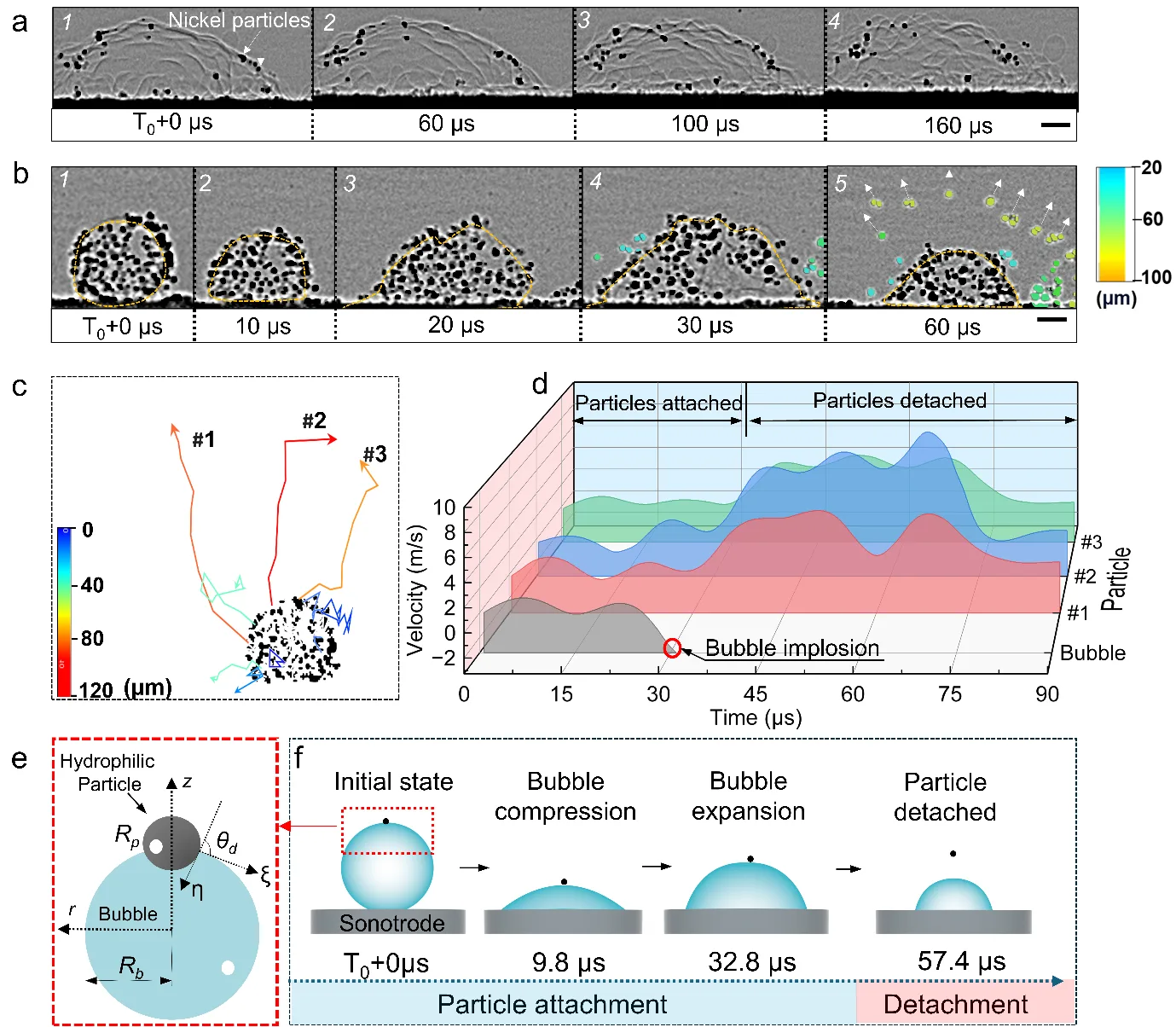
In a glass of water, ultrasound creates tiny bubbles. They grow and shrink, and sometimes they collapse sharply, like a popping soap bubble, but thousands of times faster. Near these bubbles float small particles — for example, nickel spheres the size of dust motes. With each movement, the bubble pushes them, like a swimmer who beats the water and sends waves rippling around them.
To capture these pushes, scientists used X-rays from a particle accelerator. They took snapshots every few microseconds — faster than the blink of an eye. The images show a particle being knocked away from the bubble. By measuring the speed and distance, the researchers calculated the energy. It turned out that when the bubble simply oscillates, it transfers about 16% of its energy to the particle, like a swimmer passing some of their force to a wave that nudges a ball. But when the bubble collapses, the particle gets 26% of the energy. Collapse is the most powerful push.
These pushes matter. They send particles flying through the liquid, preventing them from clumping together. This helps make paints, creams, composite materials, and even thin layers for electronics. If we can learn to control bubble energy, we could mix substances more precisely and create new materials.
So ultrasound becomes an invisible hand that quickly and gently arranges particles into place. And now we know exactly how much energy goes into that work.
Original abstract
as written by the authors arXiv:2601.13582
Multiphase fluid flows comprising of mesoscale solid particles, liquid droplets, or gas bubbles are common in both natural and man-made systems, but quantifying the energy transfer is challenging due to complex bubble-particle interactions. In this study, we used ultrafast synchrotron X-ray imaging to study the mesoscale dynamic interactions among ultrasonic cavitation bubbles and hydrophobic particles or clusters. Critical dynamic information and data were extracted from the vast amount of X-ray images and then fed into the hybrid analytical-numerical model for calculating the energy transfer from the oscillating bubble and the imploding bubble to the nearby hydrophobic particles. Using the Ni spherical microparticles as an example, at bubble oscillation approximately 16% (80-320 nJ) of the local energy was transferred to the particle. At bubble implosion, the transferred energy increased approximately 26% (0.135-1.09 uJ). Local energy transfer occurred on timescales of 1 us to 1 ms and length scales of 1 um to 1 mm. Within each ultrasound cycle, kinetic and potential energy underwent complex exchanges, with local energy exhibiting a stepwise decay at the end of each cycle. The transferred energy was mainly consumed for enabling highly efficient particle dispersion. This research provides quantitative insights into optimizing hydrophobic nanomaterial dispersion and has broader implications for interfacial energy transfer processes such as making suspensions, composite materials and exfoliated 2D materials.
The collapse of a bubble in a liquid can generate temperatures of thousands of degrees, like the surface of the Sun, but for a tiny instant.