Ultrafast processes are physical phenomena that unfold on timescales of femtoseconds (10^-15 seconds) to picoseconds (10^-12 seconds), the natural timescales for atomic and electronic motion. These processes include electron transfer in molecules, lattice vibrations in solids, and the initial steps of chemical reactions. Studying them reveals the fundamental dynamics of matter, which are otherwise averaged out in slower measurements.
History
The field was pioneered by Ahmed Zewail in the 1980s, who developed femtosecondspectroscopy to study chemical reactions in real time, earning the 1999 Nobel Prize in Chemistry. Advances in laser technology have since extended the technique to attoseconds (10^-18 seconds) for electron dynamics.
How it works
Ultrafast spectroscopy uses pulsed lasers with durations comparable to the process being studied. A 'pump' pulse triggers the process, and a delayed 'probe' pulse captures a snapshot of the system at a specifictime. By varying the delay, scientists reconstruct a movie of the dynamics with femtosecond temporal resolution.
In practice
Used in photochemistry, semiconductor device design, and materials science to optimize solar cells, understand photosynthesis, and develop faster electronic components.
Fun fact
A femtosecond is to a second what a second is to about 31.7 million years, making it possible to observe the very first moments of a chemical bond breaking.
At the center of many galaxies sits a supermassive black hole. When gas falls onto it, the gas heats up and shines brighter than an entire galaxy: this is an active galactic nucleus. Sometimes a true hurricane erupts from there: a stream of ionized gas racing at tens of percent of the speed of light.
A compass needle turns slowly, but inside some materials, tiny magnetic moments can flip over timescales that are hard to imagine. A team of physicists has calculated how to make them change direction in a quadrillionth of a second — faster than a lightbulb blinks.
Ordinary window glass may seem frozen forever, but inside, atoms never stay still. In amorphous germanium telluride (GeTe)—a material used in rewritable discs and non-volatile memory — physicists have for the first time directly tracked how atomic bonds stretch and bend in trillionths of a second.
Two dim stars whirl so close together that one siphons material off the other, like a spoon delicately skimming foam from broth. Astronomers have for the first time calculated the fate of such pairs — ultracool and brown dwarfs, the coldest and dimmest inhabitants of the galaxy. Previously, it was thought that mass exchange between them was impossible: they were too fragile.
Tearing apart an aluminum cube just a few nanometers wide is like trying to watch a droplet fall in slow motion when the camera itself is firing at machine-gun speed. Atoms inside the metal vibrate trillions of times per second, while real deformation in the lab takes minutes.
A laser flash strikes a copper oxide crystal, and magnetic excitation waves, magnons, ripple outward like ripples on water. For the first time, scientists traced their path from birth to disappearance with femtosecond precision (millionths of a billionth of a second).
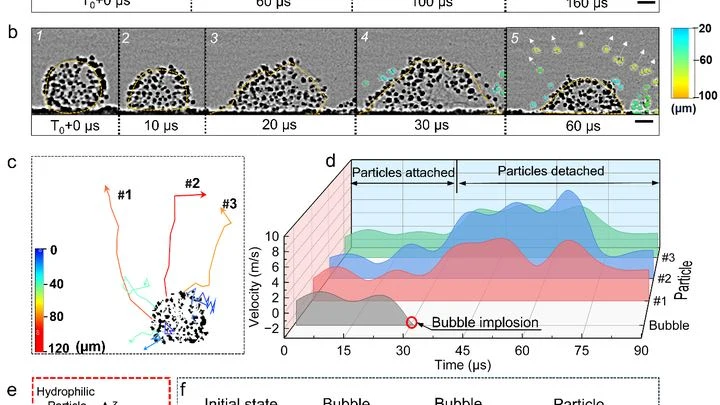
In a glass of water, ultrasound creates tiny bubbles. They grow and shrink, and sometimes they collapse sharply, like a popping soap bubble, but thousands of times faster. Near these bubbles float small particles — for example, nickel spheres the size of dust motes.
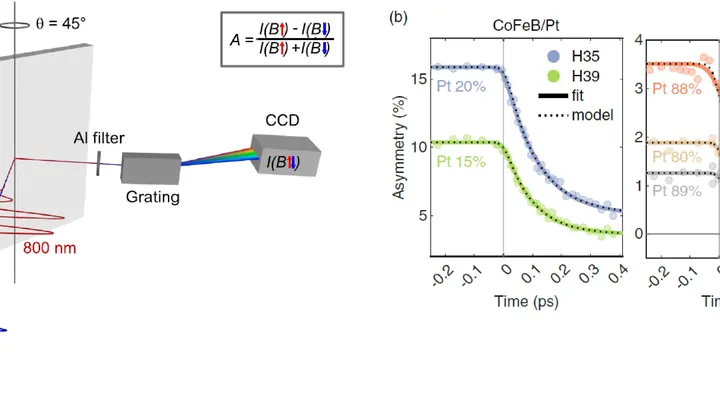
A fridge magnet holds on thanks to tiny internal arrows: each one like a miniature compass. If you hit the metal with an ultrashort flash of light, these arrows start to jitter chaotically, and magnetism melts away in a millionth of a billionth of a second. Previously, such 'melting' was too fast to observe.