The speed of sound is the rate at which a mechanical pressure disturbance travels through a given medium. It is not a universal constant but a material property, determined by how quickly neighboring particles can respond to a perturbation. In air at room temperature, sound travels at about 343 meters per second; in water, roughly 1,480 m/s; in steel, about 5,960 m/s. The speed varies with temperature, pressure, and composition, and it sets the fundamental timescale for many physical processes — from the propagation of seismic waves through Earth's interior to the behavior of shock waves in solar wind.
History
The first quantitative measurement of the speed of sound in air was performed by Marin Mersenne in 1636, who obtained a value close to the modern one. Newton later derived a theoretical formula, though it underestimated the measured speed until Laplace corrected it by accounting for adiabatic heating in 1816.
How it works
The speed of sound emerges from the balance between the medium's stiffness (how strongly it resists compression) and its inertia (how much mass must be accelerated). In a gas, the speed depends on temperature and molecular mass: hotter molecules move faster and transmit disturbances quicker. In solids, the speed is governed by elastic moduli and density, with stiffer materials like diamond transmitting sound at over 12,000 m/s. The concept also applies to exotic media: in the dense interior of a neutron star, the speed of sound can approach a significant fraction of the speed of light.
In practice
The speed of sound is critical in designing ultrasonic imaging systems, calibrating acoustic sensors, modeling earthquake wave propagation, and understanding the behavior of supersonic flows in aerospace engineering.
Fun fact
In the ultra-dense matter of a neutron star, the speed of sound can reach about half the speed of light, making these dead stars the fastest acoustic conductors in the universe.
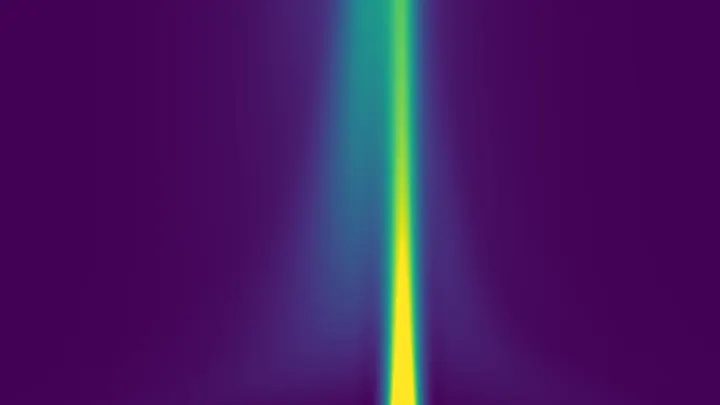
If you push water in a narrow channel too fast, a steep wave forms and breaks into foam. In the world of ultracold atoms, cooled to near absolute zero, quantum laws prevent such a wave from breaking. Physicists took a cloud of rubidium atoms stretched into a thin thread and sharply compressed it from one end with a movable wall of light.
A laser beam passes through a glass cell filled with cesium vapor. The atoms in the vapor dart around chaotically, like a crowd at a train station: each one enters the beam, spends a moment there, and flies back out. Their internal state, something like the orientation of a tiny magnet, changes under the influence of light. If all atoms were identical and stationary, the signal would be steady.
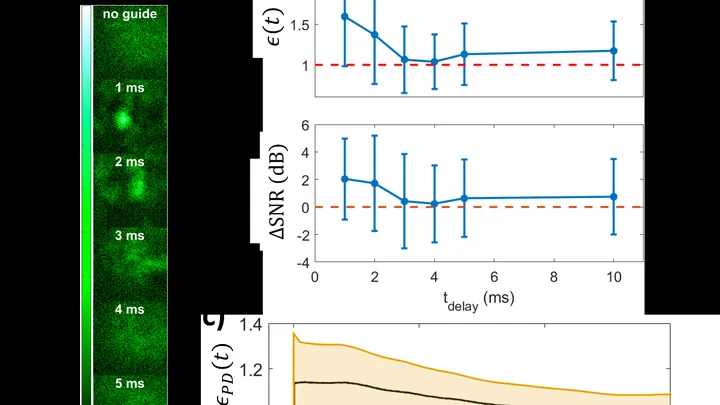
An ordinary flashlight shines in all directions, and after just a couple of dozen meters its beam fades so much it barely lights a wall. The atmosphere scatters light, and wind and heat currents distort it even more. But if you lay an invisible pipe for light right in the air, the beam will travel through it like water through a hose.
In a crystal, heat travels on waves. Atoms vibrate, and these vibrations, called phonons, carry energy from the hot edge to the cold one. For a long time, it was believed that if phonons hit resonance (their frequencies exactly match) and can exchange energy, heat would flow like an avalanche. It turns out that's not the case.
A disease outbreak is like a wildfire: the fire runs through dry grass, and its speed depends on wind and humidity. But an infection has its own 'wind'—how often people infect each other. When this rate changes along with the fraction of already infected, the epidemic wave can behave differently.
Hot tea cools down, and ice cream melts — heat always flows from warm to cold, and this law seemed unbreakable. But in the quantum world, even familiar rules can be rewritten. Physicists placed a tiny mechanical resonator (a vibrating bridge the size of a microbe) in an optical cavity between two mirrors.
In 2017, the LIGO and Virgo detectors recorded the spacetime tremor from the collision of two neutron star merger — event GW170817. After the initial burst came an after-ring: a kilohertz oscillation of the newly formed superdense remnant.
Crystals glued to the outside and inside of a metal wall act as an invisible channel. One, receiving current, starts to tremble, and these vibrations, like ripples on water, spread out in all directions through the metal. The inner crystal catches this tremor and generates electricity again.
A neutron star is a city squeezed to the size of a metropolis, where matter is packed to the limit. At the very center of such a city, a redevelopment may begin: familiar neutrons and protons give way to quark plasma — free quarks, the building blocks of almost everything around us.
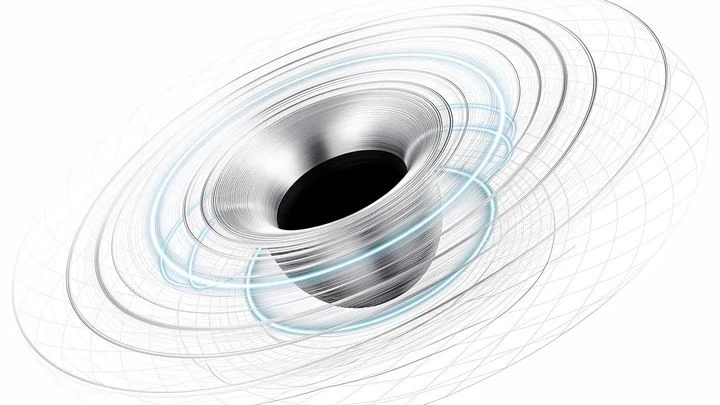
Imagine a river at a rapid: the current accelerates until no wave can go against the flow. So it is with gas near a black hole: reaching the speed of sound, it locks itself in — an acoustic black hole is born, a twin of the gravitational abyss. Here the event horizon is woven from a flow faster than its own sound.
Perth residents know: when the daytime heat becomes unbearable, relief arrives from the ocean — a fresh breeze affectionately called the Freo Doctor. The same wind, only on a global scale, decides the fate of cosmic visitors plunging into the atmosphere. A meteorite fall is a two-act spectacle.
Strike a diamond and it rings, but sound lives inside it even without a strike. Waves of compression and rarefaction constantly ripple through it, like the ripples a stone makes on water. Except this ripple is the thermal jitter of the atoms themselves, and it can be detected with a laser.
A neutron star is what remains after a massive star explodes. Its matter is squeezed so tightly that a teaspoon would weigh as much as a mountain. But what exactly happens in the deepest interior, where protons and neutrons may break apart into quarks, remains a mystery.
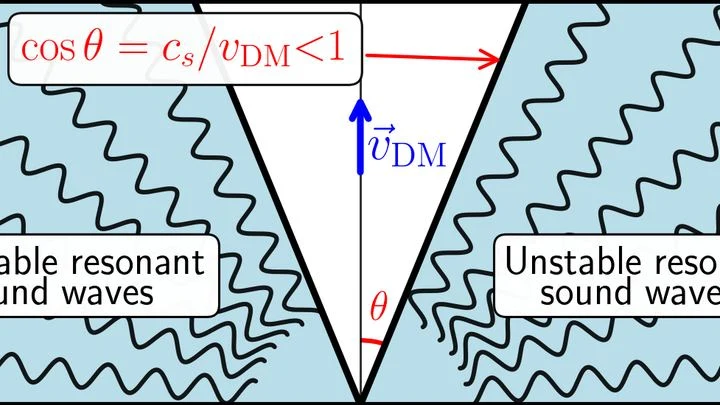
After the Big Bang, dark matter and ordinary matter (mostly hydrogen) went their separate ways in terms of speed. Their gravitational pull acts like a bow gliding across a string: when frequencies match, resonance occurs, and sound waves start to rapidly grow in ordinary matter.
Each vowel sound is a distinct shape of the mouth, tongue, and throat. When you say 'ah,' 'ee,' or 'oo,' not only does the air inside your head change, but so does the way radio waves pass through it. Researchers peered into this process using MRI scans taken right during speech and built a precise computer model of the head — from bones to soft tissues.
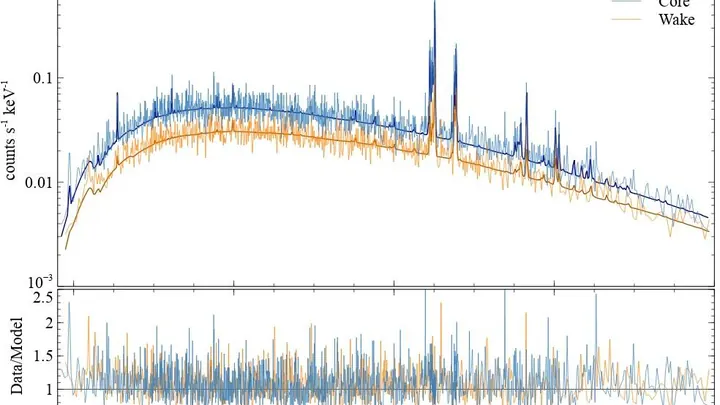
At the heart of the Ophiuchus galaxy cluster floats a bubble of hot plasma the size of several galaxies. It rises like a giant hot-air balloon in the atmosphere, leaving a wake behind it — a region where gas is set in motion.
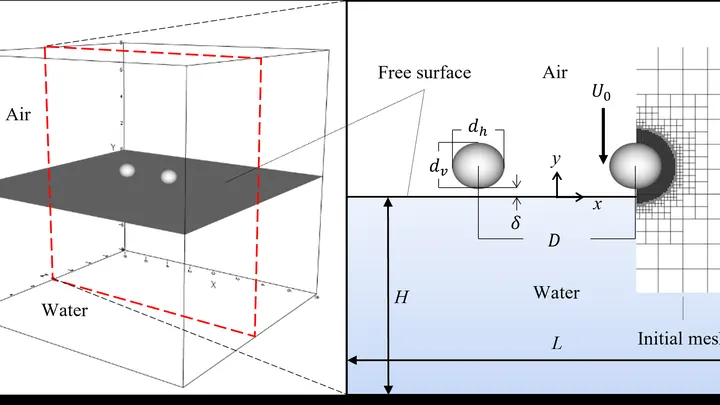
A raindrop falls into a puddle, and the impact sends up a little fountain of fine spray. Each of those droplets is a new, secondary drop. How many there are, how big they are, and how long they live depend on a host of factors: the fall speed, the drop size, the properties of the water. Scientists set out to make sense of this chaos using computer simulations.
A frictionless liquid that flows forever: that's superfluidity. Helium-3 only achieves it at thousandths of a degree above absolute zero. The theory of this state was developed by Lev Landau and Richard Feynman.
Above the Sun's surface hang long ribbons of glowing gas — streamers. They look like giant harps stretched across the corona. When a wave runs along such a ribbon, it trembles and bends like a string after being plucked.
For a long time, it was thought that only a very fast ejection of material, one traveling at more than 500 kilometers per second, could launch such a wave.
The Sun's corona looks like a shaggy dandelion: bright petal-like loops hold hot gas near the surface, while long, tenuous jets escape into space between them. These jets, the heliospheric current sheet, stretch across the entire solar system.
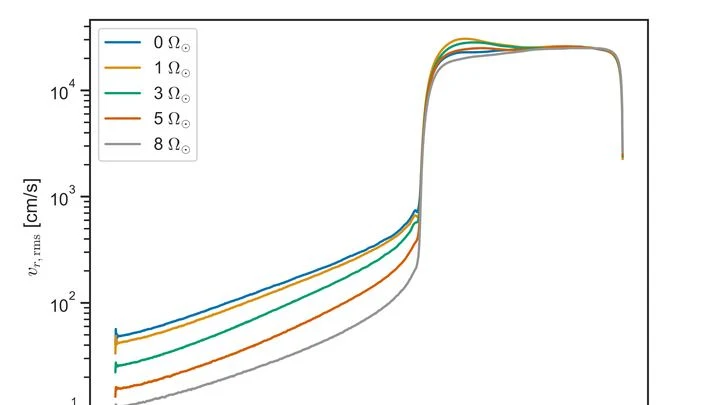
A star like the Sun hums like a bell: sound waves inside make its surface tremble ever so slightly. From this trembling, astronomers, like doctors reading a pulse, infer the star's temperature, density, and age. But the Kepler telescope spotted an oddity: many stars that spin fast and are covered in spots show no trembling at all. It's as if they've lost their voice.
In the macroscopic world we know, any motion inevitably decays: friction, a dissipative process that scatters energy, intervenes. But quantum reality has surprises in store.
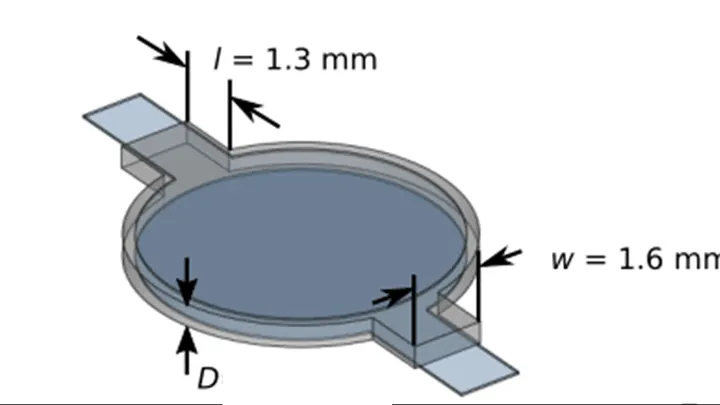
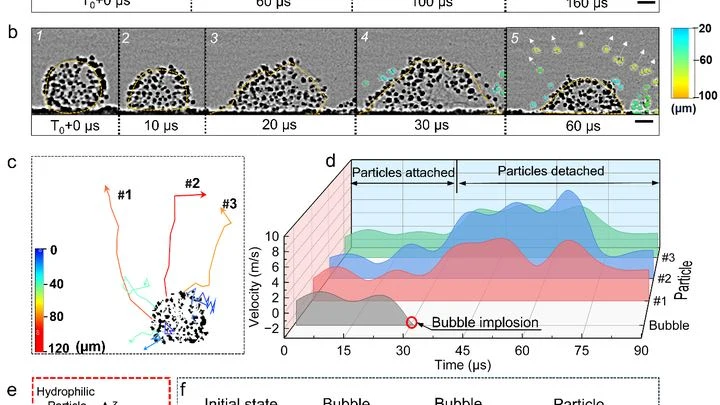
In a glass of water, ultrasound creates tiny bubbles. They grow and shrink, and sometimes they collapse sharply, like a popping soap bubble, but thousands of times faster. Near these bubbles float small particles — for example, nickel spheres the size of dust motes.
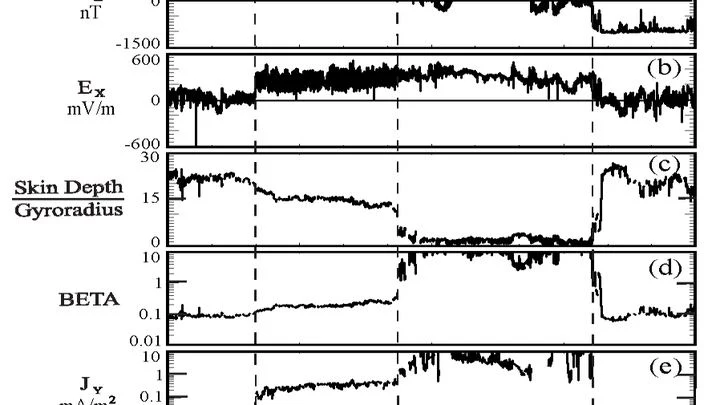
The scorching gas streaming from the Sun is not a continuous flow but rather a soup of charged particles. In this soup, waves constantly boil up: electric fields flare and fade like ripples on water from a tossed stone. One such wave is the ion-ion acoustic wave.