How Ultrasound Scatters Particles express
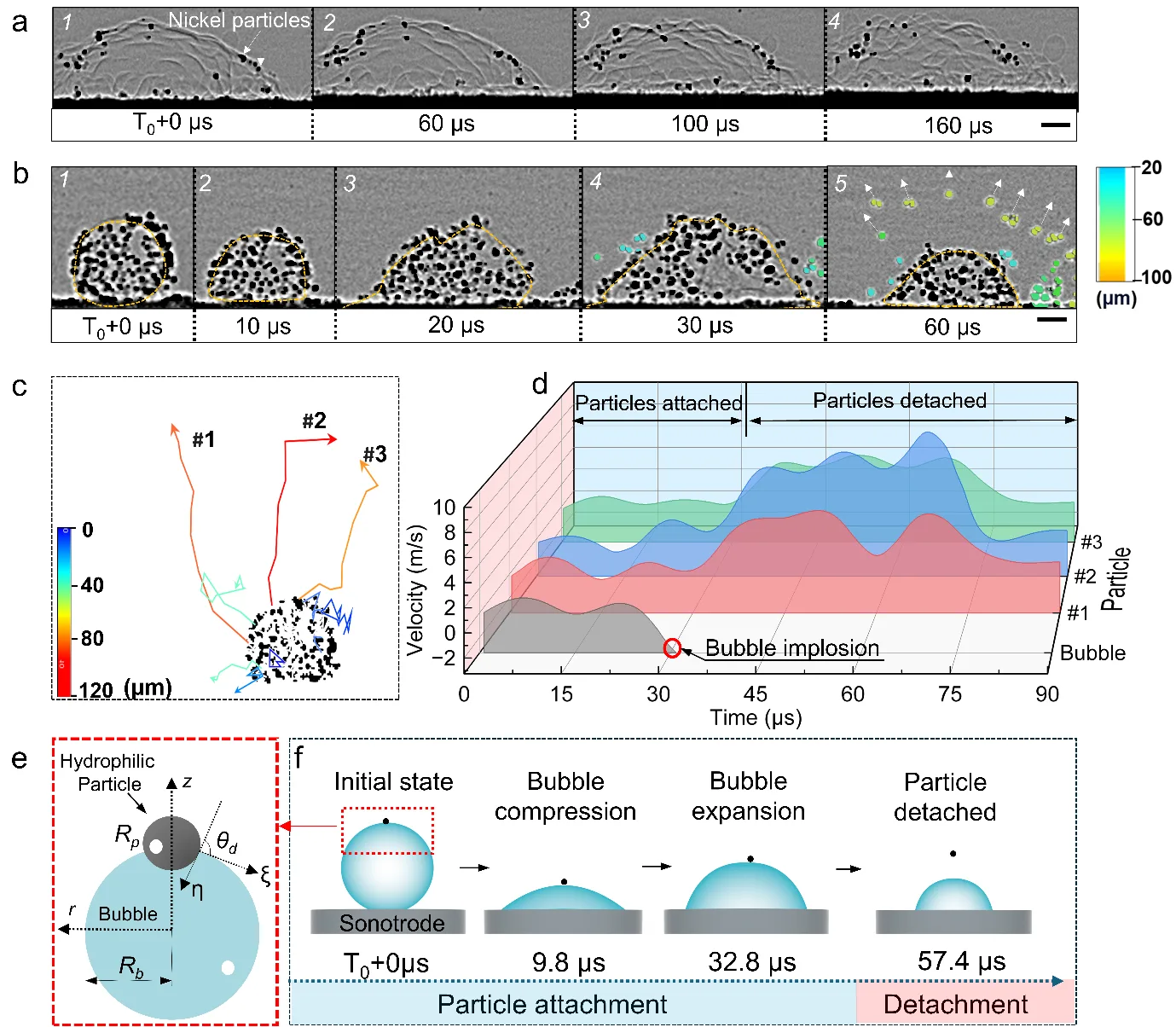
In a glass of water, ultrasound creates tiny bubbles. They grow and shrink, and sometimes they collapse sharply, like a popping soap bubble, but thousands of times faster. Near these bubbles float small particles — for example, nickel spheres the size of dust motes. With each movement, the bubble pushes them, like a swimmer who beats the water and sends waves rippling around them.
To capture these pushes, scientists used X-rays from a particle accelerator. They took snapshots every few microseconds — faster than the blink of an eye. The images show a particle being knocked away from the bubble. By measuring the speed and distance, the researchers calculated the energy. It turned out that when the bubble simply oscillates, it transfers about 16% of its energy to the particle, like a swimmer passing some of their force to a wave that nudges a ball. But when the bubble collapses, the particle gets 26% of the energy. Collapse is the most powerful push.
These pushes matter. They send particles flying through the liquid, preventing them from clumping together. This helps make paints, creams, composite materials, and even thin layers for electronics. If we can learn to control bubble energy, we could mix substances more precisely and create new materials.
So ultrasound becomes an invisible hand that quickly and gently arranges particles into place. And now we know exactly how much energy goes into that work.
The collapse of a bubble in a liquid can generate temperatures of thousands of degrees, like the surface of the Sun, but for a tiny instant.