A Thin Plate Wakes Turbulence Early express
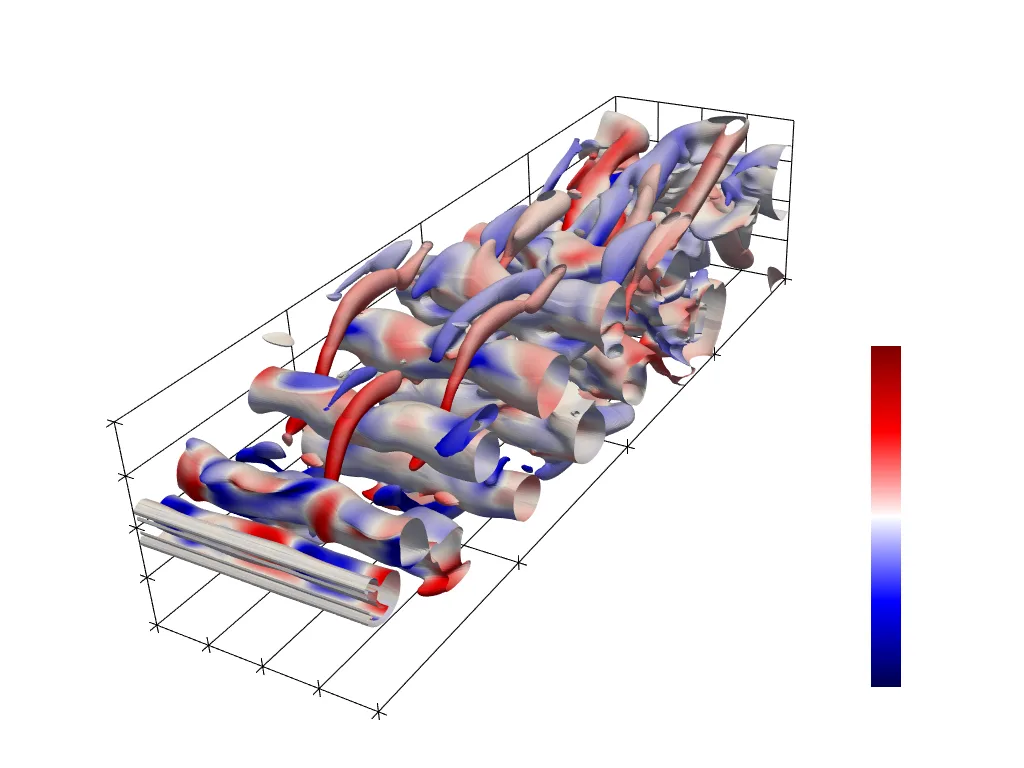
A thin plate stands across a flow of water or air. Behind it, a wake forms — a region where the flow becomes tangled and mixed. Usually, such a wake becomes turbulent when the flow speed is high enough, quantified by the Reynolds number. For circular and square obstacles, turbulence in the wake appears at Reynolds numbers on the order of several thousand. But for a flat plate, things are different.
The authors computed the flow past a plate at a Reynolds number of 400 and compared it with wind tunnel measurements at Reynolds numbers of 12500 and 19700. Key quantities (mean velocity, Reynolds stresses, and turbulent kinetic energy transport) matched within experimental uncertainty. Moreover, the simulation at 400 exhibited energy spectra and intermittency characteristic of fully developed turbulence. At a Reynolds number of 150, none of this is present: the distributions are completely different, and there is no turbulence.
The difference in wake behavior stems from how the plate sheds vortices. For a thin plate, sharp edges force the flow to separate immediately, forming a vortex street even at low speeds. For a circular cylinder, separation is gradual, and turbulence develops later. This finding helps improve calculations of flow around thin structures, from wings to bridge railings.
At a Reynolds number of 400, water in a 1 cm diameter pipe must flow at just 4 cm/s for the wake behind a thin plate to become turbulent.