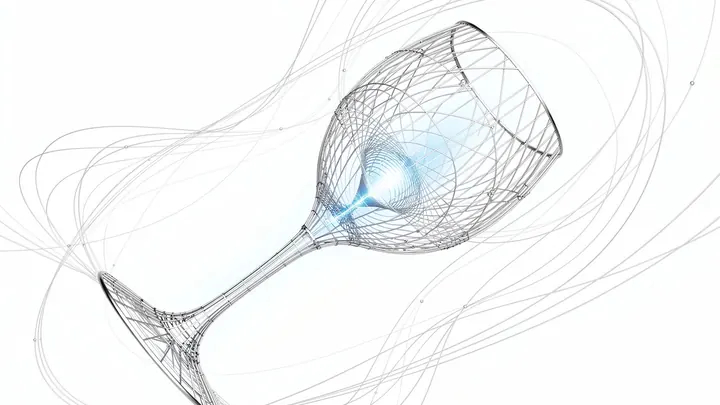
Quantum ripples are microscopic fluctuations in the fabric of spacetime itself, arising from the inherent uncertainty of quantum mechanics. At the smallest scales, spacetime is not smooth but churns with temporary, random distortions — like the surface of a boiling pot. These ripples are the quantum counterpart of gravitational waves, but they are so tiny and chaotic that they are usually invisible. Their behavior during cosmic expansion and contraction is particularly interesting: the ripples are damped (smoothed out) differently depending on whether the universe is growing or shrinking, which leaves a subtle imprint on the large-scale structure of the cosmos.
How it works
In quantum field theory, empty space is not truly empty; it is filled with virtual particles and fields that constantly pop in and out of existence. When gravity is quantized, these fluctuations manifest as ripples in spacetimegeometry. During cosmic expansion, the stretching of space tends to freeze or amplify certain ripple modes, while during contraction, they are squeezed and damped. This asymmetric damping is a prediction of some quantum gravity models and could, in principle, be detected by looking at patterns in the cosmic microwave background or in the distribution of galaxies.
If quantum ripples exist, they would cause the positions of particles to jitter by about 10^-35 meters — a billion billion times smaller than a proton.
A giant black hole tore apart a star, leaving behind a lopsided disk of scorching gas — like a vinyl record warped by the heat. Now a tiny black hole (or a star) zips around and repeatedly pierces that disk. Each puncture is a bright X-ray flare.
Cosmology has long sought a loophole behind the Big Bang. Inflation, proposed by Alan Guth, stretches and smooths out primordial inhomogeneities, but what lit the fuse itself?
A figure skater glides across the ice, gradually approaching the center of the rink. A slight twist of the torso, and the smooth spiral breaks, the trajectory becomes unpredictable. Something similar happens when a small black hole with its own rotation (spin) falls toward a giant black hole.
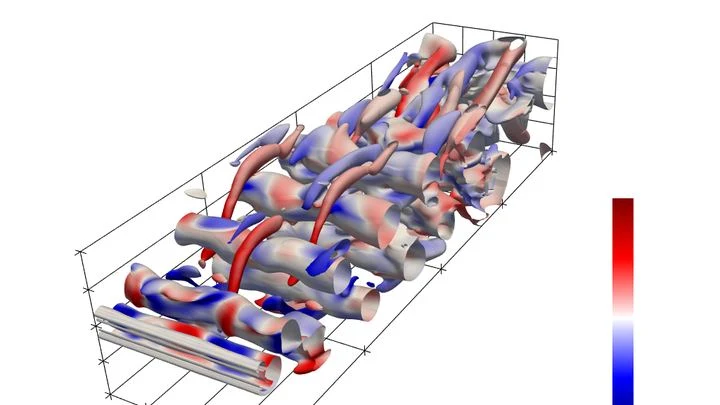
A thin plate stands across a flow of water or air. Behind it, a wake forms — a region where the flow becomes tangled and mixed. Usually, such a wake becomes turbulent when the flow speed is high enough, quantified by the Reynolds number.
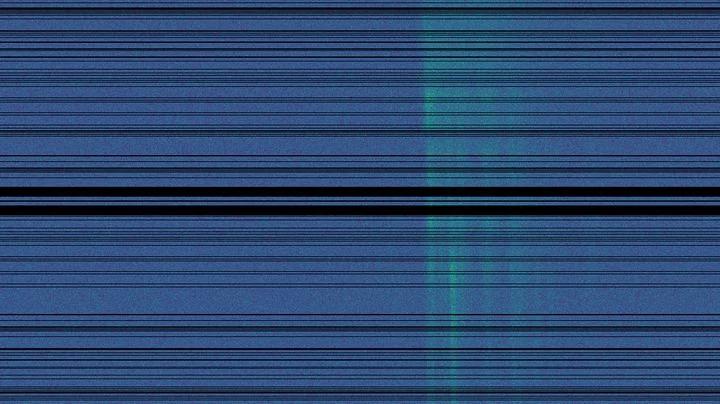
Short, powerful bursts of radio static from deep space have long puzzled scientists. Their source is believed to be the ultra-dense cores of dead stars, where magnetic fields are unimaginably strong.
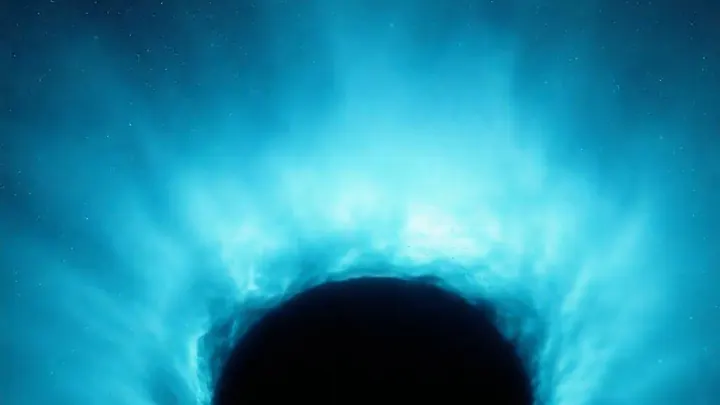
Black holes are rarely alone in the cosmos. They are often shrouded in invisible clouds of hypothetical dark matter particles — so light that they feel only gravity, barely interacting with each other or ordinary matter.
Gamma-ray bursts are the most powerful explosions in the Universe: a dying star collapses into a black hole, ejecting streams of energy. Often this happens after a supernova flare. But astronomers caught a strange rhythm — in the emission of 34 such bursts, clear pulsations appeared, like beats of a cosmic heart.
In the first moments after the Big Bang, the Universe underwent rapid expansion: inflation. But perhaps it was contracting before that, and then bounced. Both scenarios leave nearly identical imprints on the cosmic microwave background, and cosmologists have debated for decades which one is correct.