One Molecule, Quantum Light express
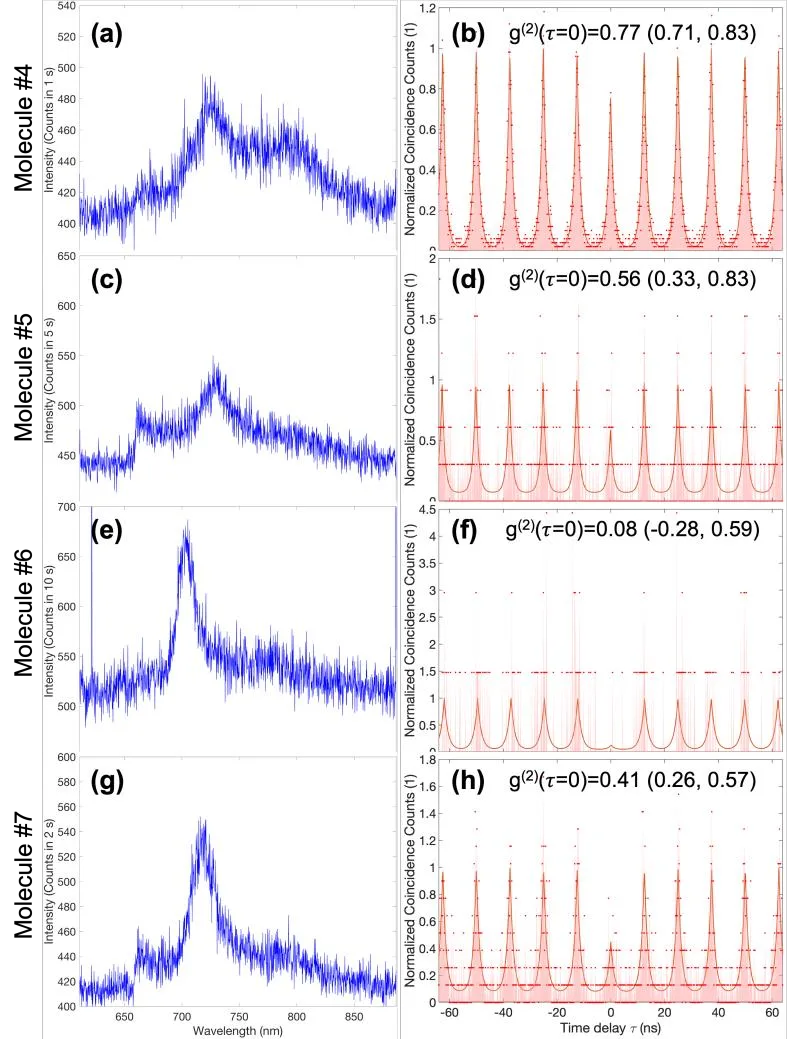
The light from a single molecule is like a lone voice in a vast choir. To hear it, you need not a microphone but a delicate instrument that catches each photon and notes its arrival time. That's exactly what researchers have built: it measures not only the brightness and color of the glow but also how often photons arrive in pairs — what's called second-order statistics.
The IDTBT molecule is a long chain of alternating units, like beads. When illuminated, it absorbs light and re-emits it. But not just anyhow: inside the chain, energy can hop from one unit to another, and if those hops are coordinated, photons come out not one by one but with a certain pattern. The instrument showed that in different parts of the spectrum (that is, for different colors of the glow) the pattern differs. And the picture changes between room temperature and cooling to cryogenic temperatures.
Why does this matter? In nature, there are molecules that transfer energy with almost no loss — for example, in plant photosynthesis. It's thought that quantum coherence helps energy reach its destination faster. The new method lets us peek into this process at the level of a single molecule without destroying it. So far, the results are just a hint, but already it's clear: the quantum life inside a molecule is richer than we thought.
Original abstract
as written by the authors arXiv:2601.19006
The frequency- and time-resolved second order quantum coherence function (g(2)({\tau})) of single-molecule fluorescence has recently been proposed as a powerful new quantum light spectroscopy that can reveal intrinsic quantum coherence in excitation energy transfer in molecular systems ranging from simple dimers to photosynthetic complexes. Yet, no experiments have been reported to date. Here, we have developed a single-molecule fluorescence g(2)({\tau}) quantum light spectroscopy (SMFg2-QLS) that can simultaneously measure the fluorescence intensity, lifetime, spectra, and g(2)({\tau}) with frequency resolution, for a single molecule in a controlled environment at both room temperature and cryogenic temperature. As a proof of principle, we have studied single molecules of IDTBT (indacenodithiophene-co-benzothiadiazole), a semiconducting donor-acceptor conjugated copolymer with a chain-like structure that shows a high carrier mobility and annihilation-limited long-range exciton transport. We have observed different g(2)({\tau}=0) values with different bands or bandwidths of the single molecule IDTBT fluorescence. The general features are consistent with theoretical predictions and suggest non-trivial excited state quantum dynamics, possibly showing quantum coherence, although further analysis and confirmation will require additional theoretical calculations that take into account the complexity and inhomogeneity of individual IDTBT single molecular chains. Our results demonstrate the feasibility and promise of frequency- and time-resolved SMFg2-QLS to provide new insights into molecular quantum dynamics and to reveal signatures of intrinsic quantum coherence in photosynthetic light harvesting that are independent of the nature of the light excitation.
The IDTBT molecule consists of thousands of atoms but behaves as a single quantum system: its emission can be 'squeezed,' meaning photons arrive in pairs more often than from an ordinary light bulb.