Catching Weak Kicks: A Quantum Trick with a Jumping Trap express
A speck of glass floats in a laser beam. Air molecules, photons, even Earth's gravity give it little pushes, and by watching its jitter, you can tell what pushed it. But every measurement has a limit: the particle's own noise hides weak signals. Quantum mechanics sets that limit, but it can be bypassed.
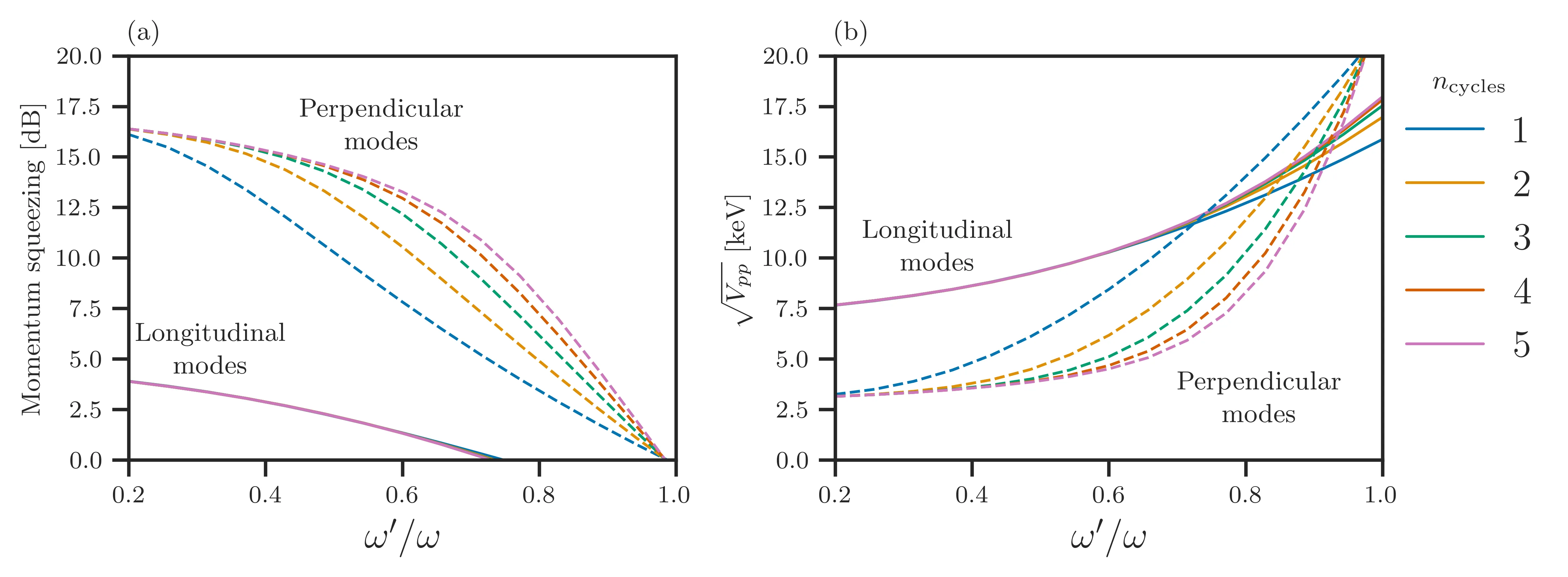
The authors propose squeezing the particle's jitter, like squeezing a balloon: in one direction it gets narrower, in another wider. To do this, they rapidly make the trap that holds the particle stiffer, then softer. The particle can't keep up and starts jittering unevenly: noise drops in one direction, grows in another. By measuring only the 'narrow' direction, you can catch a kick ten times weaker than the usual limit.
In a real experiment with a nanoparticle in an optical trap, decoherence gets in the way — the particle loses its quantum properties due to collisions with molecules. The authors accounted for this and showed that with current technology, noise can be squeezed by 10 decibels. That's enough to notice the impact of a single gas molecule or, possibly, a trace of dark matter.
Original abstract
as written by the authors arXiv:2601.22283
We propose a protocol to measure impulses beyond the standard quantum limit. The protocol reduces noise in all three spatial dimensions and consists of squeezing a mechanical system's state via a series of jumps in the frequency of the harmonic potential. We quantify how decoherence in a realistic system of an optically levitated, dielectric nanoparticle limits the ultimate sensitivity. We predict that $$\sim$$10 dB of squeezing is achievable with current technology, enabling quantum-enhanced detection of weak impulses.
10 decibels of noise squeezing is like a noisy hall suddenly becoming ten times quieter in power, making a whisper audible.
In the series 'The Expanse,' ultra-precise accelerometers on ships catch even the crew's breathing: this method brings such devices closer to reality.