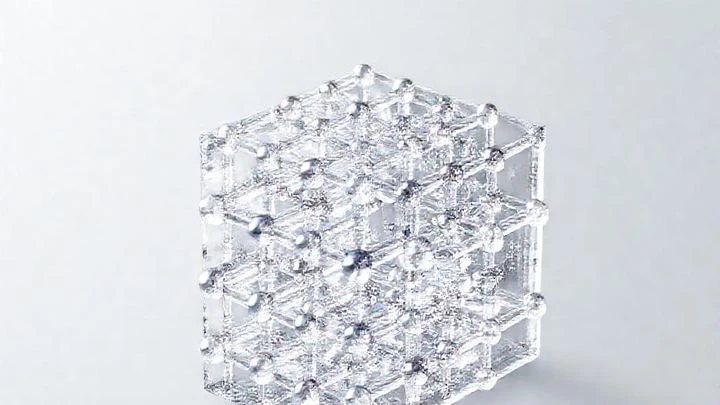
An optical trap is a device that uses focused laser light to hold and manipulate microscopic objects, from single atoms to tiny dust particles. The fundamental principle is that light carries momentum, and when photons are refracted or scattered by an object, they transfer that momentum to it, creating a force. In a tightly focused laser beam, this force can be directed toward the focal point, effectively creating a potential energy well that confines the particle in three dimensions. This technique is often called 'optical tweezers' when used for larger particles like beads or cells, and 'optical lattices' when used to arrange atoms in periodic patterns.
History
Arthur Ashkin at Bell Labs demonstrated the first optical trapping of particles in 1970, and later developed optical tweezers for biological objects in the 1980s. He was awarded the Nobel Prize in Physics in 2018 for this work.
How it works
The key is the gradient force. A laser beam with a Gaussian intensity profile is focused through a high-numerical-aperture lens. A dielectric particle (like a glass bead or atom) experiences a force proportional to the intensity gradient of the light field. Because the beam is brightest at its center, the particle is pulled toward the region of highest intensity. The scattering force, which pushes the particle along the beam direction, is counteracted by the strong axial gradient near the focus, resulting in a stable trap. For atoms, the mechanism is slightly different: the oscillating electric field of the light induces an electric dipole moment in the atom, and the interaction energy depends on the local intensity, creating a conservative potential well.
In practice
Optical traps are used to manipulate single molecules in biophysics (e.g., studying molecular motors), to cool and confine atoms for quantum computing and precision measurements, and to sort microscopic particles in lab-on-a-chip devices.
Fun fact
Optical tweezers can hold and stretch a single strand of DNA, allowing scientists to measure its mechanical properties directly.
In a dark room, you can hold a glowing sphere without touching it: walls of light push it away but do not burn it. That is roughly how the trap built in Rio de Janeiro for yeast cells works. A conventional optical tweezer, that is, a focused laser beam, acts like tweezers made of light, but the light itself pierces the cell from side to side.
A laser beam focused to the size of a dust speck can hold a single molecule, much like tweezers hold a tiny bead. But filling a hundred such tweezers with exactly one molecule each is like trying to put a single drop of water into every compartment of an egg carton without spilling a drop.
The laser beam in an optical tweezer is not just a spot of light but a force bag. A particle caught in it usually rolls toward the brightest point, like a ball into a dimple.
A regular laser beam travels straight, like the light from a flashlight. But light can be twisted into a spiral, like the thread of a corkscrew. Such a beam carries orbital angular momentum: it doesn't just illuminate, it also spins anything it encounters.
A magnetic vortex is like a tiny whirlpool in the sea, except that instead of water, it's magnetization that swirls. Such vortices could become memory cells in future computers, but to write and read information, you need to be able to move each vortex individually. So far, this is done crudely — shifting a whole bunch at once.
A stack of playing cards lies still. You can slide the top card with your finger: that's crude intervention. Or you can blow so that the whole stack momentarily changes shape, but the cards don't scatter. That's roughly how light, in a new experiment, rearranges a crystal of tin selenide (SnSe).
Usually, to change the structure of a solid, you heat it or pass a current through it.
Catching a single molecule in a beam of light and nearly stopping its motion is like trying to hold a dandelion fluff in a gust of wind. A particle that's too hot slips out of the trap, so physicists first tame its thermal jitters with laser cooling.
The authors applied a technique called Sisyphus cooling to strontium hydroxide (SrOH) molecules.
Imagine a green beam that, passing through an ingenious optical setup, twists into a three-dimensional funnel of light — an optical vortex. At its heart, like in the eye of a hurricane, the intensity drops to zero. It is there that photons disappear.
Light flows like an invisible river. If you place an obstacle in the stream, the water whirls into eddies. Likewise, specially designed surfaces create light 'whirlpools' that catch nanoparticles like wood chips.
At the heart of nearly every large galaxy shines an active nucleus — a supermassive black hole surrounded by a flat, rotating disk of incandescent gas. The disk itself flickers, but astrophysicists suspect that within it lurks a whole swarm of small, stellar-mass black holes.
A flashlight beam in a dark room can hold a dust mote almost still: that's how optical tweezers work. But light doesn't just push the particle; it also jostles it with random kicks. Each absorbed photon strikes it like an invisible hammer. The authors of the new study have devised a light trap of a special shape.
Light isn't just straight rays; it's electromagnetic waves that can twist through space like a pair waltzing. Physicists call their total twist orbital angular momentum, and for a long time it was thought to obey the conservation law — a fundamental principle that follows from the symmetries of nature discovered by Emmy Noether.
An optical tweezer is a laser beam that holds an atom in place, much like fingers holding a pea. Arrays of these tweezers form the basis of future quantum computers. But there's a catch: not every tweezer catches an atom. Typically, only half of the traps get filled, and for molecules, even fewer. Empty spots break the whole setup.
Light usually pushes an atom straight ahead, like wind pushing a sail. But if the beam is twisted into a corkscrew, the picture changes: the atom can fly off to the side, as if caught by a spinning wheel. In the new work, physicists calculated that such a vortex photon can transfer almost all of its rotation to the atom — up to 100 percent.
A steady laser beam is like a taut string: if it vibrates even a little, the music turns into cacophony. In a quantum computer, the laser holds atoms in a trap, and any frequency jitter ruins the computation. That's why laser setups used to occupy entire tables, and tuning took weeks.
An optical tweezer is a beam of light that holds and moves tiny objects like bacteria or dust grains. If you need to carry a particle from point A to point B, you could simply pull it straight there. But that would consume more energy than a cleverly chosen detour.
An active particle is a microscopic object that propels itself forward, like a tiny swimmer.
A particle wanders through a medium scattered with obstacles. Sometimes it pushes them aside like a snowplow, and it was thought that this pushing is what eventually stops the motion. But in three-dimensional space, that mechanism doesn't work.
It turns out that stopping arises from rare events: every so often, a particle randomly finds itself in a trap, and all exits close, as if doors slam shut.
Ultracold molecules are a promising material for quantum computing, but assembling them into a neat array, like eggs in a carton, is no easy feat. A method has been proposed to load molecules one by one into optical tweezers or lattices directly from a gas. The molecules immediately end up in the calmest state of motion.
A football kicked with spin doesn't fly straight: it bends to the side. A tightly focused beam of light does something similar: it starts pushing an atom not just forward but also sideways. Physicists measured this shift on a single calcium ion trapped in a light trap.
The beam was aimed at the atom like a spotlight on a grain of sand.
An ordinary laser amplifies light into a bright beam. Run the process in reverse, and you get an anti-laser — a device that sucks in light without a trace. But such a machine is finicky: even a slight disorder can ruin the absorption.
Physicists have found a way to make the anti-laser invulnerable.
Throw pebbles along a tight row of posts: they ricochet into a dense spray. Throw at an angle, and they scatter. Gamma rays in a crystal do the same: they spawn particle cascades that spread out unless the crystal’s atomic rows are perfectly aligned. Align them within a hair’s width, and the cascade sharpens into a tight beam. A small crystal then outperforms a large one.
A laser beam usually looks like a straight column of light. But if you pass it through a wafer with a pattern thinner than a hair, the beam scatters into thousands of tiny pockets of light. In each pocket, you can suspend a single atom, like a pea in a dimple.
Four cesium atoms hang in vacuum, held by laser tweezers like beads on an invisible thread. Around them is a ring resonator, a closed loop of mirrors where light circulates without obstacles. When a probe beam strikes this tiny chain, something strange happens: the atoms scatter light not uniformly in all directions, but predominantly in one direction.
Two pendulums linked by a spring of light begin to swing in unison without ever touching. In the quantum world, such synchronization means something more: particles lose their individuality and become a single object.