Optical tweezers are a technique that uses a highly focusedlaser beam to trap and manipulate microscopic objects, such as individual cells, bacteria, or even single molecules. The gradient force of the light field pulls the particle toward the focal point, holding it in place. This tool has revolutionized biology and physics by allowing researchers to hold, move, and measure forces on tiny objects with unprecedented precision.
History
Arthur Ashkin developed optical tweezers in 1970 at Bell Labs, for which he received the Nobel Prize in Physics in 2018. His early work demonstrated trapping of dielectric spheres and later biological particles.
How it works
A laser beam is focused through a high-numerical-aperture microscope objective. The electric field gradient creates a force that attracts dielectric particles toward the region of highest intensity. The scattering force pushes the particle along the beam direction, but the gradient force dominates near the focus, creating a stable trap. By moving the beam or the sample stage, the trapped particle can be manipulated. The stiffness of the trap can be calibrated to measure piconewton forces.
In practice
Optical tweezers are used to study molecular motors, DNA mechanics, cell sorting, and to assemble microstructures. They are also used in quantum optics to trap neutral atoms.
Fun fact
Optical tweezers can trap and manipulate individual atoms, which was key to many quantum computing experiments.
Light falling on matter usually scatters off it or heats it up. But when there are many photons and they are very energetic, two quanta of light can collide and vanish, leaving two particles in their place: an electron and its antimatter twin, the positron. This process, predicted back in 1934, has never been reproduced in the lab with real photons.
In a dark room, you can hold a glowing sphere without touching it: walls of light push it away but do not burn it. That is roughly how the trap built in Rio de Janeiro for yeast cells works. A conventional optical tweezer, that is, a focused laser beam, acts like tweezers made of light, but the light itself pierces the cell from side to side.
In a dark room, you can hold a glowing sphere without touching it: walls of light push it away but do not burn it. That is roughly how the trap built in Rio de Janeiro for yeast cells works. A conventional optical tweezer, that is, a focused laser beam, acts like tweezers made of light, but the light itself pierces the cell from side to side.
A laser beam focused to the size of a dust speck can hold a single molecule, much like tweezers hold a tiny bead. But filling a hundred such tweezers with exactly one molecule each is like trying to put a single drop of water into every compartment of an egg carton without spilling a drop.
A laser beam focused to the size of a dust speck can hold a single molecule, much like tweezers hold a tiny bead. But filling a hundred such tweezers with exactly one molecule each is like trying to put a single drop of water into every compartment of an egg carton without spilling a drop.
The laser beam in an optical tweezer is not just a spot of light but a force bag. A particle caught in it usually rolls toward the brightest point, like a ball into a dimple.
A magnetic vortex is like a tiny whirlpool in the sea, except that instead of water, it's magnetization that swirls. Such vortices could become memory cells in future computers, but to write and read information, you need to be able to move each vortex individually. So far, this is done crudely — shifting a whole bunch at once.
A stack of playing cards lies still. You can slide the top card with your finger: that's crude intervention. Or you can blow so that the whole stack momentarily changes shape, but the cards don't scatter. That's roughly how light, in a new experiment, rearranges a crystal of tin selenide (SnSe).
Usually, to change the structure of a solid, you heat it or pass a current through it.
Any measuring device is spoiled by quantum noise — the chaotic jitters of elementary particles. To tame it, physicists used a trick on calcium fluoride molecules, much like squeezing a balloon: press in one spot, and it bulges in another.
An ordinary photometry detector can't tell a left photon from a right one. But let it start moving, and everything changes.
Imagine a rower moving between two flutists playing the same note. His ear is perfectly tuned to that note and ignores all others. As he moves, the pitch from the flutist ahead sounds higher, and from the one behind sounds lower.
Usually, isotopes are separated by exploiting the difference in nuclear weight. That difference is tiny, like sorting grains of sand that differ by one hundredth of a millimeter. The new method ignores weight and instead looks at the nucleus's rotation: its spin.
The laser hits the molecules twice with a short pause in between.
A garden hose shoots a thin, powerful jet. If you sweep it across the yard, you can water the whole bed without flooding the path. That's roughly how the new approach to treating deep tumors works: instead of a broad radiation field, you take a narrow beam of electrons accelerated to nearly the speed of light and scan it across the tumor like a jet of water.
An optical tweezer is a laser beam that holds an atom in place, much like fingers holding a pea. Arrays of these tweezers form the basis of future quantum computers. But there's a catch: not every tweezer catches an atom. Typically, only half of the traps get filled, and for molecules, even fewer. Empty spots break the whole setup.
A dust grain hangs in the air, held by an invisible beam of light. Around it is ordinary air, but sometimes a tiny spark jumps across the grain. For the first time, scientists have observed such discharges up close and found that they are triggered not by the grain itself, but by invisible visitors from space and from the ground.
Light from distant stars travels for millions of years, but X-rays can't be caught with ordinary glass: they pass right through it like a bullet through paper. That's why X-ray telescopes need special lenses: stacks of tiny prisms that gently deflect the rays and focus them to a single point.
Biologists often tag cells with glowing molecules — it's like searching for a dim light in the smoke. The light quickly fades, and the smoke creates interference.
To avoid losing a fast soccer player in the frame, a drone doesn't need a bright beacon — recognizing the silhouette is enough. Similarly, a neural network now tracks microbes: the algorithm analyzes an ordinary microscope image and instantly finds a bacterium in a drop of water.
To spot a dim star above a brightly lit city, astronomers subtract one image from another — removing the glare of streetlights. They do the same with living neurons: their faint flashes drown in noise, but if you subtract everything unchanging, only they remain.
A steady laser beam is like a taut string: if it vibrates even a little, the music turns into cacophony. In a quantum computer, the laser holds atoms in a trap, and any frequency jitter ruins the computation. That's why laser setups used to occupy entire tables, and tuning took weeks.
A typical accelerator is like an assembly line where electrons are the workpieces. To get the desired X-ray pulse, the workpiece is fine-tuned after it's already on the line: squeezed, filtered, corrected. In the new work, engineers decided to take a different approach — shaping the workpiece before it even hits the conveyor.
At LCLS-II, electrons are knocked out of a metal by a short laser pulse.
Ultracold molecules are a promising material for quantum computing, but assembling them into a neat array, like eggs in a carton, is no easy feat. A method has been proposed to load molecules one by one into optical tweezers or lattices directly from a gas. The molecules immediately end up in the calmest state of motion.
At 0.1 K, just three-tenths of a degree above absolute zero, matter stops following the usual rules. Helium becomes superfluid: it flows without friction, seeps through cracks, and behaves like one giant quantum liquid. Seeing what happens inside such cold is a challenge at the edge of possibility.
Modern X-ray light sources are like an orchestra without a conductor: electrons in the beam fly every which way, and the radiation comes out blurry. The new idea is to make electrons line up in neat rows with a spacing of a few nanometers. Then the light they emit becomes coherent, like a laser beam.
Two liquid droplets hanging side by side begin to sing in unison. One droplet is like a string tuned to a certain pitch, and together they form a laser that shines with a single, pure color. That's how a new type of sensor, a liquid photonic molecule, works.
The secret is that the droplets are slightly different in size.
Terahertz radiation sits between microwaves and infrared light. It passes through clothing, paper, and plastic but is blocked by water and metal. That's why these waves are used in security scanners and for quality control of materials.
On a lab bench sits a laser trap — an invisible hand that holds a glass bead the size of a bacterium in midair. Next to it is a mirrored cavity where light bounces between two reflective walls. Scientists made the bead and the light exchange quantum entanglement: their states are now linked so that measuring one instantly reveals the other.
A speck of glass floats in a laser beam. Air molecules, photons, even Earth's gravity give it little pushes, and by watching its jitter, you can tell what pushed it. But every measurement has a limit: the particle's own noise hides weak signals. Quantum mechanics sets that limit, but it can be bypassed.
In giant particle accelerators, particles fly at nearly the speed of light and smash head-on. But sometimes one beam is slightly denser than the other, like someone stepping onto a packed escalator the wrong way. Then collisions become uneven, and detectors start 'flickering,' throwing off measurements.
Even a laser beam has an invisible tremor — quantum noise. Physicists have learned to 'squeeze' it, like a balloon pinched at the waist: the noise quiets in one direction but amplifies in another. Scientists hid the excess noise where it doesn't interfere with precise light measurements.
A laser beam usually looks like a straight column of light. But if you pass it through a wafer with a pattern thinner than a hair, the beam scatters into thousands of tiny pockets of light. In each pocket, you can suspend a single atom, like a pea in a dimple.
The space between two closely spaced surfaces is far from empty: it's a seething "quantum glue." Within it, quantum fluctuations continuously pop in and out of existence: microscopic bursts of energy in electromagnetic fields that, according to quantum theory, give the vacuum a dynamic structure.
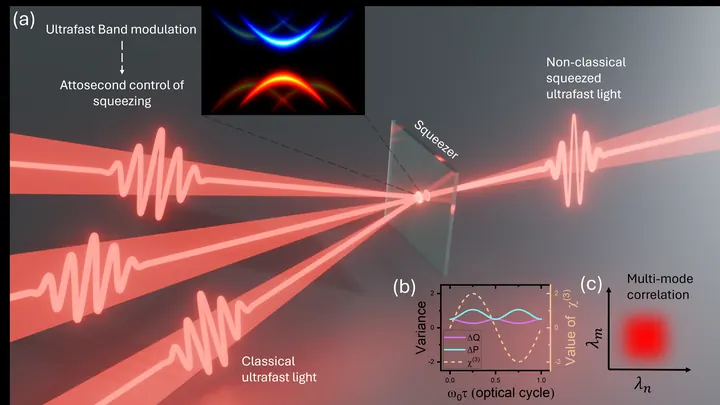
Ordinary light always jitters a bit: its brightness and color fluctuate, like the air in a balloon after a tap. In 'squeezed' light, these fluctuations are redistributed — as if you squeeze the balloon from one side, making it thinner here and thicker there, but the total volume stays the same.
Four cesium atoms hang in vacuum, held by laser tweezers like beads on an invisible thread. Around them is a ring resonator, a closed loop of mirrors where light circulates without obstacles. When a probe beam strikes this tiny chain, something strange happens: the atoms scatter light not uniformly in all directions, but predominantly in one direction.