How Galaxy Clusters Quench Star Formation express
A galaxy cluster is like a busy intersection where galaxy-cars race through a headwind of hot gas. This wind, called ram pressure, strips galaxies of their cold gas — the fuel for star formation. Astronomers from the SAMI survey traced how this happens in hundreds of galaxies across eight nearby clusters.
They divided the galaxies into three groups based on the appearance of their glowing hydrogen: undisturbed, lopsided, and truncated. The lopsided ones are currently experiencing ram pressure: their gas is being blown into a tail, like smoke from a campfire in the wind. The truncated ones have already lost their outer gas, and their glowing region has become shorter. The undisturbed ones have not yet hit a strong flow.
Comparing star formation rates shows that in affected galaxies, the outskirts fade first. In the center, star formation proceeds as usual, but the outer regions lose gas and stop making stars. This is most pronounced in the 'truncated' galaxies: those that have already passed through the peak of pressure.
Thus, an evolutionary picture emerges: a quiet galaxy falls into a cluster, becomes lopsided, and then truncated. Star formation fades from the outside in, like a puddle drying from the edges toward the middle. That is why clusters have so many old red galaxies that stopped forming stars long ago.
Original abstract
as written by the authors arXiv:2602.03088
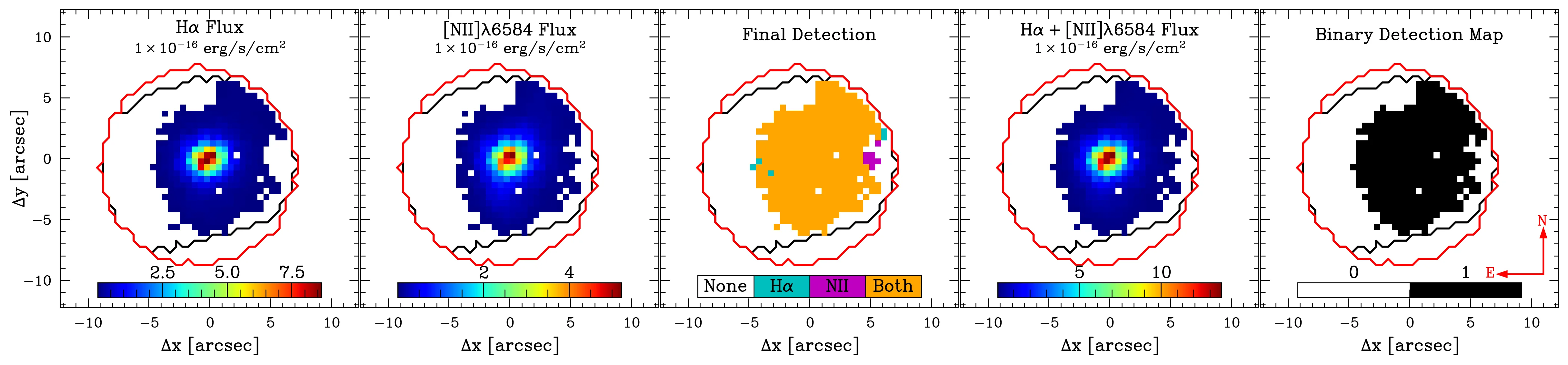
Cluster environments influence galaxy evolution by curtailing star formation activity, notably through ram-pressure stripping (RPS). In this study, using spatially resolved spectroscopic data from the SAMI Galaxy Survey, we identify galaxies undergoing or recently affected by RPS in eight nearby clusters ($$0.029 < z < 0.058$$), through a visual classification scheme based on the ionised gas ($$\rm H\alpha + [NII]\lambda 6584$$) morphologies, split into unperturbed, asymmetric, and truncated. The projected phase-space analysis shows that asymmetric galaxies are found in a narrow region in cluster-centric distance ($$\rm 0.1 < R/R_{200} < 0.6$$) and have a larger dispersion in line-of-sight velocity ($$\sigma(|v_{pec}|)_\mathrm{Asym} = 0.71^{+0.09}_{-0.07}\ \sigma_{200}$$) compared to the truncated and unperturbed samples. In terms of star formation activity, RPS candidates yield a much steeper resolved star-forming main sequence (rSFMS; $$\Sigma_\mathrm{SFR} - \Sigma_\ast$$) relation compared to the unperturbed counterparts, primarily emerging from having lower $$\Sigma_\mathrm{SFR}$$ values for the low mass density regime, with the steepest gradient deriving from the truncated sample. Moreover, radial star formation profiles reveal that star formation in RPS candidates is suppressed in the outskirts relative to unperturbed galaxies and is more prominent for the truncated sample. In contrast, central ($$\rm r/r_{eff}<0.5$$) star formation activity in RPS candidates is comparable with that in their unperturbed and field counterparts, suggesting no elevated activity. Taken together, this suggests an evolutionary trend linked to the RPS stage, where unperturbed galaxies likely represent recently accreted systems (pre-RPS), while asymmetric and truncated galaxies may correspond to populations undergoing RPS and post-RPS phases, respectively, favouring outside-in quenching.
There is so much gas in a galaxy cluster that it glows in X-rays, and its temperature reaches tens of millions of degrees.
In the series 'Star Trek', galaxies are often depicted as isolated islands, but in reality their lives depend heavily on their environment, as shown in this study.