Bubble Catapult: How Bubble Curvature Controls the Jet express
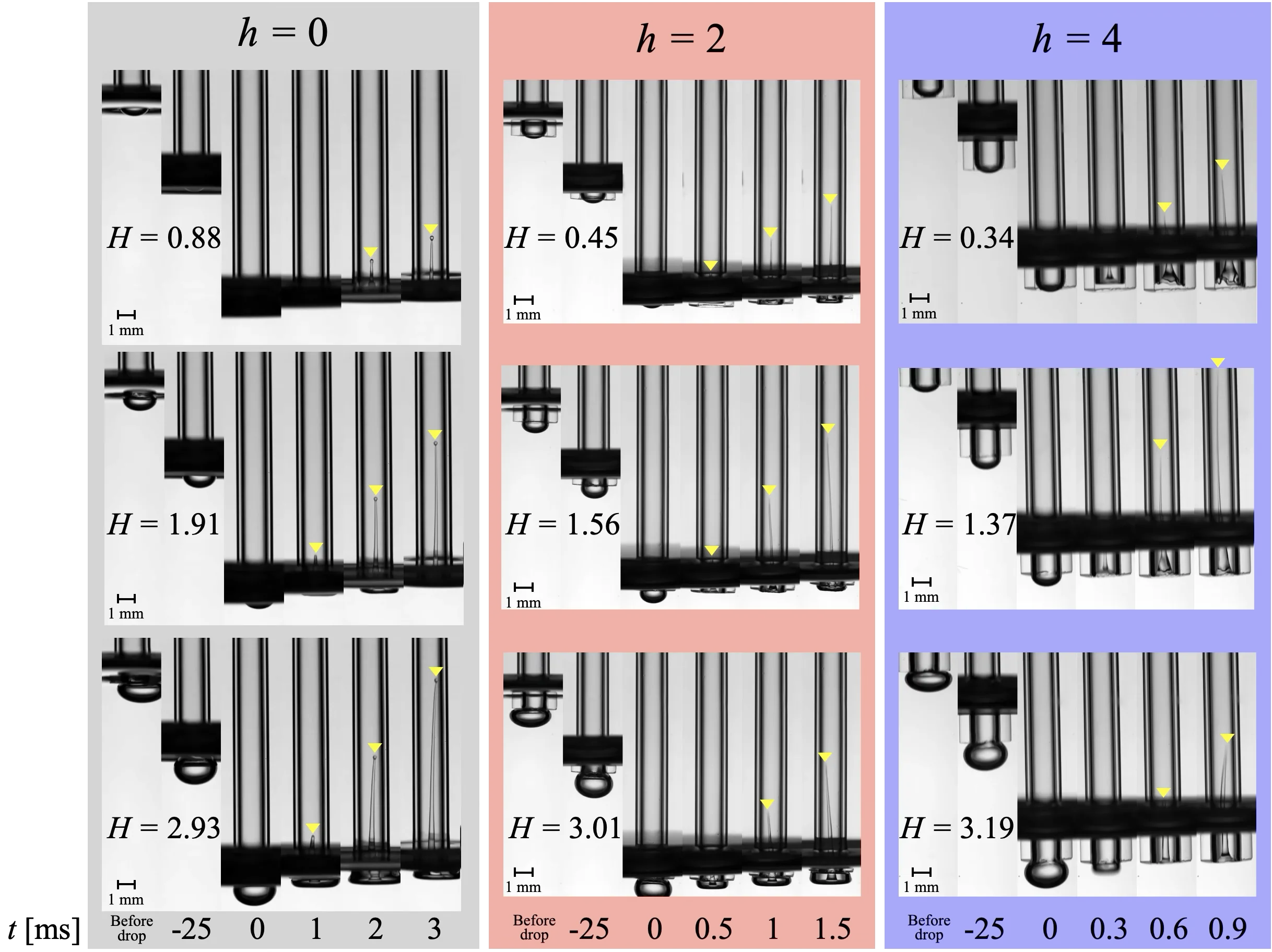
A drop falls into a glass, and a tiny jet, a thin fountain, shoots up from the surface for an instant. Something similar happens with a bubble stuck to the wall of a tube when you yank the tube downward. Water around the bubble rushes in, and a jet fires from its top. The speed of this jet depends on the bubble's shape — how much it bulges, like an umbrella dome.
When the tube is in air and the bubble sits at its end, it's simple: the more deeply the bubble is pushed in, the faster the jet. But if you submerge the tube in water, a twist appears. The water pressure around it changes the picture, and now the bubble has a best curvature. Too flat — the jet is weak. Too bulged — also weak. But the sweet spot hits hardest.
The researchers derived a formula that combines two contributions: one from the bubble's own curvature, the other from the tube's submersion depth. Experiments with real bubbles and high-speed imaging confirmed the calculations. It turned out that the optimal bubble shape shifts as the tube is submerged deeper. This isn't just a curiosity: such jets occur in nature — for example, when bubbles burst on the ocean surface and fling tiny salt droplets into the air.
Original abstract
as written by the authors arXiv:2602.03185
This paper investigates the relationship between the contact angle of a spherical bubble attached to a tube submerged in a container and the jet speed induced by an impulsive acceleration at its base. While it has been well established that bubble geometry strongly influences the ejection speeds of liquid jets, mathematical studies of liquid jets with arbitrary bubble shapes remain limited. In this work, we derive a pressure impulse in the small-cavity limit as a tractable integral of classical Legendre functions. It is shown that the jet speed can be divided into two components: (i) the velocity induced by the hydrostatic pressure impulse distribution created by the curvature of the bubble, and (ii) the velocity induced by the distribution of the submersion of the tube in a container. This decomposition reveals that an optimal bubble curvature emerges only when the tube is submerged: the optimality is absent for non-submerged configurations, where the jet speed increases monotonically with bubble depth. Experiments confirm this non-monotonicity and quantitatively support the predicted shift of the optimal geometry with submersion depth.
When a bubble bursts on a water surface, the jet can accelerate to several meters per second — faster than a person can run.