Escape velocity is the minimum speed an object must reach to leave a celestial body's gravitational influence without any additional thrust. For Earth, this is about 11.2 kilometers per second. The concept is fundamental to spaceflight, determining the energy needed to send probes to other planets or rockets into orbit — though orbital velocity is lower, escape velocity represents the threshold for breaking free entirely.
History
The concept was first derived by Isaac Newton in his 'Principia' (1687), where he imagined a cannonball fired fast enough to orbit or escape Earth. The term 'escape velocity' became standard in the early 20th century with the advent of rocketry.
How it works
Gravity pulls objects toward a body's center, and to escape, an object must have enough kinetic energy to overcome the gravitational potential energy binding it. The escape velocity depends only on the mass and radius of the celestial body, not on the object's mass. It is calculated as the square root of twice the gravitational constanttimes the mass divided by the radius. Once an object reaches this speed, it will continue to slow down but never fall back, asymptotically approaching zero velocity at infinite distance.
In practice
Escape velocity is used to design launch trajectories for interplanetary missions, calculate fuel requirements, and determine whether atmospheres can retain gases — lighter molecules move faster and can escape more easily.
Fun fact
On the Moon, escape velocity is only 2.4 km/s, so a well-hit baseball could theoretically leave the lunar surface and never return.
In 1934 Jean Leray proved that the Navier–Stokes equations always have solutions "in a generalized sense". Whether a solution stays smooth or can break down into a singularity he could not tell, and nobody could for ninety years. In 2000 the Clay Institute made the question one of its seven Millennium Prize problems.
Four witnesses to a single crossing. On November 10, 2017, the four MMS spacecraft flew through an invisible boundary in the solar wind where magnetic field lines reconfigure and release energy.
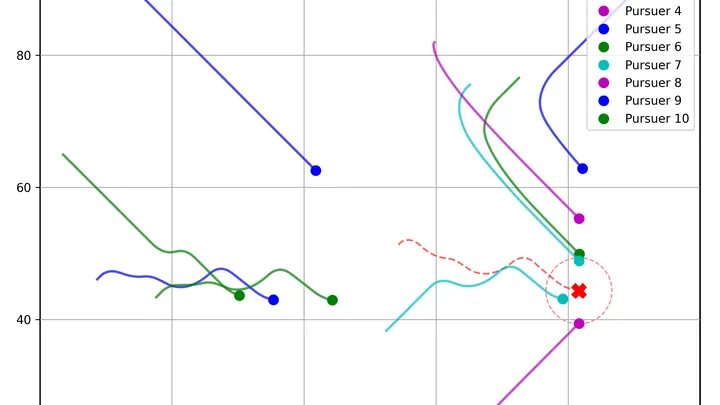
A wolf pack switches from chasing prey to defending its den in an instant. Engineers have instilled this same versatility into an algorithm for a robot swarm. The key is a method proposed by John von Neumann: instead of chasing the target, the robots calculate its future moves and block escape routes, like beaters cutting off trails.
Decades of radio astronomy have listened to space, hoping to catch narrowband radio transmissions — the technogenic 'voice' of distant exoplanets. But our own technological evolution reveals a paradox: loud analog signals, like 1960s TV broadcasts, are just a brief squawk of a newborn civilization.
Every civilization is born with a gravitational debt. The home planet's mass determines the loan amount, and the Tsiolkovsky equation is the interest rate applied to each kilogram of payload. To send a probe to the stars, you have to pay with fuel, and the debt grows exponentially.
Light passing near a massive body slightly changes its path — gravity pulls even on rays. In ordinary situations, a beam of light from a distant star is squeezed as if drawn together by an invisible rubber band. This property is called the null convergence condition: gravity makes light trajectories converge rather than diverge.
At the heart of a warp drive lies Einstein's idea that massive bodies curve spacetime — the very stage on which all cosmic events unfold. Picture a bubble of such curved spacetime. Inside it, the ship floats without any G-forces, like a passenger in an airplane cabin who doesn't feel the headwind.
In 1963, Maarten Schmidt unraveled the nature of quasars — distant active nuclei outshining entire galaxies. Since then, we've learned that at their hearts lurk supermassive black holes, converting infalling matter into blinding light.
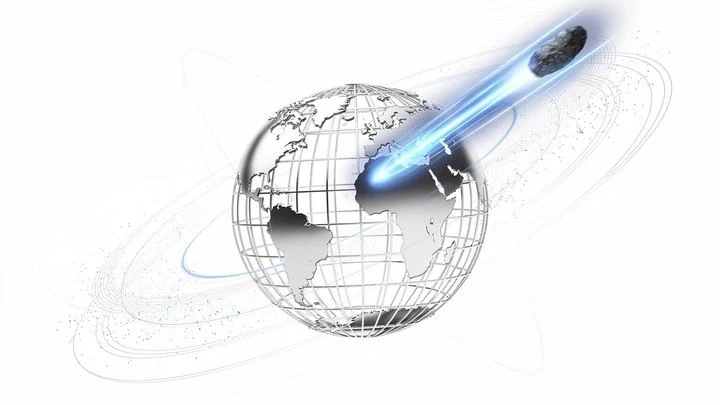
On April 1, 2026, satellites recorded a bright fireball blazing in the sky over the South Atlantic. Photometric tracking satellites detected the entry and demise of the object at an altitude of 90.5 km. An ordinary asteroid? No. Astronomers recalculated the velocity vector into the heliocentric system — and gasped: 51.73 km/s.
Interstellar space is not a cosmic desert, but a super-fast highway. Trillions of asteroids and comets from other systems race past us, yet camera-telescopes only catch a few. Imagine a night highway: the headlights of a distant car flash brightly, but if it zooms by too fast, the camera shutter can't click in time.
Among the icy chunks hurtling through the void, there are special travelers — interstellar comets. They were born around distant stars and happened to wander into our neighborhood. One of them, 3I/ATLAS, came under the gaze of telescopes as it approached the Sun. Its material, frozen gases and refractory dust, began to evaporate, leaving a glowing tail behind.
The fate of a civilization isn't just a matter of luck or disasters. Scientists simulated a thousand years of history under ten different scenarios, accounting for resource consumption, governance, and random shocks. The key metric turned out to be the 'activity coefficient' – the fraction of time when a civilization is technologically alive. At best, this fraction nears 100%; at worst, it drops to 38%.
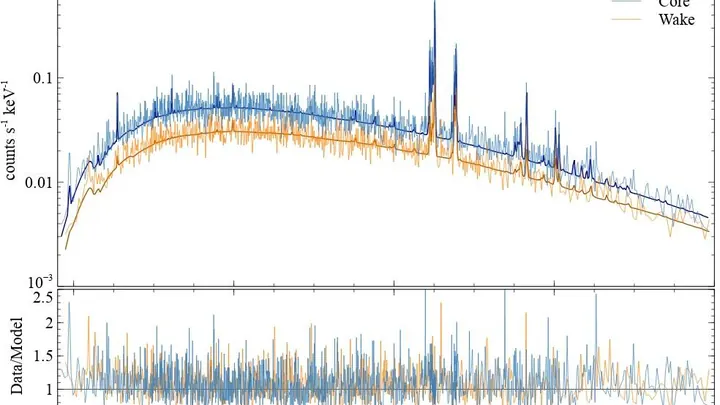
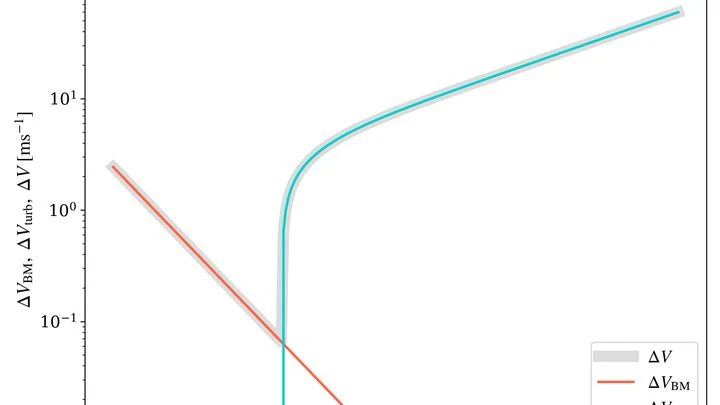
At the heart of the Ophiuchus galaxy cluster floats a bubble of hot plasma the size of several galaxies. It rises like a giant hot-air balloon in the atmosphere, leaving a wake behind it — a region where gas is set in motion.
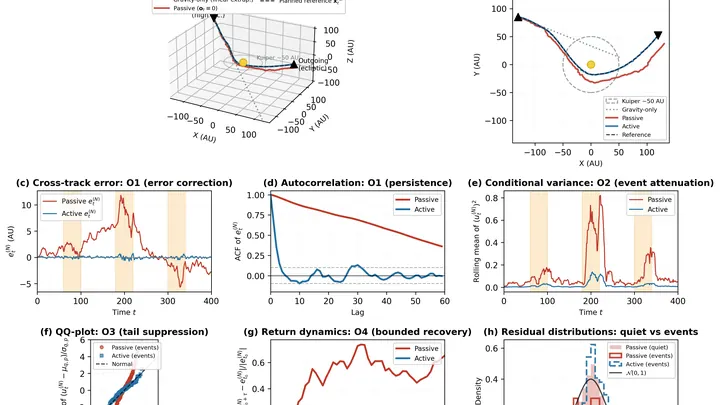
An icy rock is flying through the Solar System on an open trajectory — coming in from interstellar space, swinging around the Sun, and heading back into the dark.
A comet hurtling through space is a mountain of ice and dust that carries itself across the Solar System. If you mount small engines on such a mountain, it becomes a ship with its own fuel: gas from the interior can be vented through nozzles to change course.
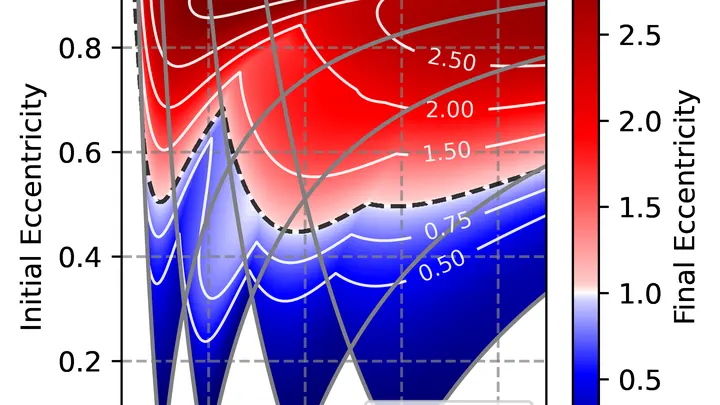
Interstellar wanderers are rocks and icy chunks that have broken free from their home planetary systems and now drift through the Galaxy. The first such visitor, 'Oumuamua, zipped past the Sun in 2017, followed by Comet Borisov and the ATLAS object. Where do they come from?
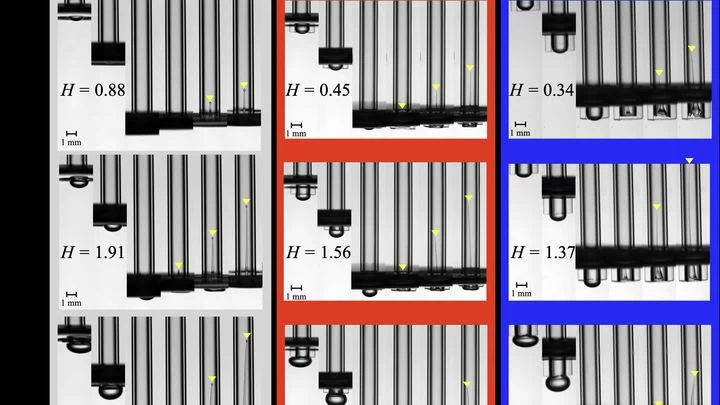
A drop falls into a glass, and a tiny jet, a thin fountain, shoots up from the surface for an instant. Something similar happens with a bubble stuck to the wall of a tube when you yank the tube downward. Water around the bubble rushes in, and a jet fires from its top. The speed of this jet depends on the bubble's shape — how much it bulges, like an umbrella dome.
In the cold clouds of gas and dust where stars will one day ignite, some atoms have lost electrons and become charged. Charged particles feel the magnetic field, while neutral ones do not, so the charged ones slip through the neutral ones like water through a sieve. Astronomers have measured this drift speed: about a hundred meters per second.
Planet WASP-121b orbits so near its star that the fierce heat boils its atmosphere away, streaming like a comet's tails. With the James Webb Space Telescope, astronomers continuously watched this process for the first time.