Lone Waves That Won't Stop express
The popping lid of a jam jar is the hero of this story. Press it, and with a loud click it flips from a convex to a concave shape. Exactly the same happens with a hinged beam inside each cell of a new mechanical lattice.
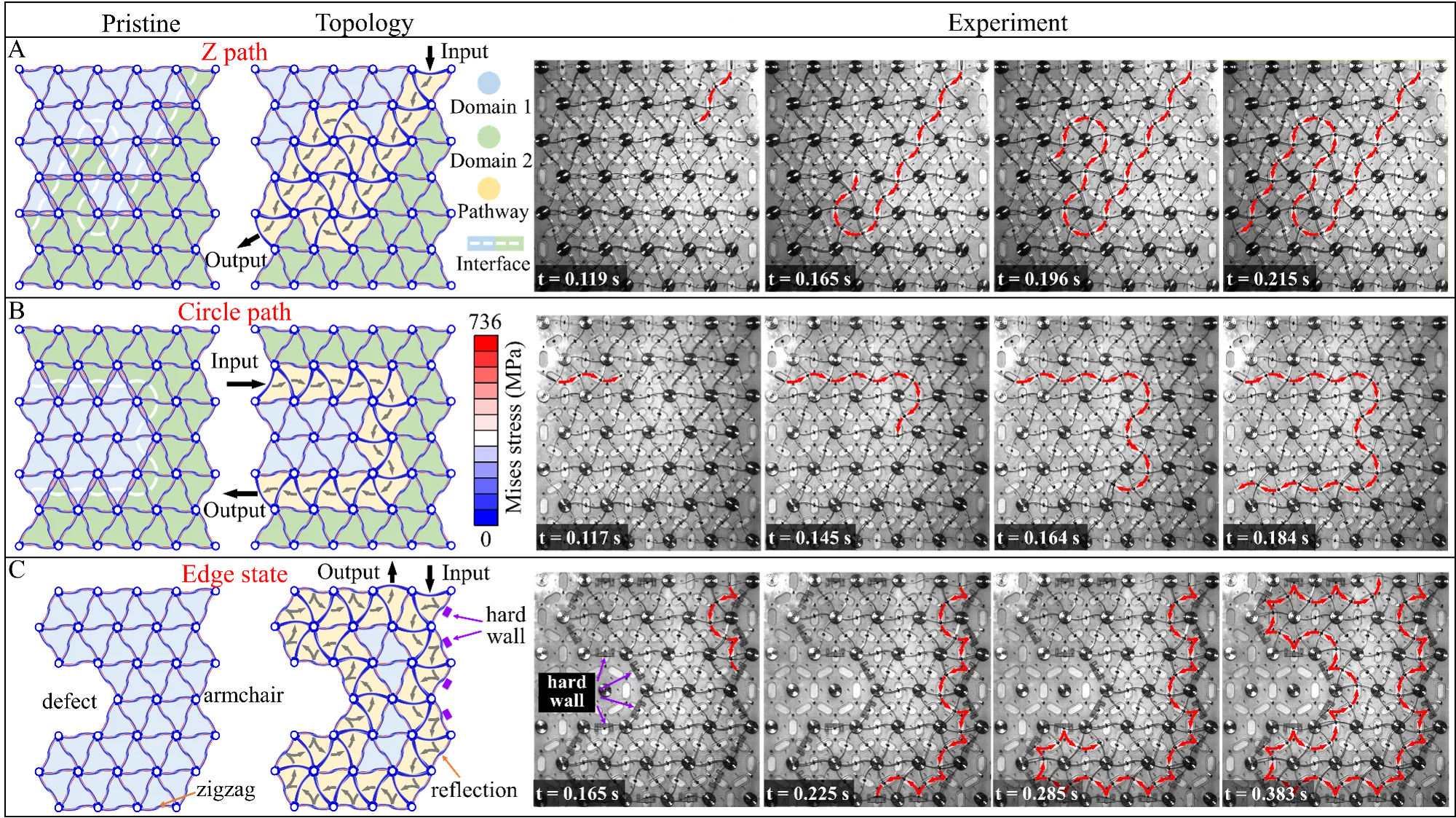
Scientists assembled these snapping beams into a hexagonal grid, like honeycomb, but made of elastic plates. When one beam is sharply compressed, it snaps and pushes its neighbor. That one snaps too, and a solitary wave runs through the lattice: a single bend that neither spreads nor fades. The most intriguing part is that this wave travels in only one direction. Even if it hits a sharp turn, it simply rounds the corner and continues on its way.
Usually, one-way motion in devices relies on magnets or spinning gyroscopes. Here there are none — only geometry and snaps. The wave can be described by an equation similar to that of a pendulum, but with an extra term that accounts for the preferred direction. This extra term is the mechanical 'chirality'—the property that distinguishes a right-handed glove from a left-handed one.
Such a lattice is a step toward mechanical circuits that direct vibrations and impacts without electronics. Bridges that absorb seismic waves, or sturdy structures that damp vibration, are possible applications. And all thanks to a simple snap.
The snap of a jar lid is a transition between two stable states, just like the snapping beam in the lattice. Such systems are called bistable, and they even occur in DNA molecules.